Houseplant · Bromeliaceae
Earth Star
Cryptanthus bivittatus
Hand it bright indirect light and steady humidity, and the earth star keeps its color all year.
Bright indirect
Every 5–7 days
61–84°F · 16–29°C
USDA 10–12
Overview
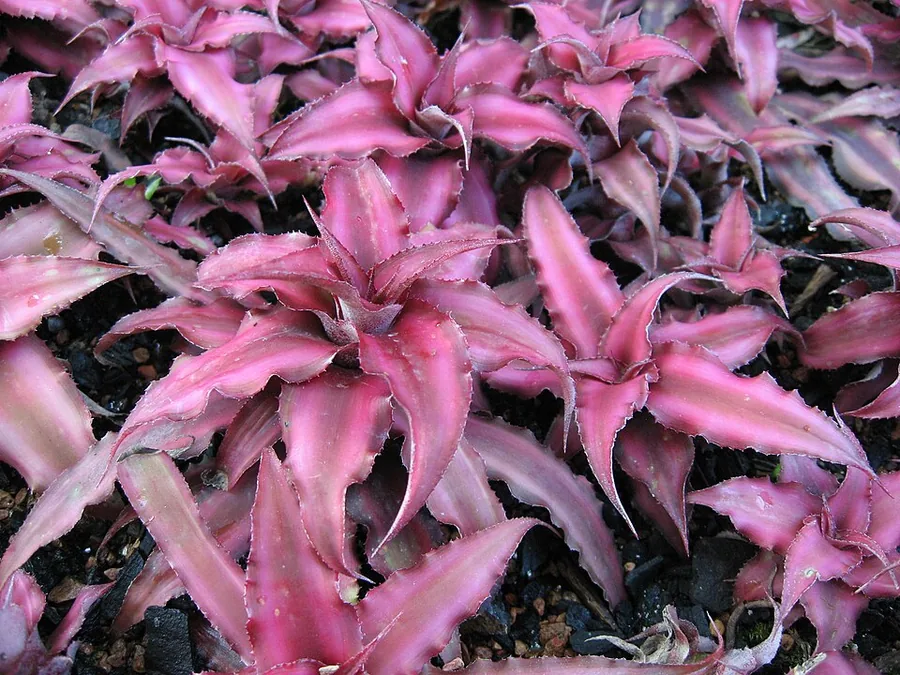
So what's an earth star? It's a little flat-growing bromeliad that opens out into a star-shaped rosette of stiff, wavy leaves. Here's the twist: unlike its cup-forming relatives, it grows right in the soil, and that's where the name terrestrial bromeliad comes from. The leaves wear bands and stripes of green, pink, and red that stick around all year when it's indoors.
It's a tidy little thing, only 3 to 6 inches (8 to 15 cm) tall and a touch wider, so it tucks into a small pot, a dish garden, or a terrarium without ever hogging the room. Growth is slow, and the rosette flowers just once, popping up small white blooms in its center before it starts to fade and hands things off to its pups.
Care is genuinely easy once you remember what it's after: warmth, humidity, and bright but filtered light. Give it too much direct sun and the leaves bleach out, but leave it in too little and the color drains away. Find that sweet spot, though, and the bright striping is what you get back.
Care
The short version: bright indirect light, a rich organic mix kept lightly moist but never soggy, plus warmth and high humidity. Feed it once a month through the growing season, and just let it raise its own pups.
Light
Set it up with bright, indirect light and it'll be happy. It'll put up with medium light or partial shade, but the color goes flat there, and harsh direct sun just bleaches the leaves. A spot by a window with a sheer curtain? That's pretty much ideal.
Water
Keep that rich organic mix lightly moist but well drained, and water it about every 5 to 7 days once the top has dried out a bit. Don't let it dry out all the way, and don't water into the center either, because standing water rots the crown. Remember, there's no cup to fill on this terrestrial bromeliad, so it's all about the roots.
Soil
Go with a rich, organic, well-drained mix, something peat- or sphagnum-based instead of a heavy standard potting soil. The roots like things a little acidic, a pH of 5.0 to 6.0, and they'll sulk in dense ground that holds too much water.
Temperature
Regular room warmth is all it wants, anywhere from 61°F to 84°F (16°C to 29°C). Just keep it clear of cold drafts and chilly winter windowsills, since it really can't handle the cold.
Humidity
This one's a humidity fan, happiest between 50% to 70%. Average indoor air usually runs drier than that, so a pebble tray, a cluster of plants, or a terrarium helps keep it steady. Notice the leaf tips browning near a vent? That's the dry air talking.
Feeding
Feed it monthly from mid-spring through early fall with a balanced water-soluble fertilizer cut to about half strength. It grows slowly and doesn't need much, so just quit feeding once growth stalls in the cooler months.
Pruning
There's hardly any pruning to do. Pull off any dead or damaged outer leaves whenever you spot them, and once the rosette has flowered and started to fade, cut away the spent mother plant after its pups have shown up.
Repotting
You'll only need to repot every 2 to 3 years, or sooner if pups crowd the pot, the mix dries out fast, or the rosette starts pushing up out of the soil. With growth this slow, it's in no hurry for a bigger home.
Size & spacing
It stays small, topping out at just 3 to 6 inches (8 to 15 cm) tall and spreading 6 to 12 inches (15 to 30 cm) across. That compact size makes it a natural for shallow dishes, terrariums, and those tight little windowsill corners.
Troubleshooting
Most earth star troubles boil down to light, water, or air that's gotten too dry, and the leaves usually tip you off early. Just find the symptom that matches below and make the little fix before it spreads. Pests aren't common, but it doesn't hurt to glance over the plant now and then.
Fuzzy white bits, hard bumps, or a sticky coating on leaves
Cottony tufts, hard bumps, or a sticky film usually mean mealybugs or scale, while fine webbing in dry air points to spider mites instead. Check the leaf bases and undersides, then wipe the pests off with a cotton swab dipped in isopropyl alcohol. After that, treat with insecticidal soap or horticultural oil, and keep the plant off on its own until it's clean.
Fix:
- Wipe off pests with a cotton swab dipped in isopropyl alcohol
- Treat with insecticidal soap or horticultural oil and repeat as needed
- Isolate the plant until the infestation clears
Washed-out, burnt-looking marks on the sun-facing leaves
Seeing bleached or scorched spots on the brightest leaves? That's too much light, and harsh midday sun is the worst offender. Direct rays overheat the rosette and bleach the most exposed leaves until the edges shrivel. Just move it into bright but diffused light and give it only gentle morning or evening sun.
Fix:
- Move to bright but diffused/indirect light
- Provide only gentle morning or evening sun and shield from intense midday sun
Color going dull and those pink stripes fading away
When an earth star sits in deep shade, that bright pink and red striping goes muted and flat. The fix couldn't be easier: shift it to a brighter spot with bright indirect light, and the next flush of growth comes back nice and vivid.
Fix:
- Move to a brighter spot with bright indirect light
Brown, crunchy tips and edges even though the leaf looks fine
Dry air is usually the reason, especially when the plant's parked near a heat or air vent. The tips brown while the rest of the rosette looks just fine. Move it clear of the drafts, bump up the humidity with a pebble tray or by grouping plants, and keep the mix evenly moist.
Fix:
- Move away from heating/cooling vents
- Raise humidity with a pebble tray or grouping plants and keep the mix evenly moist
Toxicity
Got pets? Good news, because the earth star is non-toxic. The ASPCA lists Cryptanthus as safe for cats and dogs, with no toxic compounds in any part of it. The only thing to keep an eye on is the stiff, wavy leaf edges, which can give a light scratch but won't cause any chemical trouble.
Safe for
People · Cats · Dogs · Horses · Rabbits · Livestock · Birds
Cats None
Totally safe to be around. The ASPCA finds no toxic principles, so a curious cat that bats at or chews a leaf isn't in any danger, though a big mouthful might bring a little stomach upset.
Dogs None
Nothing to worry about here. There's nothing poisonous in the plant for dogs, and the worst a determined chewer gets is a brief, mild tummy ache from the fibrous leaves.
Horses None
Harmless to horses. The plant's got no toxins, so a nibble won't do any harm beyond the mild upset any unfamiliar greenery can cause.
Rabbits None
Fine around rabbits. There's no poison here, and the leaves pose no chemical risk if one decides to have a taste.
Livestock None
No threat to grazing animals. Since it's a non-toxic bromeliad, it holds nothing that would harm cattle, goats, or sheep.
Birds None
Pet birds are in the clear too. The plant doesn't carry any toxic compounds, so if a bird nibbles the rosette, it won't come to any harm.
People None
Not poisonous to people. The one thing to watch is the stiff, wavy leaf edges, which can lightly scratch small hands, but apart from that it's a non-toxic plant.
Leaves are stiff with wavy, sometimes finely toothed edges that can lightly scratch; no chemical hazard. As with any plant, nibbling may cause mild stomach upset.
Varieties
Earth stars show up in all sorts of colors and sizes, and a handful of forms turn up the most at homes and garden centers. Here are the ones worth knowing by name.
Cryptanthus bivittatus var. atropurpureus
This is a darker color form of the species, all deep reddish to purple-bronze foliage, and it's recognized as a variety in Kew's Plants of the World Online.
'Minor' (Dwarf Rose-Stripe Star)
A compact dwarf form with rose-pink stripes running down its leaves, and yes, it's on the ASPCA's list of non-toxic earth stars.
'Pink Starlite'
A really popular cultivar with broad creamy-pink and green banded leaves that blush a deeper pink when the light's bright.
How to propagate
Want more earth stars? They pretty much handle that themselves, sending up a fresh round of pups every time the mother rosette wraps up flowering.
Offsets & pupsEasy
After the mother rosette flowers and produces pups, typically anytime in the warm growing season · 4 to 8 weeks
Earth stars make more of themselves through offsets, or pups, that pop up at the center and base of the parent once it's flowered, usually during the warm growing season. Just gently detach a pup, press it into a moist organic potting mix, and keep it watered and humid. Give it a bit and it'll root and settle in within 4 to 8 weeks.
SeedDemanding
Warm season under controlled humidity · Several months
Growing from seed works too, but it's slow and rarely done at home. Sown in the warm season under controlled humidity, seedlings take several months to amount to much, which is exactly why offsets stay the go-to way to propagate.
Myths
Earth stars want their water poured into a central cup, same as other bromeliads do.
Cryptanthus are terrestrial bromeliads with a flat rosette and no water-holding tank, so there's nothing to fill. You water them at the roots instead, growing them in soil and keeping the organic mix lightly moist rather than pouring water into the center.
Earth stars are bromeliads, so they're poisonous to cats and dogs.
Nope, not this one. The ASPCA classifies earth star (Cryptanthus) as non-toxic to cats and dogs, with no toxic principles identified, so it's a safe pick for a home with curious animals.