Tree · Fabaceae
Eastern Redbud
Cercis canadensis
Watch it set the bare spring woods aglow with rose-pink blooms straight off the branches before the first leaf shows up.
Full sun
Every 7–14 days
USDA 4–9
20–30 ft · 6.1–9.1 m
Overview
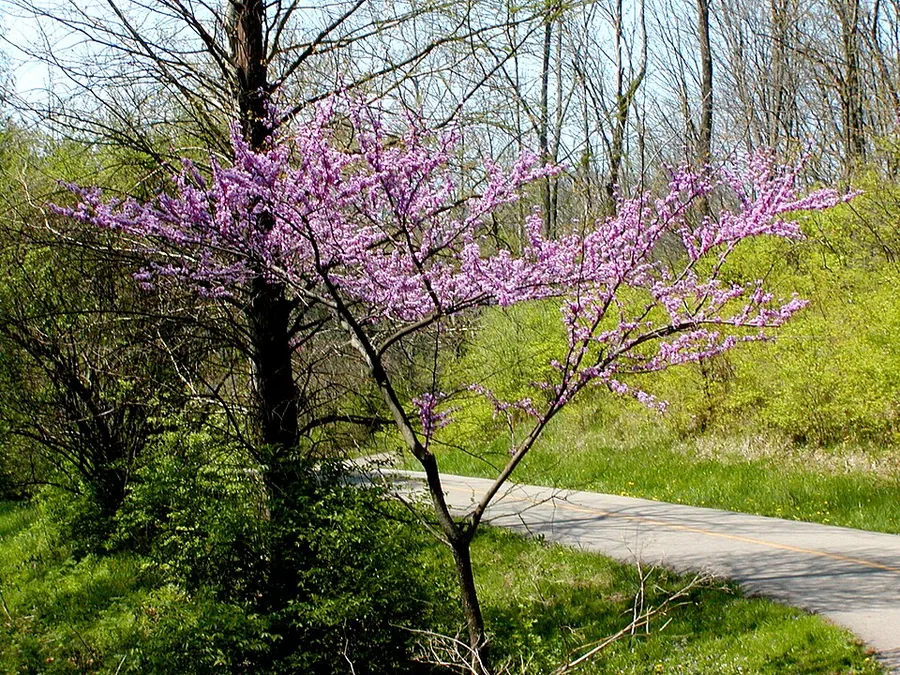
Eastern redbud is a little native tree that really steals the show in early spring, when rose-pink to magenta flowers pop right out of bare branches and even the trunk before any leaves bother to show. It's part of the legume family, the same crew as peas and beans, and that's exactly why the blossoms look like tiny pea flowers and why flat seed pods turn up afterward as the season rolls on.
Once the flowers wind down, the tree fills in with wide heart-shaped leaves and eases into a relaxed, rounded form. It stays on the small side, topping out around 20 to 30 feet (6 to 9 m) tall, so it slots nicely into a yard where a big shade tree would just hog all the space. And since it puts up with everything from full sun to pretty heavy shade, it's a handy choice for a woodland edge or tucking under taller trees.
Settle it in and redbud turns out tough and low-fuss, doing well right across zones 4 through 9. What really needs your attention? Mostly just root disturbance, because it hates being moved, plus a handful of fungal diseases that pounce on a stressed tree. Keep it in good shape and it won't ask for much at all.
Care
The short version: pop it into full sun to part shade in average, well-drained soil, keep the water coming while it's young, and save your pruning for after the flowers finish. It rolls with most soils and laughs off cold, but it really can't stand soggy ground and would rather not be dug up once it's settled.
Light
Redbud isn't picky about light at all, taking anything from full sun to full shade in stride. That said, it blooms hardest and stays fuller in full sun to part shade, which is why it slots so well into a woodland edge that catches sun for part of the day.
Water
Keep the soil evenly moist with steady watering for the first year or two while those roots get a grip. A grown tree can ride out brief dry spells, but a long drought is too much for it, and it really pouts in soggy, waterlogged ground. When a dry stretch drags on past a few weeks, give it a good deep soak.
Soil
This tree takes to loam, clay, or sand just fine as long as the water drains away, and it copes with a broad pH range from 5.5 to 8.0. Plain, medium-moisture ground works great for it. The one thing it just won't put up with is dirt that stays wet.
Temperature
Redbud is genuinely hardy, shrugging off winters as low as -29°F (-34°C) and summer heat climbing to 95°F (35°C). That deep cold tolerance is exactly what lets it grow across such a big swath of the country.
Humidity
Plain outdoor humidity covers everything it needs, so there's really no number for you to chase. What counts more is good airflow, because still, cramped conditions are what set off leaf spot and other fungal headaches.
Feeding
Give it a meal in early spring as it starts growing again, reaching for a balanced slow-release tree fertilizer. Feeding isn't only about more growth either, since a well-fed tree stands up much better to canker and wilt.
Pruning
Do your pruning in late spring, just after the blooms fade, clearing out dead, broken, or cankered wood and tidying the shape while you're at it. Snip off any cankered or wilting branches the second you notice them so disease can't spread. And keep lawn weedkillers far away, since redbud is really touchy about herbicide drift.
Repotting
You'll rarely see redbud in a pot, and it almost never wants repotting. If you are holding a young one in a container, though, keep an eye out for roots circling or poking out, water shooting straight through, or sparse new growth, all hints it's ready for more room or a place in the ground.
Size & spacing
Plan on a grown tree hitting 20 to 30 feet (6 to 9 m) tall with a broad, spreading crown of 25 to 35 feet (7.5 to 10.5 m). Hand it that much open space up front, because the canopy fans out wide and the tree hates getting moved after it's planted.
When to plant
Plant a young redbud out in early spring, back when it's still small and simplest to set into a forever spot, because it doesn't appreciate being shuffled around later on. The payoff lands the next spring, when those bare branches erupt in pink from March through May, well before most of the garden has even woken up.
Northern hemisphere
Southern hemisphere
Typical months for a temperate climate: start earlier in warm zones, later where spring frosts linger.
- Plant: early spring while young, in a permanent protected site (does not transplant well)
- Harvest: early spring (March to May), pea-like rose-pink to magenta flowers on bare branches and trunk before leaves emerge
Hardiness
USDA hardiness zones: 4–9
Temperature: down to -34°C
Troubleshooting
Almost every redbud problem comes back to a fungus moving in on a tree that's already stressed or wounded. Once you can tell a real canker or wilt apart from no-big-deal leaf spots, you'll know exactly when to jump in and when to just let it ride. Pair up what you're seeing with the notes below, then act fast on the ones that truly count.
Dieback with sunken dark patches showing on the bark
What you're seeing is Botryosphaeria canker, a fungus that sneaks in through a wound or some stressed wood and then chokes off the branch above it. Your move is to cut that branch off well below the sunken patch, then burn or bag the wood and wipe your blades clean between snips. Here's the good part: a tree that's growing strong almost never gets bothered, so keep the water and care steady.
Fix:
- Prune out and destroy all dead, dying, and cankered branches well below the lesion
- Disinfect pruning tools between cuts
- Improve vigor with proper watering, mulching, and correct fertilization
One side droops with leaves that came in too small
That lopsided look is Verticillium wilt, which climbs up from the roots and plugs the sapwood, so trouble usually lands on a single side first. Want proof? Peel back the bark on a wilting branch and you'll spot dark streaks running through the wood. Nothing cures it, so your job is to keep the tree strong, snip away the dead wood, and never plant a susceptible species back into that same dirt. The cultivar 'Forest Pansy' takes the worst of it.
Fix:
- Prune out dead wood and dispose of it
- Improve host vigor with light mulching and watering during dry periods of more than a few weeks
- Fertilize when appropriate and manage other stresses
Dark spotting and blotchy marks dotting the foliage
Those marks are fungal leaf spot and anthracnose, and they tend to pop up when leaves stay damp and the air just sits inside a packed canopy. They look rough, sure, but they hardly ever do real harm to a settled tree. Rake the dropped leaves and toss them, keep water off the foliage, and your redbud takes it in stride.
Fix:
- Rake up and destroy fallen infected leaves
- Improve air circulation and avoid overhead wetting of foliage
- Maintain tree vigor with proper watering and fertilization
Toxicity
If you've got pets or kids, you can relax, because eastern redbud is safe top to bottom. It's nowhere on the ASPCA toxic list, nothing about it actually endangers animals, and the flowers and young pods are tasty enough that people drop them into salads. So there's not a single part of this tree you have to wall off.
Safe for
People · Cats · Dogs · Horses · Rabbits · Livestock · Birds
Cats None
Since it never made the ASPCA toxic list, a nosy cat can chew on a leaf or a dropped flower and walk away just fine.
Dogs None
There's nothing poisonous in play, so a dog gnawing a pod or two is no problem, though wolfing down a heap of the bulky things could bring a quick run of loose stool.
Horses Safe
Grazing horses have nothing to fear from this tree, and they'll sometimes browse it with no ill effect.
Rabbits Safe
Both the leaves and flowers sit fine with rabbits, who tend to nibble young redbud growth out in the wild anyway.
Livestock Safe
Cattle, goats, and sheep are welcome to munch the leaves and pods without any risk.
Birds Safe
Birds happily pick at the seeds and drop by the spring flowers, and all of that is perfectly harmless.
People Safe
Those pink spring blossoms and the soft young pods are edible too, often showing up in salads and fritters.
No special handling required for pet safety; as with any plant, discourage pets from gorging on fallen pods, which can cause mild non-specific stomach upset from the bulk.
Varieties
Past the plain wild species, growers have picked out redbuds for leaf color, bolder flowers, and smaller frames. Below are the named varieties you've got the best odds of running into at a nursery.
'Forest Pansy'
Fresh leaves arrive a deep scarlet purple and ease toward green over time, though that gorgeous color comes at a cost, since it's the one most likely to catch verticillium wilt.
'Appalachian Red'
If you want the loudest bloom out there, this is it: a vivid magenta so intense it practically tips into neon pink.
'The Rising Sun'
New growth opens in apricot and gold and then mellows to lime and green, which means the canopy ends up showing off several colors all at once.
'Hearts of Gold'
Golden-yellow leaves are the calling card here, a lucky discovery that turned up in a Greensboro, North Carolina garden back in 2002.
'Ace of Hearts'
Think of this as the pint-sized pick: a compact dwarf with little heart-shaped leaves that slips into a snug corner no full-size redbud would ever fit.
How to propagate
Redbud usually gets started from seed or by grafting, mainly because it doesn't shift well once it's grown and it's a real pain to root from cuttings. None of these are fast routes, so honestly, patience counts for more than any green-thumb trick here.
SeedModerate
Collect mature pods in fall; sow after pretreatment · 1-2 years to a transplantable seedling
Pick the ripe pods once fall rolls around, and then you'll want to nick that stubborn seed coat and let the seed sit through a stretch of cold, damp storage, because it won't wake up otherwise. Skip either step and germination gets really sluggish. And even after it pops, plan on 1 to 2 years before a seedling is sturdy enough to shift to its own spot.
GraftingDemanding
Late winter to spring (budding in summer) · 1-2 seasons
Since named cultivars like 'Forest Pansy' don't breed true from seed, growers instead bud or graft them onto seedling rootstock. That work spans late winter into spring, with the budding handled in summer, and the union needs a season or two to knit together properly. It's fiddly stuff, so it's really one for experienced hands.
Stem cuttingsDemanding
Early summer from softwood · Several months to a season
Snip softwood cuttings in early summer if you'd like a go, but brace yourself, because redbud roots badly and patchily this way. Even the cuttings that do take will want several months to a full season to settle in. That's why most folks lean on seed or grafting before bothering with this.
Myths
Eastern redbud pods and seeds are dangerously poisonous to dogs and cats.
Here's the thing: the ASPCA doesn't flag eastern redbud as toxic, and it's considered safe for both cats and dogs. People actually eat the flowers and young pods, so this tree is not the dangerous legume some gardeners worry about and really shouldn't get grouped with the genuinely harmful ones.