Ornamental · Boraginaceae
Forget-me-not
Myosotis sylvatica
Plant it once for a spring carpet of tiny blue flowers, and it'll sow the next batch all on its own.
Full sun
Every 3–7 days
56–70 days
USDA 3–8
Overview
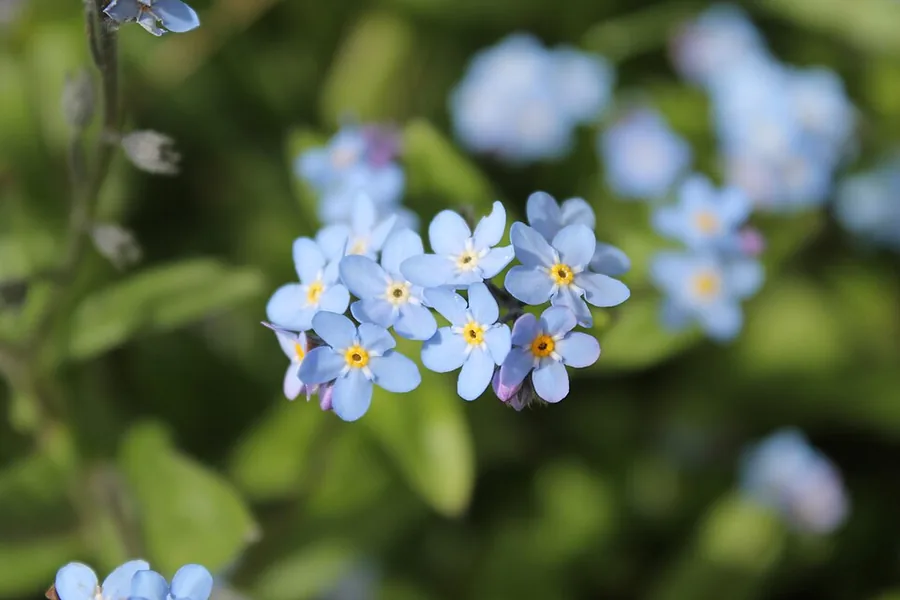
You know those drifts of tiny sky-blue flowers that fill in around spring bulbs? That's forget-me-not. It's part of the borage family and comes from Europe and Asia, where it grows in damp woodland and along streambanks. In the garden it stays low and modest, a biennial that flowers in its second spring and then leaves seedlings to keep things going.
Here's the funny thing: what makes it easy is also what makes it a bit of a handful. It seeds itself freely and roots from creeping stems, so one planting can turn into a patch and then a whole colony. That's great news under tulips and daffodils, but it's worth keeping an eye on where it could slip into wild ground.
Give it rich, steadily moist soil and a little afternoon shade in hot regions, and it basically runs itself. The flowers open in April and May, with stray blooms drifting into summer, and it's tough as nails in the cold, hardy right down to brutal winter lows.
Care
The short version: rich, consistently moist soil, full sun to part shade with afternoon shade when summers turn hot, and a light feed at planting. Then just deadhead after bloom to keep the self-seeding honest.
Light
Forget-me-not is fine in full sun through partial shade, but it's happiest with morning sun and a break from the afternoon where summers really heat up. Why? Too much heat with too little shade stresses it out and basically rolls out the welcome mat for mildew.
Water
Keep the soil consistently moist and don't let it bake dry, especially in the heat. It'll even shrug off the occasional spell of wet feet or a bit of shallow standing water, so when you're not sure, go damp rather than dry.
Soil
Plant it in rich, well-drained loam or clay that's loaded with organic matter and it'll be thrilled. A pH of 6.1 to 7.5 works, which covers slightly acidic to mildly alkaline, so most garden beds you've got will be just fine.
Temperature
This one's a real toughie, happy up to about 86°F (30°C) and able to ride out winter lows near -40°F (-40°C). Heat's the bigger headache, not cold, since those hot, muggy stretches are what bring on disease.
Humidity
Regular outdoor humidity is fine, and there's no magic number to hit. What actually matters is airflow, because damp, crowded leaves are exactly where powdery mildew and rust like to get started.
Feeding
Forget-me-not isn't a big eater, so don't overthink it. Just work a little balanced fertilizer or compost into rich soil at planting and call it done, because feeding it all season long isn't necessary.
Pruning
Snip off the spent flower cymes right after they bloom to coax out more flowers and rein in the self-seeding. While you're there, cut back any tired or mildewed foliage to neaten things up.
Repotting
It hardly ever needs repotting and is usually grown right in the ground, so this is rarely an issue. If you do keep one potted, only size it up when roots start circling or poking through the drainage holes or the soil dries out way too fast.
Size & spacing
These stay small, around 6 to 12 inches (15 to 30 cm) tall and 6 to 10 inches (15 to 25 cm) wide. Give each a little breathing room so air can move through and the leaves stay nice and dry.
When to plant
Forget-me-not runs on a two-year clock, which sounds fussier than it is. Sow seed indoors 8 to 10 weeks before your last frost for flowers the same year, or scatter it outdoors in mid-summer for bloom the next spring. The big show lands in April and May, with a few stragglers carrying on into summer.
Northern hemisphere
Southern hemisphere
Typical months for a temperate climate: start earlier in warm zones, later where spring frosts linger.
- Sow: 8-10 weeks before the last spring frost for bloom the same year
- Plant: Direct sow in mid-summer for bloom the following spring, or transplant seedlings after frost
- Harvest: April to May, with sporadic intermittent bloom into mid-summer
Hardiness
USDA hardiness zones: 3–8
Temperature: down to -40°C
Troubleshooting
Honestly, forget-me-not doesn't cause much trouble, and what does come up usually shows on the leaves or in how fast it spreads. The trick is spotting it early, because a quick response keeps things easy. Find what matches below, then deal with it before it gets ahead of you.
Seedlings turning up everywhere and crowding their neighbors
Forget-me-not is a real self-seeder, and its creeping stems root as they go to make new patches. Left totally alone, it can swamp a bed and even sneak out of the garden. So deadhead the spent flower cymes before the seed drops, pull whatever volunteers you don't want, and lift any rooted runners.
Fix:
- Deadhead and remove flower cymes immediately after bloom to limit seeding
- Pull unwanted volunteer seedlings
- Remove rooted creeping stems to control spread
A dusty white film showing up on leaves and stems
That white dust is powdery mildew, and it loves plants packed together in still, humid air. You can wipe it off, but it'll keep coming back until the air starts moving. So thin or space the plants, water down at the soil line, and shear back the worst of it after bloom.
Fix:
- Improve air circulation by thinning or spacing plants
- Remove and discard severely affected foliage
- Avoid overhead watering and water at the soil line
- Shear back heavily infected plants after bloom
Orange or brown spots dotting the leaves
See raised rusty bumps on the foliage? That's rust, a fungus that thrives when leaves stay wet. Just pull and toss the marked leaves as soon as you notice them. Keep water off the foliage and open the planting up so the leaves dry out fast after rain.
Fix:
- Remove and destroy infected leaves
- Avoid overhead watering to keep foliage dry
- Improve spacing and air movement
- Clean up plant debris at season end
Toxicity
Got pets or little kids? Here's the good news: true forget-me-not isn't considered toxic. The NC State Extension Plant Toolbox lists no poison data for it, and the ASPCA doesn't flag it either. The only real catch is not mixing it up with Chinese forget-me-not, which is a different plant that does carry harmful alkaloids.
Safe for
People · Cats · Dogs · Horses · Rabbits · Livestock · Birds
Cats None
Safe for cats. A curious nibble of leaf or flower won't poison your cat, though a big mouthful of any plant can mean a little drooling or a passing upset stomach.
Dogs None
Safe for dogs. There's no toxin here that puts a dog at risk, so a stray bite from the garden is nothing to worry about.
Horses Safe
Safe for horses. The true forget-me-not isn't the toxic look-alike, Chinese forget-me-not, so grazing near a patch isn't a real danger.
Rabbits Safe
Safe for rabbits, who can browse the foliage just fine. Like with any green, ease new plants into the diet slowly instead of all at once.
Livestock Safe
Safe for cattle, goats, and sheep. The species only holds trace alkaloids and isn't flagged as a poisonous pasture plant.
Birds Safe
Safe for birds. Backyard hens and wild visitors can peck at the seeds and foliage with no trouble at all.
People Safe
Safe for people, and the small blue flowers even turn up as an edible garnish sometimes. No need to fence it off from the kids.
Generally considered safe; as with any plant, discourage pets and small children from eating large amounts of foliage or flowers.
Varieties
Almost every forget-me-not you'll spot for sale is a selection of this one species, and they're really just sorted by flower color and shape. Here are the ones you're most likely to run into.
Victoria Blue
A compact one that's all about rich blue flowers and a tidy, mounded shape.
Victoria Rose
A pink-flowered pick that trades the usual sky blue for a soft rose.
Snowball
A white-flowered version that looks cool and clean against darker leaves.
Blue Basket
A taller blue-flowered selection that stands just a bit above the rest.
Ultramarine
A selection that's prized for its deep, dark-blue flowers.
Companions
Forget-me-not earns its keep woven among spring bulbs, where its low blue haze fills the gaps and sets off taller flowers above it.
Plant near
Spring-flowering bulbs such as tulips and daffodils: Forget-me-not is recommended for interplanting with spring bulbs, where its blue flowers complement bulb displays and fill in around them.
How to propagate
Forget-me-not pretty much propagates itself, so this part's easy. But if you want to nudge it along, you can grow it from seed or split a clump that's settled in.
SeedEasy
Start indoors 8-10 weeks before last frost for same-year bloom, or sow outdoors in mid-summer for bloom the following spring · Several weeks to germinate and establish; biennial sowings bloom the next season
Seed is the usual way to go, and forget-me-not makes it pretty painless. Start it indoors 8 to 10 weeks before your last frost for flowers the same year, or just scatter it outdoors in mid-summer and wait for bloom the following spring. The seedlings take a few weeks to get rolling, and once a patch settles in it self-seeds freely, sometimes more than you really planned for.
DivisionEasy
Spring or after flowering · A few weeks once rooted
You can also split an established clump in spring or once the flowers fade. Those creeping, stolon-like stems root as they spread and throw off clonal offsets, so just lift one of the rooted pieces, pull it apart, and replant it. It'll settle in within a few weeks and look exactly like the parent.
Myths
All forget-me-nots are dangerously poisonous to pets.
Not so, at least not the true one. Myosotis sylvatica isn't reported as toxic and stays off the ASPCA toxic plant list. The worry actually belongs to a totally different plant, Chinese forget-me-not (Cynoglossum amabile), a separate genus whose pyrrolizidine alkaloids can hurt a horse's liver with large or long-term feeding.
Forget-me-not is a North American native wildflower.
Nope, Myosotis sylvatica is native to Europe and Asia, not North America. It's escaped cultivation and naturalized across parts of the continent, and a few Midwestern areas now treat it as a noxious weed.