Houseplant · Malvaceae
Money Tree
Pachira aquatica
Easygoing and safe around pets, the money tree grows fast and doesn't ask much of you.
Bright indirect
64–75°F · 18–24°C
USDA 10–12
6–8 ft · 1.8–2.4 m
Overview
So this is the money tree, Pachira aquatica, and out in the wetlands of Mexico and Central and South America it grows into an honest-to-goodness tree. Indoors, though, it stays a much more manageable 6 to 8 feet (183 to 244 cm) tall, with glossy hand-shaped leaves spreading out from the top of a slim trunk. You'll usually spot it with several trunks braided together, and here's the thing: that's the grower's handiwork, not something the plant does by itself.
What got it into so many homes? It's just easy to keep alive. It'll put up with less light than most houseplants, it grows fast once it's settled, and it forgives a skipped watering way more than a soggy one. And here's a bonus that matters if you've got a full house: it's one of the few houseplants that's genuinely safe around cats, dogs, and little kids.
All it really wants is bright, filtered light and a watering routine that doesn't leave it sitting in water. Get those two right and honestly, the rest is pretty forgiving. Push it into harsh sun or a pot that never dries out, though, and you'll be looking at dropped leaves or rotted roots before long.
Care
The short version: give it bright indirect light, water once the top of the soil dries, keep it warm and humid, and don't ever let the pot sit in standing water.
Light
Money trees are happiest in bright, indirect light, so think near a window but out of the direct beam. They'll cope with medium light and even a bit of shade, which is why they hang on in dim rooms, but the brightest spot short of harsh sun is where they really grow well.
Water
Let the top of the soil dry out between waterings, then give it a good drink. It minds wet feet way more than dry ones, and standing water is the quickest way to rot the roots. Let it get too parched, though, and it'll tell you by dropping leaves.
Soil
Go with a moist but well drained potting mix, something with peat, perlite, and a bit of loam or sand so the water runs through. And don't sweat the pH, because it's happy anywhere from 6.0 to 8.0.
Temperature
Keep it in normal room warmth, somewhere between 64°F and 75°F (18°C to 24°C). It's tropical, so it's got no time for cold, which means keeping it clear of chilly drafts and frosty windows come winter.
Humidity
Being tropical, it likes high humidity. Regular indoor air is fine, but it does better with a little extra, so group it with other plants or set it near a humidifier if your place is dry and heated.
Feeding
Feed it once a month with a balanced houseplant fertilizer through spring and summer while it's growing. Then ease off in fall and winter, when it slows down and just doesn't need much.
Pruning
Prune it however you like to keep the size and shape you want, because it handles a trim just fine. Those flexible young stems are the same ones growers braid together while they're pliable, so if you want to braid, it has to happen while the trunks are still young and bendy.
Repotting
Repot it every 1 to 2 years, or sooner if you see roots circling around or poking out the drainage holes. Water rushing straight through and growth that stalls out are the other clues it wants a bigger pot.
Size & spacing
Indoors, a money tree gets to around 6 to 8 feet (183 to 244 cm) tall, though it'll stay a lot smaller in a modest pot. Just give it some headroom and a quarter turn now and then so it grows evenly toward the light.
Troubleshooting
Good news: money trees are tough, and just about every problem circles back to water or light. Dropped leaves, mushy roots, scorched patches, they each tell you something specific. Find the one that matches what you're seeing and tweak things before a small slip gets away from you.
Wilting plant with soft, brown roots
Root rot shows up when the soil just won't dry out and the roots can't get any air. Tip the plant out and you'll find them brown, mushy, and a bit sour smelling, while the top droops even though the soil's soaked. Here's the good part: cut away every rotted root and repot into fresh, well drained mix in a pot that actually drains, and it often pulls through.
Fix:
- Remove from wet soil and cut away rotted roots
- Repot into fresh well-drained mix in a pot with drainage
- Water only after the top of the soil dries
Leaves turning yellow and dropping
Seeing yellow leaves let go? Nine times out of ten it's a watering thing. A pot that's gone bone dry does it, but so do soggy, waterlogged roots, and if you just moved the plant somewhere darker or draftier, that can set it off too. Pick one spot and leave it there, wait until the top of the soil dries before you water, and give it a light feed through the growing season.
Fix:
- Adjust watering so the top of the soil dries between waterings but the rootball is never bone-dry or waterlogged
- Stabilize the plant's location and light exposure
- Raise ambient humidity and feed during the growing season if nutrient-deficient
Gluey leaves, fuzzy white patches, or little gnats by the soil
Indoors, a money tree can pick up the usual sap suckers. Keep an eye out for the white cottony fluff of mealybugs, the little bumps of scale, huddled aphids, or fungus gnats buzzing over damp soil. Wipe or wash them off, hit the stubborn ones with insecticidal soap or horticultural oil, and let the soil surface dry out so the gnats can't keep breeding.
Fix:
- Wipe off or wash off pests
- Treat with insecticidal soap or horticultural oil as needed
- Let soil surface dry to discourage fungus gnats
Washed-out or brownish spots showing up on the leaves
Getting bleached or browned patches on the leaves near the window? That's direct sun burning them. A money tree wants bright light, sure, but filtered, not the harsh blast of midday. Just scoot it back from the glass or pop a sheer curtain up, then snip off the leaves that got the worst of it.
Fix:
- Move to a spot with bright indirect light or filtered sun
- Remove badly scorched leaves
Toxicity
If you've got pets or kids, you can relax, because the money tree is safe all around. The ASPCA lists it as non-toxic to cats, dogs, and horses, and there's no toxic principle in the plant at all. Go ahead and set it on the floor next to a nosy dog or a toddler and don't give it another thought.
Safe for
People · Cats · Dogs · Horses · Rabbits · Livestock · Birds
Cats None
Got a cat? No problem here. The ASPCA lists the money tree as non-toxic to cats with no toxic principle identified, so a leaf nibbled by a curious one won't hurt.
Dogs None
Dogs are fine around it too. The ASPCA calls it non-toxic to dogs, so a swiped leaf or a chewed stem won't poison them, though you know how it goes: a big mouthful of any greenery can leave a sensitive stomach a little queasy.
Horses None
Horses get the thumbs up from the ASPCA as well. There's no toxic compound in it, so a stray bite is nothing to stress about.
Rabbits Safe
Rabbits have nothing to worry about with a money tree. It carries no toxic principle, so about the worst a nibble does is a bit of tummy grumbling from the unfamiliar leaf.
Livestock Safe
Goats and sheep can graze near it without any risk of poisoning, since there's no toxin in the plant at all.
Birds Safe
A pet bird can hang out in the same room as a money tree just fine, because none of its parts are toxic to them.
People Safe
It's safe to keep around kids, with no toxic compound identified. In fact, people eat its big seeds in parts of its native range, so a leaf in a little hand really isn't a worry.
How to propagate
Want more money trees? You can grow them from cuttings, fresh seed, or air layering, though most people go with cuttings since the plant hardly ever sets seed indoors.
Stem cuttingsModerate
Spring to summer · Several weeks to root
Take softwood or stem cuttings in spring or summer, while the plant's actively growing. Stand them somewhere warm and humid, and give it time, because the roots come in over several weeks. That warmth and steady moisture is really what decides whether a cutting takes or just sits there and sulks.
SeedModerate
When fresh seed is available · Germinates readily from fresh seed
Those big saba nuts sprout easily as long as the seed's fresh, so get them in the soil as soon as you can. The catch? Houseplants barely flower, and a plant that doesn't flower won't set seed, which is why most folks just go with cuttings instead.
Air layeringModerate
Spring to summer · Several weeks
Air layering's the third option, and spring or summer is the time for it. You nick a section of stem, wrap it up so it stays moist, and roots form right there on the living plant over several weeks before you cut the new one free.
Myths
That spiral trunk just happens on its own as the plant gets bigger.
Nope, it doesn't braid itself. Someone at the nursery wove those young stems together by hand while they were still soft and bendy, and then the trunks fused as they thickened up. The braid is a nursery trick, not something the plant does on its own.
Sooner or later a potted money tree pushes out blooms in the living room.
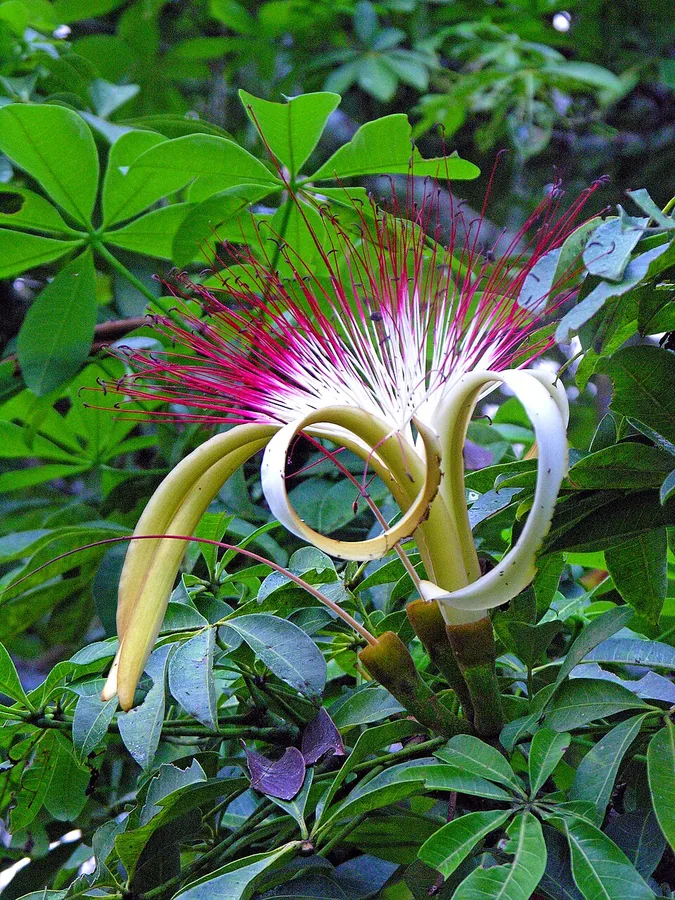
Waiting for flowers? Don't hold your breath. Pachira aquatica barely ever blooms as a houseplant, and a braided one even less, since it saves the showy flowers for plants grown outdoors over several years. Indoors, it's the glossy leaves you keep it for, not the blooms.