Tree · Fagaceae
Northern Red Oak
Quercus rubra
A fast-growing native that hands you deep shade and brilliant red fall color for a good long while.
Full sun
Every 7–14 days
USDA 3–8
50–75 ft · 15.2–22.9 m
Overview
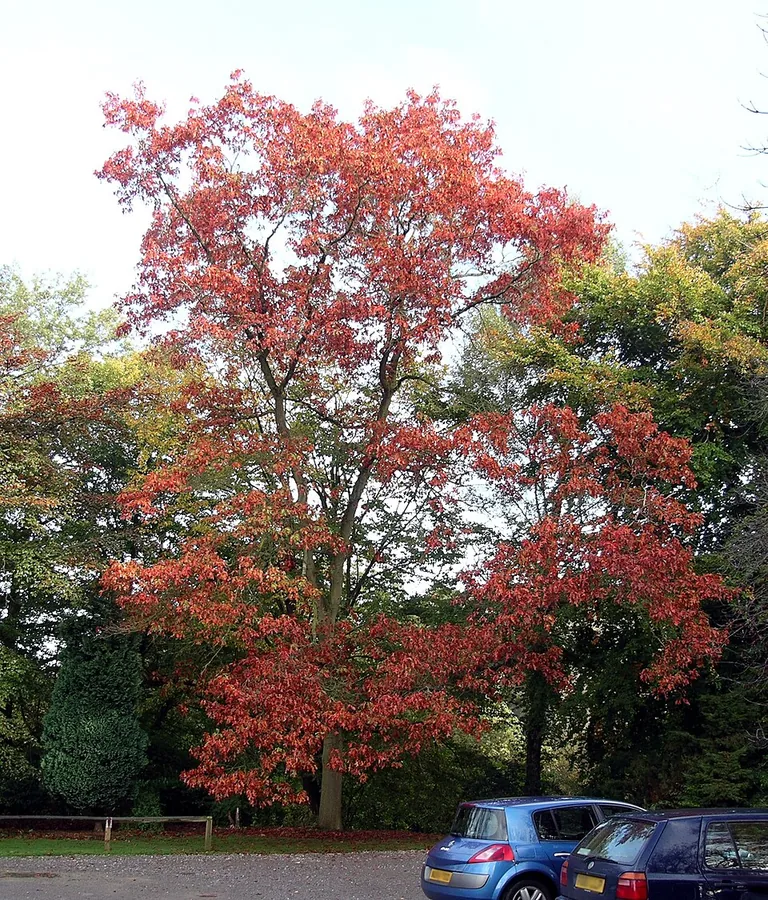
So what's the tree most people are picturing when they say oak? Odds are it's northern red oak. It's part of the beech family and grows all over eastern North America, topping out around 50 to 75 feet (15 to 23 m) with a wide, rounded crown. The long pale ridges in the bark and those pointed, bristle-tipped leaf lobes are the giveaway that it's in the red oak crowd.
Here's the thing that makes it stand out: it grows quick. Red oak puts on height faster than most other oaks, so it's the go-to when a town wants street or park shade without waiting forever. It doesn't mind city soil and road grit much either, and once the nights get cold it turns a gorgeous russet and brilliant red.
Give it some elbow room and the right ground, and honestly it won't ask for much once it's past those first few years. The one catch? Its acorns and young leaves carry tannins that don't sit well with grazing animals, so it's better off in a yard or park than out in a pasture.
Care
The short version: full sun, deep and acidic well-drained soil, and regular water for the first few years while that taproot digs in, and after that the tree pretty much takes care of itself.
Light
Red oak really wants full sun to grow up straight and full, though a young one will handle a bit of partial shade just fine. Give it plenty of light and it'll fill out into that broad, even crown that makes such great shade.
Water
While it's young, keep it watered through the first few years so the roots can reach down, and let the top half of the soil dry out between drinks. Once it's settled in, it's surprisingly drought tolerant and gets by on rain except when things get really dry.
Soil
It's happiest in deep, fertile, well-drained soil that runs a little acidic, roughly a pH of 4.5 to 7.0. It's not a fan of alkaline ground, where it yellows up with iron chlorosis, so a moist loam or sandy loam is the sweet spot.
Temperature
This one's tough in the cold, shrugging off winters down to -40°F (-40°C) and taking summer heat up around 100°F (38°C). That's a big chunk of the temperate zone covered.
Humidity
Regular outdoor air is all it needs, so there's really no number to chase here. What matters more is good airflow through the canopy, since stuffy, damp air is what gives leaf fungi a foothold.
Feeding
An established oak barely needs feeding at all, so don't stress about it. If the soil's genuinely poor, a balanced slow-release tree fertilizer in early spring does the job, and that's plenty.
Pruning
Only prune in the dormant winter months, and never from April through June, because fresh cuts then call in the beetles that carry oak wilt. Clip out anything dead, damaged, or crossing, and otherwise just let it grow.
Repotting
There's no real repotting down the line, since this turns into a full-on forest tree. Move it only while it's young, before that deep taproot locks in, and plant it somewhere it can stay put for good.
Size & spacing
A full-grown red oak hits 50 to 75 feet (15 to 23 m) tall and spreads 40 to 65 feet (12 to 20 m) wide, so it needs plenty of open space. Keep it well away from buildings and power lines and everyone's happier.
When to plant
Red oak likes to keep to the seasons, so timing's easy. Acorns come down in fall and need a cold winter before they'll sprout, so plant them then or pop in young saplings come early spring. And save the pruning for the middle of winter, which keeps oak wilt from sneaking in.
Northern hemisphere
Southern hemisphere
Typical months for a temperate climate: start earlier in warm zones, later where spring frosts linger.
- Sow: Stratify acorns over winter (60-90 days cold-moist) and sow in deep containers in late winter to early spring
- Plant: Plant acorns in fall or transplant young saplings in early spring
- Harvest: Inconspicuous yellow-green catkins in spring; acorns mature over two growing seasons and drop in fall
Hardiness
USDA hardiness zones: 3–8
Temperature: down to -40°C
Troubleshooting
A grown red oak is pretty tough, and when something's off it usually shows up on the leaves first. Oak wilt is the one you really can't ignore, but most of the rest are just cosmetic or sort themselves out. Find what matches below and deal with it while it counts.
Leaves browning inward while the top of the tree fades fast
This is oak wilt, a fungus that gums up the tree's plumbing so water can't get around, and red oaks just don't have much defense. You'll see leaves go dull, brown in from the edges, and drop while the top of the crown thins out, and it can take a whole tree down in one summer. Get it checked by a lab, take the tree out quickly, and cut the roots that connect it to nearby oaks so it can't spread below ground.
Fix:
- Remove and properly dispose of infected trees promptly
- Sever root grafts between adjacent oaks to limit underground spread
- Avoid wounding or pruning healthy oaks April-June
Brown spots along the veins after a soggy, cool spring
That's oak anthracnose, a leaf fungus that acts up when spring stays cold and wet. It smudges brown along the veins, warps the new leaves, and knocks off a twig here and there, but it won't really hurt a grown tree. Just rake up and toss the fallen leaves, snip out the dead twigs, and let more air move through the branches.
Fix:
- Rake and destroy fallen infected leaves
- Prune out dead twigs
- Apply labeled fungicide early in the season before bud break only in severe cases
Chewed-up leaves with caterpillars all over the canopy
Those would be spongy moth caterpillars, the ones that used to be called gypsy moth, and they can strip a crown bare come late spring. Good news though, a healthy oak just brushes it off and grows itself a whole new flush of leaves. Scrape the egg masses off the trunk in winter, band the trunk or pick the caterpillars off in small outbreaks, and keep the tree watered while it bounces back.
Fix:
- Hand-pick or use sticky bands on trunks for small infestations
- Apply Bacillus thuringiensis (Bt) to young larvae
- Support tree vigor with water during defoliation years
Yellow leaves with green veins on the freshest growth
When new leaves go yellow but the veins stay green, you're looking at iron chlorosis, which happens when the soil's too alkaline for the roots to grab iron. The color washes out between the veins, worst on the newest leaves up top. Bring the pH down slowly with elemental sulfur and give a hurting tree some chelated iron, but really, the best fix is just planting it in acidic ground to begin with.
Fix:
- Lower soil pH with elemental sulfur over time
- Apply chelated iron as a soil drench or foliar spray
- Improve soil drainage and aeration
Toxicity
If there are animals around, this is more of a look-but-don't-graze tree. The leaves, buds, and green acorns are full of tannins that upset the stomach, and in horses and livestock they can do real, sometimes deadly, damage to the kidneys. People shouldn't munch raw acorns either since they're bitter till they're leached, so keep grazing animals, pets, and little kids away from whatever drops.
Toxic to
Cats · Dogs · Horses · Rabbits · Livestock · Birds · People
Cats Mild
A cat that chews on a leaf or acorn will usually just get a queasy stomach, some throwing up, loose stools, and no interest in dinner. They hardly ever eat enough to be in real trouble, but it's smart to sweep up fallen acorns wherever a cat likes to hang out.
Dogs Mild
Dogs are the ones most likely to go crunching on acorns, and that tends to bring on vomiting, diarrhea, and a so-so appetite. A bunch of whole acorns can even get stuck and block the gut, so clear them out of any yard where a dog likes to snoop.
Horses Severe
Horses really don't do well with oak. Munching young leaves, buds, or green acorns can cause belly pain, constipation that turns into bloody diarrhea, a dull mood, lots of peeing, dark urine, jaundice, and kidney damage bad enough to kill.
Rabbits Toxic
A rabbit's tummy just can't cope with the tannins in oak leaves and acorns, so keep all of it well clear of the hutch. Even a little can leave a rabbit off its food and feeling rough.
Livestock Severe
Cattle, sheep, and goats that nibble young oak leaves, buds, or green acorns can wind up with ulcers in the gut and failing kidneys as the tannins add up. Enough of it turns deadly, and animals will actually go looking for acorns after a storm knocks them down, so keep them fenced off.
Birds Caution
Wild jays and woodpeckers eat acorns like it's nothing, but those raw tannins are rough on backyard poultry and pet birds. Just keep any caged birds away from the leaves and green acorns to be safe.
People Caution
Raw acorns are bitter and mouth-puckering thanks to the tannins, so nobody should eat them right off the tree. The old trick is a long soak in water to leach them, and it's worth keeping little kids from sticking acorns or leaves in their mouths.
Keep livestock and horses away from oak leaves, buds, and fallen green acorns; pick up acorns where pets forage. Most poisoning occurs when animals eat large amounts.
Helpline numbers

United States
ASPCA Animal Poison Control: (888) 426-4435 (fee applies)
Poison Control: (800) 222-1222


Canada
Poison Centres: 1-844-764-7669
Varieties
Almost every red oak out there is just the plain species, and that's fine. That said, a couple of named picks do turn up once in a while.
Aurea
Aurea's new leaves come out a bright golden yellow before easing into green, though good luck finding one for sale.
Splendens
Splendens got picked for the clean, brilliant red it puts on every fall.
How to propagate
Want more red oaks? They come up easily from their own acorns, as long as you give the seed the cold stretch it's after before it'll sprout.
SeedModerate
Collect ripe acorns in fall; sow outdoors immediately or stratify over winter and sow in spring · Germinates the spring after cold stratification; several years to establish a sapling
Red oak grows pretty happily from its own acorns, you just have to give the seed a cold winter first. Grab ripe acorns in fall and either sow them outside right away or give them 60 to 90 days of cold, moist stratification near 32°F to 40°F (0°C to 4°C) before sowing in spring. They'll sprout the next spring and take a few years to turn into a real sapling, and since the tree drops a deep taproot, plant it where it'll stay or only move it while it's young in a deep container.
Myths
Every dropped oak leaf and brown acorn is just as poisonous to grazing animals all year round.
Not quite. The real danger's packed into spring's young leaves and buds and the green, unripe acorns, where the tannins are strongest. The brown leaves that fall in autumn have way less, and it takes a big feed to make an animal seriously sick, not one stray bite. What actually matters is when and how much, not just that there's an oak nearby.
Red oak grows too slowly to be worth planting for shade.
Nope, northern red oak is actually one of the quicker oaks and gains real height at a moderate to fast pace. It more than earns its spot as a long-lived native shade and street tree, and you'll be waiting a lot less than the rumors say.