Vegetable · Brassicaceae
Romanesco
Brassica oleracea var. botrytis
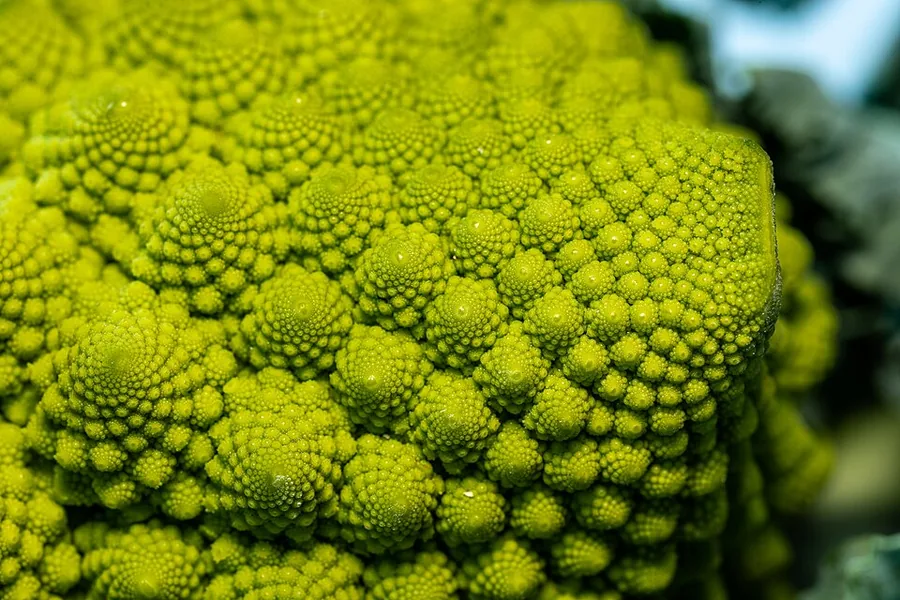
Grow it in a cool fall and you'll get a head that spirals into neat little green fractals.
Full sun
Every 5–7 days
50–70°F · 10–21°C
75–100 days
Overview
Ever seen a vegetable that looks like it wandered out of a geometry class? That's Romanesco, and each head is a stack of lime-green cones that keep repeating smaller and smaller toward the point. It's part of the cabbage family, sitting right next to cauliflower and broccoli. It cooks a lot like cauliflower too, just with a sweeter, nuttier taste, and Italian gardeners have been growing it for generations.
Here's the honest part: it's the most demanding brassica to get right. What it's really after is steady moisture, rich soil, and cool weather while the head fills out. Try to push it through summer heat and the curds go loose and grainy, so most folks just grow it as a fall crop and let the harvest land on those cooler days.
Once you've got the timing sorted, the rest isn't a big deal. Give it full sun, even water, and some room, keep the cabbage pests off the leaves, and cut the head while it's still nice and tight. That's really it, and what you pull out of the bed is honestly one of the prettiest things you'll grow.
Care
The short version: full sun, rich soil that stays evenly moist, and a feed every couple of weeks, all timed so the head ripens in cool fall weather instead of summer heat. Simple enough, right?
Light
Romanesco is a full sun kind of plant, and it really does need all that light to turn the head a proper chartreuse. A bit of partial shade won't hurt, but don't go tying the leaves over the curds like you would with white cauliflower. Shade them and the color just goes dull.
Water
Try to keep the soil evenly moist, roughly an inch of water a week, and don't let it dry out on you. Uneven watering is exactly what leads to buttoning and those ragged heads. Watering in the morning helps too, since the leaves dry off and disease has a harder time getting started.
Soil
It likes rich, well-drained soil with plenty of compost or well-rotted manure mixed in, the kind that stays moist but never turns to mud. Aim for a pH somewhere between 6.0 and 7.0, and here's a bonus: that slightly sweeter range also helps keep clubroot from taking hold.
Temperature
Cool weather is basically the whole trick. Romanesco is happiest between 50°F and 70°F (10°C to 21°C), and the head needs that chill to set nice and tight. Let the days climb into the mid-80s and, sure enough, the curds start to loosen and go grainy.
Humidity
You don't need to fuss over humidity at all, since regular outdoor air is plenty. What actually counts is good airflow. Crowded, damp leaves are what invite the diseases brassicas tend to catch, so a little space goes a long way.
Feeding
This one's a hungry plant, so plan to feed it every two weeks with a balanced or low-phosphorus fertilizer picked from a soil test. Once the plants hit about 4 inches tall, give them a side-dressing of nitrogen, something like calcium nitrate. Keep the meals coming and growth won't stall.
Pruning
There's nothing to shape here, which is nice. Just leave the head uncovered so the sun can do its color thing, and only pull the outer leaves if they turn diseased or the pests really chew them up. Otherwise, hands off.
Size & spacing
Plants get to about 2 to 3 feet (60 to 90 cm) tall and spread 18 to 30 inches (45 to 75 cm) wide, so give each one that full space. Why bother? Because air moving between those big outer leaves keeps disease from settling in.
When to plant
With Romanesco, timing is pretty much everything, since the head really needs to fill out while it's cool. Start seed indoors about 6 to 8 weeks ahead, then plant out in cool early spring, or better yet, in mid to late summer so it heads up as fall rolls in.
Northern hemisphere
Southern hemisphere
Typical months for a temperate climate: start earlier in warm zones, later where spring frosts linger.
- Sow: Start seed indoors 6-8 weeks before the intended transplant date.
- Plant: Transplant in cool early spring, or (preferred) in mid- to late summer for a fall harvest; Romanesco is best grown as a fall crop.
- Harvest: Cut the head when it is full-sized, firm and tight, before the fractal spiral curds begin to separate or loosen.
Hardiness
USDA hardiness zones: 3–10
Temperature: down to -40°C
Troubleshooting
Most of the time, Romanesco trouble comes back to one of two things: growth that got interrupted, or heat showing up at the wrong moment. The head and the leaves are where you'll spot it first, so keep an eye there. Find what matches below and jump on it early, and you'll usually stay ahead of it.
No firm head, or one that goes loose and ricey
Nine times out of ten this is heat, since the curds fall apart once daytime temps get past 86°F (30°C) while the head's forming. A lack of boron can pile on too, browning the curds and keeping them from staying tight. So time the crop to finish in cool fall weather, and only bother with boron if a soil test says you're short.
Fix:
- Time the crop so heads mature during cool weather
- Correct boron deficiency per soil test
Wilting, stunted plants with swollen, lumpy roots
Dig up a struggling plant and you might find the swollen, twisted roots of clubroot or maggots chewing through the root zone. There's no saving a plant once it's infected, so just pull it and toss it. Bumping the soil toward neutral pH keeps clubroot down, and a long break from brassicas stops it from building up.
Fix:
- Remove and destroy affected plants
- Raise soil pH toward neutral to suppress clubroot
A tiny head pops up early on a small, stalled plant
What you're seeing is buttoning, and it usually shows up after some kind of hiccup in growth, maybe transplant shock, a hungry plant, or a dry stretch. Seedlings that went out too old or caught a cold snap are the usual suspects. The fix is easy enough: keep the soil evenly moist and well fed, and get young transplants out at the right time so they never stall.
Fix:
- Maintain even moisture and adequate fertility
- Avoid transplanting overgrown or cold-stressed seedlings
Chewed holes in the leaves with green caterpillars around
The soft green cabbageworms and cabbage loopers are your main chewers, and those tiny hopping flea beetles love punching shot holes in young seedlings. Picking the caterpillars off by hand works great, and popping floating row covers on early keeps the whole gang out. If the caterpillars really get going, Bacillus thuringiensis sorts them out without bothering anything else.
Fix:
- Handpick caterpillars
- Use floating row covers
- Apply Bacillus thuringiensis for caterpillars if needed
Toxicity
Good news if you've got pets around: Romanesco is a food crop and totally safe. There's nothing toxic in the leaves, stems, or head, so it's fine to grow wherever the cat, the dog, or the chickens like to wander. The only tiny thing? A lot of raw brassica can make some animals a bit gassy.
Safe for
People · Cats · Dogs · Horses · Rabbits · Livestock · Birds
Cats None
Cats are totally fine around it, since there's nothing toxic in the leaves, stems, or head. Worst case, a nibble leaves them a little gassy.
Dogs None
No worries for dogs either. A few plain cooked florets make a nice treat, though a big pile of raw brassica might leave a pup a bit gassy.
Horses Safe
It won't poison horses at all. Brassicas just aren't their usual food, so keep it to small amounts and their stomachs will stay happy.
Rabbits Safe
Rabbits can safely munch the leaves and florets, and it's a good green for them. Just ease it in slowly so their tummies adjust.
Livestock Safe
It's fine as forage with nothing toxic in it. The only thing to watch is heavy, steady brassica grazing, since the natural goitrogens can build up over time.
Birds Safe
Backyard chickens love it and will happily peck at the leaves and curds. No part of the plant is going to hurt them.
People Safe
For people it's a tasty, healthy vegetable, raw or cooked. The whole head and the tender leaves are all good eating, no caution needed.
Safe to handle and grow around pets and children. Note that brassica glucosinolate goitrogens are mainly a concern for heavily-grazed livestock, not household pets.
Varieties
You'll only run into a couple of Romanesco types at most seed shops, and honestly both give you that great spiral. Here's what sets them apart.
Veronica
It's a favorite hybrid that dependably gives you uniform lime-green fractal heads with sharp, well-defined spirals.
Romanesco Italia
It's an open-pollinated heirloom with classic apple-green pointed spirals, growing on tall plants over a nice long season.
How to propagate
There's really just one way to get Romanesco going at home, and that's from seed. It won't root from cuttings, so every plant starts its life in a little tray indoors.
SeedModerate
Sow indoors 6-8 weeks before transplanting; transplant when seedlings have 4-5 true leaves. · About 4 weeks from sowing to transplant-ready seedling, then 75-100 days to a mature head.
Romanesco grows from seed and doesn't get cloned at home, so a seed packet is really where every plant begins. Start it indoors 6 to 8 weeks ahead of transplanting, and once the seedlings have 4 to 5 true leaves, about 4 weeks in, they're ready to go out. After that it's a bit of a wait, roughly 75 to 100 days, before you've got a head to cut.
Myths
Romanesco heads need blanching, so you tie the leaves over them like white cauliflower.
That whole trick is really a white cauliflower thing, since it needs shade to stay pale, and Romanesco wants the opposite. The chartreuse curds need full sun to color up, so leave the leaves untied and let the light get to the head. Easy call, right?
Romanesco is some lab-made cross between broccoli and cauliflower.
Nope, it's just a traditional Italian cultivar of Brassica oleracea, hanging out in the same cauliflower and broccoli group as its cousins. It's an old heirloom, not a GMO, and gardeners have been growing it for generations.