Ornamental · Asteraceae
Stokes Aster
Stokesia laevis
A laid-back native perennial that keeps the blue summer flowers coming without asking for much.
Full sun
Every 5–10 days
USDA 5–9
12–24 in · 30–61 cm
Overview
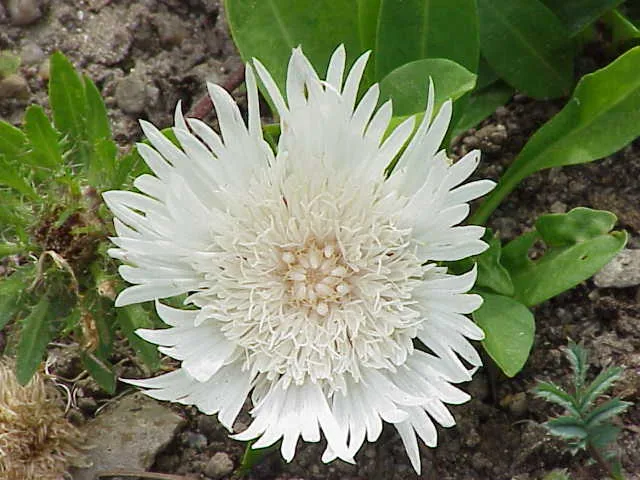
So what is Stokes aster? It's a clump-forming perennial from the southeastern United States, and it's named after the botanist Jonathan Stokes. You'll get fringed, daisy-like flowers in lavender-blue, white, and creamy yellow sitting above a low rosette of shiny, strap-shaped leaves. It looks a bit delicate, but don't let that fool you, since it takes heat and humidity that would knock out pickier plants.
The flowers are really the whole point here. They open up to 5 inches (13 cm) across in early summer, and they'll keep coming if you pinch off the old heads, pulling in bees and butterflies the whole time. Even after the blooms fade, that evergreen rosette hangs around through mild winters, so there's still something to look at.
Once it's settled in, honestly it doesn't ask for much. Full sun, soil that drains, and a division every few years, and that's pretty much the list. The one thing it can't stand? Wet feet over winter. Nail that, and the clump just keeps spreading year after year; miss it, and it'll quietly rot on you.
Care
The short version: pop it in full sun with average, well-drained soil, keep it watered while it's growing, and whatever you do, keep it dry over winter, because cold, soggy soil is what does it in.
Light
Full sun is where it's happiest, giving you the strongest stems and the most flowers. It'll put up with a bit of shade, but too much and it starts to stretch, flop over, and bloom less, so brighter is better.
Water
Try to keep the soil at average to medium moisture while it's growing, watering about every 5 to 10 days when the rain doesn't show up. Don't stress over the exact timing, though, because drainage matters way more, and it's standing winter water, not a missed watering, that really causes trouble.
Soil
Average soil that drains well is all it's after, and it's totally fine with sandy ground and a bit of summer wetness. Shoot for a pH between 5.5 and 7.0, and if your spot stays wet, sort the drainage out before anything else.
Temperature
This one's tough as nails, handling roughly -20°F to 95°F (-29°C to 35°C) and doing well across USDA zones 5 through 9. Southern heat and humidity? No big deal. Just throw down a winter mulch if you're gardening at the colder end of things.
Humidity
Regular outdoor humidity doesn't faze it, so there's no number to chase here. What actually helps is good airflow, keeping the leaves dry and the crown in good shape.
Feeding
Go light on the food. A single spring feeding of balanced fertilizer, or just some compost on top, is all it needs, and overdoing it only gets you soft, floppy stems.
Pruning
Snip off the spent flowers to keep the show going, and tidy up any ragged leaves while you're at it. Then every few years, lift and divide the clumps to keep them going strong.
Repotting
A potted one only needs moving when it outgrows the pot or the crown gets crowded and flowers start thinning out. In the ground? Just divide it every 3 to 4 years and you'll get the same fresh start.
Size & spacing
Plants get about 12 to 24 inches (30 to 61 cm) tall and 12 to 18 inches (30 to 46 cm) wide, so give them roughly that much room. That way air moves through easily and each clump has space to bulk up.
When to plant
Stokes aster works on a warm-season schedule, so there's no hurry. Start seed indoors in late winter, move plants out in spring once the frost's gone, and you'll see the fringed flowers open from early summer into July, often with an encore in fall.
Northern hemisphere
Southern hemisphere
Typical months for a temperate climate: start earlier in warm zones, later where spring frosts linger.
- Sow: Late winter to early spring (about 6-8 weeks before last frost)
- Plant: Spring after danger of frost has passed
- Harvest: Early to mid summer (May to July), sometimes reblooming into fall
Hardiness
USDA hardiness zones: 5–9
Temperature: down to -29°C
Troubleshooting
Here's the good news: Stokes aster barely gives you any trouble. Floppy stems and a few nibbled leaves are just cosmetic, but winter crown rot is the one that'll actually kill it, so keep an eye out for that. Find your symptom below and go from there.
It didn't come back after winter
If a plant just doesn't show up in spring, you're probably looking at crown rot from soggy winter soil, which honestly kills more Stokes asters than anything else. The roots and crown sit wet through the cold, go soft and dark, and the plant either collapses or never wakes up. Clear out the rotted crowns, fix the drainage with a raised bed or slope, and mulch it in colder zones.
Fix:
- Improve drainage by amending soil or planting on a raised bed or slope
- Remove and discard rotted crowns
Stems tipping over after the rain
Ever notice the tall stems flopping after a downpour? That's top-heavy blooms soaking up rain and wind and bending under the load. Too much shade or rich soil makes it worse, since that soft growth never firms up. Just move it to full sun, ease off the feeding, and tuck a grow-through support under the taller ones before they bloom.
Fix:
- Provide light staking or grow-through support for tall cultivars
- Site in full sun to promote sturdier stems
- Avoid over-fertilizing
Something's been munching the leaves
See ragged holes and a few dark specks? That's usually caterpillars having a snack. It looks bad, but it rarely amounts to much, and the plant shrugs off a little grazing while feeding pollinators all season. Just pick the caterpillars off when you spot them and leave it be.
Fix:
- Handpick caterpillars
- Tolerate minor feeding as the plant supports pollinators and is generally pest-free
Toxicity
Got pets or little kids? You're fine, because Stokes aster is completely safe to be around. No extension or botanical source calls it poisonous, and there's nothing about skin irritation either, so it can go pretty much anywhere a curious nose or hand might end up.
Safe for
People · Cats · Dogs · Horses · Rabbits · Livestock · Birds
Cats None
Cats are totally fine here, since there's no toxicity to worry about and a little nibble means nothing. If a cat really goes to town on any plant, it might cough a bit back up or get a quick upset stomach, kind of like it does with grass.
Dogs None
Dogs are safe too, because there aren't any poisonous compounds in it. The most you'd see from a big mouthful is some mild tummy upset that sorts itself out.
Horses Safe
There's nothing toxic to horses, so it's fine along a pasture edge or in a bed they can get to.
Rabbits Safe
Rabbits can munch the leaves without any harm, since it's toxin-free. That said, they'll happily chow down on the foliage and flowers, so fence the clump off if you actually want blooms.
Livestock Safe
Cattle, goats, and sheep can graze near it with no poisoning risk at all. No extension or botanical source lists it as one of the plants that bother livestock.
Birds Safe
Birds have got nothing to worry about. The flowers bring in bees and butterflies, and seed-eating birds can pick at the old heads without any trouble.
People Safe
It's non-toxic to people too, with no reports of poisoning or skin irritation. It's not a food plant, so there's nothing you're meant to eat, but if a kid tastes a bit by accident, no harm done.
No special handling precautions noted; wash hands after gardening as general practice.
Varieties
The different Stokes asters mostly come down to flower color and how neat they stay, and here are the ones you're most likely to bump into.
Blue Danube
It stays nice and compact, but the lavender-blue flowers get huge, up to about 5 inches (13 cm) across.
Alba
This one's got clean white flowers, perfect if you'd rather have that cool look than the usual blue.
Mary Gregory
It surprises you with soft creamy-yellow blooms, which is pretty unusual for a plant that's normally blue.
Peachie's Pick
A compact, easygoing bloomer that keeps cranking out deep blue flowers for ages.
How to propagate
Want more Stokes aster? Easy, since you can split a clump, save some seed, or root a cutting.
DivisionEasy
Spring (or early fall) · One growing season
The easiest thing to do is lift and split an established clump in spring, or early fall if that's better for you. Doing it every few years also perks up an older clump once the middle starts to thin, and each piece gets going within a single growing season.
SeedModerate
Spring; readily self-sows in the garden · Blooms typically in the second year from seed
You can start seed indoors in late winter or just sow it outside in spring, and it'll often self-sow around the garden without any help. The catch? Patience, since seedlings usually wait until their second year to flower.
Stem cuttingsModerate
Growing season · Several weeks to root; root cuttings are also effective
Take stem cuttings during the growing season and give them a few weeks to root. Root cuttings work too, so a chunk of the rootstock will grow into a new plant if you'd rather go that way.
Myths
Stokes aster is a real aster and belongs in the genus Aster.
The name's a bit of a tease. It actually has its own genus, Stokesia, named after the English botanist Jonathan Stokes, and it only shares the big daisy family with the true asters. So sure, the flower plays the part, but the plant's really just a cousin, not the real deal.
Since it grows wild in bogs and savannas, Stokes aster must want soil that's always soaking wet.
It does like damp ground while it's growing, which is where that bog idea comes from. But here's the catch: good drainage isn't optional, and wet winter soil is what kills it more than anything. Keep it moist in summer, dry in winter, and it's happy.