Ornamental · Poaceae
Big Bluestem
Andropogon gerardii
Hand it full sun and lean soil, and this towering native grass stays standing from summer right through winter.
Full sun
Every 7–21 days
60–90 days
USDA 3–9
Overview
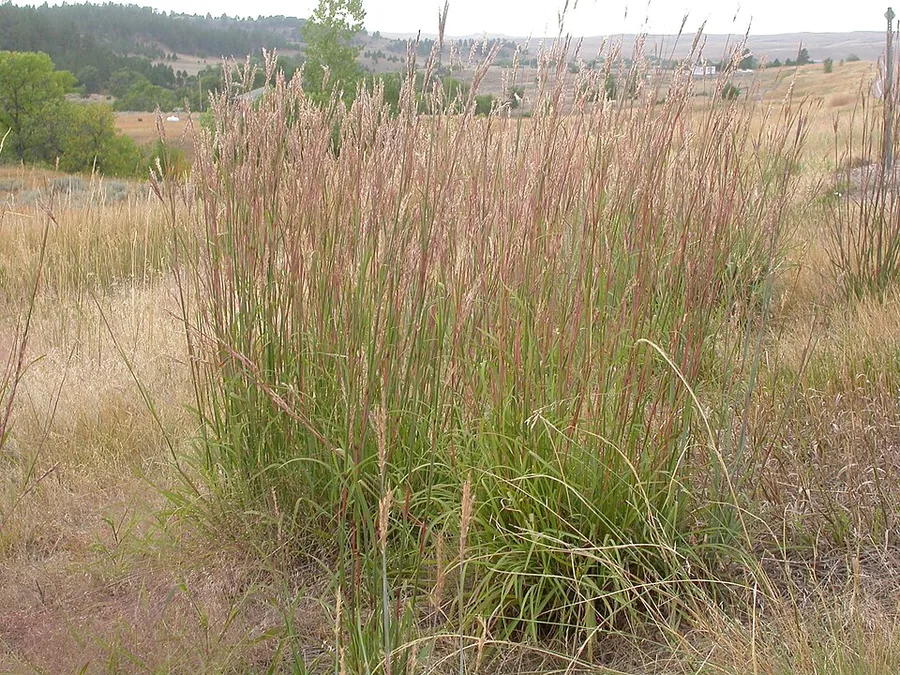
Big bluestem is the grass that once ran the show across the tallgrass prairie, and that's exactly how it picked up the nickname King of the Prairie Grasses. It's a warm-season native that races to 4 to 8 feet (122 to 244 cm) in just one season, throwing up blue-green stems that flush copper and red as autumn rolls in. At the top, the seed heads fan out into three fingers, and that odd little shape is why folks also call it turkeyfoot.
Honestly, this is about as easy as plants get, and that's mostly because it asks for so little. It brushes off drought once those deep roots dig in, copes with clay or sand or worn-out ground, and wants zero fertilizer. Give it sun and decent drainage and it pretty much takes care of itself.
That said, it does have a bit of a wild side. Big bluestem seeds itself and spreads wherever it's happy, and it grows tall enough to engulf a small bed, so it's at its best in meadows, big borders, and naturalistic plantings where it has elbow room. Leave it up over the cold months and the bleached stems and seed heads feed the birds and keep their shape against the snow.
Care
The short version: full sun, lean and well-drained soil, and no fertilizer. Keep it watered while it settles in, then hand it over to the rain, and cut last year's growth back once a year in late winter.
Light
Big bluestem is after full sun, which means 6 or more hours of direct light each day. A bit of shade won't kill it, but the stems turn weak and flop without strong light, so the more sun it soaks up, the better it stands.
Water
Only give it regular water while it's settling in. Once that's done it's drought tolerant and gets by on rainfall in average to dry soil, wanting a drink just every 7 to 21 days during a genuine dry stretch.
Soil
Set it in lean, well-drained ground, anything from dry to medium. It handles poor, sandy, or clay soil without complaint across a pH of 5.0 to 7.5, but rich, moist soil makes it grow soft and flop, so leave the heavy amendments out.
Temperature
This one covers a huge range, shrugging off bitter cold and summer heat alike, taking temperatures from roughly -29°F to 104°F (-34°C to 40°C). It dies back to the ground every winter and pushes up fresh once late spring warms up.
Humidity
Plain outdoor air does the job, so there's no level for you to fuss with. What matters far more than any humidity reading is good airflow, since open spacing keeps the odd bout of leaf rust from taking hold.
Feeding
Skip the feeding entirely. Big bluestem is a native that does best on poor soil, and the extra richness from fertilizer only grows weak, leggy stems that topple over.
Pruning
Cut the whole clump back to a few inches in late winter or early spring, before the new shoots appear. Let it stand through the cold months, where the dried stems and seed heads keep their shape and feed wildlife.
Repotting
Big bluestem hardly ever needs lifting. If an old clump begins to fade out in the middle or loses steam after many years, dig it up and divide it in spring to freshen the planting.
Size & spacing
Count on a grown plant hitting 4 to 8 feet (122 to 244 cm) tall with a base of 2 to 3 feet (61 to 91 cm). Leave it that whole footprint so air can move through and the clump can stand tall without crowding what's around it.
When to plant
Big bluestem lives on summer heat and goes quiet in the cold. You can start seed indoors in late winter after a cold-moist chill, set plants out once the frost has cleared in spring, or scatter seed dormant over fall and winter. Those purplish turkey-foot heads show up from late summer into fall.
Northern hemisphere
Southern hemisphere
Typical months for a temperate climate: start earlier in warm zones, later where spring frosts linger.
- Sow: Late winter to early spring, 8-10 weeks before last frost (cold-moist stratify seed)
- Plant: Spring after last frost, or dormant-seed in fall/winter
- Harvest: Late summer to fall (purplish turkey-foot seed heads)
Hardiness
USDA hardiness zones: 3–9
Temperature: down to -40°C
Troubleshooting
For a grass this tough, big bluestem comes with a pretty short list of headaches, and most of them lead back to too much shade or a site that's too rich. Catch the early hints on the stems and leaves and the fix is usually easy. Find what matches below, then act before it sets the look of the whole clump.
Floppy stems that splay out and leave a gap in the middle
When big bluestem flops, the cause is nearly always too little sun or too much food. Sit it in shade or rich, fertile ground and the stems shoot up soft and tall, too weak to hold their own weight. The fix? Move it into full sun, quit feeding it, and cut it back hard in late winter so the fresh growth comes in stiff and upright. If you want it handled once and for all, an upright cultivar like 'Blackhawks' does the trick.
Fix:
- Site in full sun
- Stop fertilizing and avoid rich amendments
- Cut back hard in late winter so sturdy new growth emerges
- Choose an upright cultivar such as 'Blackhawks' if flopping persists
Surprise seedlings appear and the clump drifts past its spot
Big bluestem drops seed all on its own and creeps outward on short rhizomes, and it does both most enthusiastically in sunny, fertile, moist ground. Want to keep it reined in? Snip off the seed heads and toss them before they ripen. Splitting the clump in spring helps too, and any volunteers you didn't ask for are easy enough to pull up or shift elsewhere.
Fix:
- Cut and remove seed heads before they mature to limit self-seeding
- Divide and reduce the clump in spring
- Pull or transplant volunteer seedlings
One oversized clump that takes over a small bed
Remember, this is a tallgrass-prairie giant by nature, reaching 4 to 8 feet (122 to 244 cm) on a 2 to 3 foot (61 to 91 cm) base, so it'll loom over anything crowded in beside it. Hand it some space as a backdrop or screen, or relocate it somewhere it can spread its arms. Prefer to leave it put? Dividing the clump shrinks its footprint nicely.
Fix:
- Relocate to a larger space or use as a backdrop/screen
- Divide to reduce footprint
Orange, rusty flecks dotted over the foliage
Those little raised orange spots are rust, a fungus that shows up here and there but seldom causes any real trouble. Open the plant up so air can move through it, pull off any leaves that are badly speckled, and cut the whole clump down in late winter to get rid of the spores that hang on over the cold. Beyond that, this grass really has nothing else worth worrying about.
Fix:
- Improve air circulation
- Remove and dispose of heavily affected foliage
- Cut back in late winter to remove overwintering inoculum
Toxicity
Big bluestem is safe across the board. It's a native prairie grass with no poisonous parts, it doesn't appear on any ASPCA toxic-plant list, and it's actually valued as livestock feed. The one thing worth keeping an eye on is the pollen, which can stir up hay fever in anyone already touchy about grasses.
Safe for
People · Cats · Dogs · Horses · Rabbits · Livestock · Birds
Cats None
Totally fine to have around. A cat that munches a blade or two might bring it back up, like cats do with any grass, but there's nothing poisonous in it.
Dogs None
Nothing to fret over. There are no toxins in the grass, so a dog can sniff it or chew on it without any harm done.
Horses None
Completely safe. Horses happily graze big bluestem, and it's among the better native pasture grasses you can offer them.
Rabbits None
No problem for rabbits to nibble. It's just a grass, with no poisonous parts at all.
Livestock None
Treated as good feed, not a hazard. Cattle, goats, and sheep all graze it, and it rates as top-quality forage out on the prairie.
Birds None
No threat to birds, who eat the seed and tuck into the standing clumps for cover all winter.
People None
Safe to handle and be near, no poison involved. The one snag is the pollen, which can kick off hay fever if you already react to grasses.
Grass pollen can trigger seasonal hay-fever allergies in sensitive people, and pets that nibble grass may occasionally vomit, but the plant is not poisonous.
Varieties
Most of the big bluestem you'll find for sale is grown for its fall color or for a tougher, more upright build. Here are the named picks worth knowing about.
Blackhawks
An upright grower that won't flop, with dark green spring leaves that darken toward near-black come fall; it took Perennial Plant of the Year for 2026.
Red October
Picked for its autumn display, when the leaves shift to a striking red to red-purple.
Indian Warrior
A selection valued for the deep red-purple shades it turns in fall.
Dancing Wind
Known for the colorful red-tinged leaves it carries into autumn.
Andropogon hallii (sand bluestem)
A close relative suited to dry, sandy ground that looks a lot like big bluestem itself.
Companions
Big bluestem pairs naturally with the other tallgrass-prairie plants it grew up alongside, grasses and sun-loving forbs that share its taste for full sun and well-drained ground.
Plant near
Switchgrass (Panicum virgatum): Companion warm-season prairie grass often planted together for forage and naturalistic plantings.
Indiangrass (Sorghastrum nutans): Co-dominant tallgrass-prairie grass with matching site needs for meadow and restoration plantings.
Purple coneflower (Echinacea purpurea): Full-sun prairie forb that pairs well with big bluestem in native borders and meadows.
How to propagate
You can grow big bluestem from seed or split an existing clump, and either route makes it an easy plant to multiply once you've got its rhythm down.
SeedEasy
Spring sowing, or dormant fall/winter seeding; cold-moist stratify for best germination · Somewhat slow to establish (1-2 seasons), then vigorous
Seed is how most plantings get going, either sown in spring or scattered dormant across fall and winter, with a cold-moist chill beforehand to rouse it from sleep. The seedlings sprout up sturdy, but give the stand a season or two to settle before it really hits its stride. Once it does, it carries on by itself, dropping seed freely anywhere the conditions agree with it.
DivisionEasy
Spring as new growth begins · One growing season
Need more plants in a hurry, or want to cut an oversized clump down to size? Dig up an established one and split it right as growth kicks off in spring. The pieces take root and fill back out inside a single season.
Myths
Big bluestem and little bluestem are the same plant.
Not so; they're different grasses sitting in different genera. Big bluestem, Andropogon gerardii, can shoot up 4 to 8 feet (122 to 244 cm) and carries that three-pronged turkey-foot seed head it's named after. Little bluestem, Schizachyrium scoparium, belongs to its own genus and stays a tidy 1 to 3 feet tall. The names rhyme, sure, but you can't swap one for the other.