Ornamental · Sarraceniaceae
Cobra Lily
Darlingtonia californica
A hooded carnivore that wants a hot top and cold feet.
Full sun
Every 1–3 days
1095–1825 days
USDA 6–9
Overview
The Cobra Lily (Darlingtonia californica) is a carnivorous pitcher plant in the Sarraceniaceae family, and it's the only species in its genus. Despite the name, it's not a true lily at all. It grows wild in the cold mountain bogs and seeps of northern California and Oregon, which tells you a lot about what it's after.
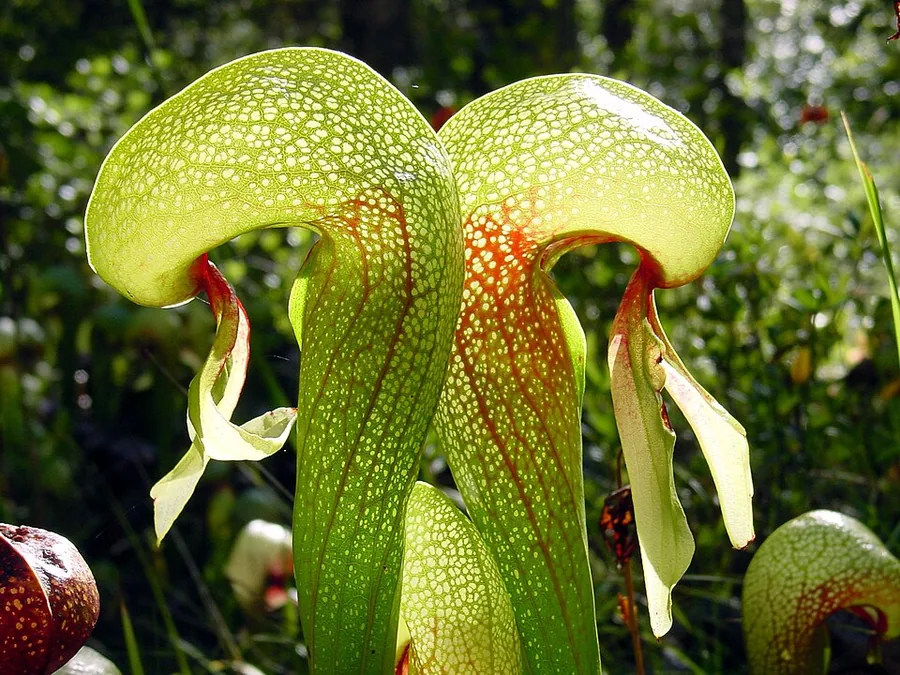
Where does the name come from? Each leaf rolls up into a hooded pitcher that rears up like a striking snake, with a forked tongue-like flap hanging under a translucent dome. Insects head toward the bright patches glowing through the hood, lose track of the exit, and slide down into the digestive pool. The soil it lives in holds almost no nutrients, so trapping bugs is how it makes up the difference.
Here's the part that trips people up: in the wild, cold snowmelt runs constantly over its roots while the foliage sits out in open sun. Hot top, cold bottom. That split is the whole game, and it's exactly why this plant defeats anyone who treats it like a regular potted ornamental. Get the cool-roots, bright-leaves balance right and you're most of the way there.
Care
The short version: keep this carnivore in full sun but keep its roots cool and constantly wet, watering every 1 to 3 days with distilled, RO, or rainwater only. Never use tap water and never fertilize, since the pitchers feed themselves on insects. Plant it in acidic nutrient-poor bog mix, give it damp airy conditions, and remember that warm water around the roots is the most common way it dies.
Light
Full sun is what it loves, and it's what brings out that deep red veining in the hood. It'll get by in partial sun or light shade, but go too dim and the pitchers turn pale and floppy. One big catch though: that strong light has to come with cool roots, never a hot dry spot, or you'll cook it.
Water
Keep the bog mix constantly wet, usually every 1 to 3 days, and use only distilled, reverse-osmosis, or rainwater since tap or mineral water will kill it. Just as important, keep that water cold. Warm standing water around the roots is the most common cause of death, even when the top growth is happily soaking up full sun.
Soil
Go with a nutrient-poor bog mix, either live sphagnum or a peat-perlite blend. It needs to be acidic, somewhere in the pH of 4.0 to 6.0 range. Whatever you do, never use standard potting soil, since the nutrients in it will rot the plant.
Temperature
This one's tough as nails in the cold and shrugs off a freeze, handling 5°F to 86°F (-15°C to 30°C). The thing to remember is the roots want to stay cool even on warm days. Heat at the crown does far more damage than cold ever will.
Humidity
As a bog plant it likes damp air, roughly 50% to 80%, but airflow matters just as much. Stagnant muggy air around the crown invites rot, so don't let it sit still and stuffy. Outdoors in a cool breezy spot, it usually takes care of its own humidity.
Feeding
Don't fertilize it, full stop. The pitchers catch and digest their own insects, and that's the only food it actually wants. Drop in fertilizer or a bit of fatty meat and you'll rot it from the inside out.
Pruning
There's barely anything to do here. Once a pitcher has fully browned and died back, snip it off at the base with clean scissors. Otherwise just leave it be, and never cut it for shape.
Repotting
Plan on repotting every 2 to 3 years in early spring into fresh bog mix. You'll know it's time when stolons crowd the pot edge, the medium goes compacted and broken down, or the pitchers start coming in smaller and weaker.
Size & spacing
Expect it to reach 10 to 31 inches (25 to 80 cm) tall and spread 12 to 24 inches (30 to 60 cm) as its stolons creep outward. It's a slow grower, so give it room from the start and let it fill in at its own pace.
When to plant
This is a hardy outdoor perennial for zones 6 through 9, and it runs on a slow clock so don't rush it. Here's the rough rhythm through the year.
Northern hemisphere
Southern hemisphere
Typical months for a temperate climate: start earlier in warm zones, later where spring frosts linger.
- Sow: late winter after cold stratification
- Plant: spring after last frost
- Harvest: late spring
Hardiness
USDA hardiness zones: 6–9
Temperature: down to -23°C
Troubleshooting
Most trouble with this plant traces back to the same theme: roots that got too warm or water that wasn't pure enough. Here's what to watch for and how to fix it.
Cooked roots, the number one way folks lose this plant
So here's the cruel twist: you can keep this plant soaking wet and still lose it to heat. In the wild its crown sits in cold mountain runoff while the pitchers bake in open sun, so warm standing water around the roots quietly starves it even as the top looks fine. If it fades on hot days while staying damp, the roots are the problem. Move it somewhere cooler and breezier, flush the mix with cold distilled or rainwater when the weather spikes, and top-dress with live sphagnum to keep that root zone cool.
Fix:
- Move the plant to a cooler, airy spot out of reflected heat
- Flush the medium with cool distilled or rainwater on hot days
- Top-dress with live sphagnum to insulate and cool the root zone
- Avoid leaving the pot in warm standing trays in summer
Mineral burn from the wrong water
When pitcher tips start browning and the whole plant slumps over a few weeks, salts are usually the culprit. Tap or hard water leaves minerals behind, and so does any fertilizer or rich soil that sneaks in. Check the medium and pot rim for a white crusty film, that's the tell. Switch to distilled, RO, or rainwater only, flush the mix repeatedly to leach the salts out, and if the contamination runs deep, repot into fresh bog mix.
Fix:
- Switch to distilled, RO, or rainwater only
- Flush the medium repeatedly with pure water to leach salts
- Repot into fresh nutrient-poor bog mix if contamination is severe
Just not enough light
Pale, floppy pitchers that never color up are basically the plant asking for more light. The dead giveaway? New pitchers come in plain green instead of that striking red veining you want. Give it brighter conditions, ideally full sun paired with cool roots, but don't shove it into blazing sun overnight. Step up the exposure over a week or two so it can adjust without scorching.
Fix:
- Provide brighter light, ideally full sun with cool roots
- Acclimate gradually to avoid scorch
Toxicity
Good news here, this plant isn't toxic to anyone. The bigger risk actually runs the other way, since a curious paw or nose can wreck the delicate bog setup faster than the plant could ever harm a pet.
Safe for
People · Cats · Dogs · Horses · Rabbits · Livestock · Birds
Cats None
A curious cat is in no danger here. Worst case, a nibble on a fibrous leaf might bring on mild drooling or a bit of stomach upset, nothing more. The wet acidic leaves don't read as food anyway, so most cats leave it alone.
Dogs None
Dogs are fine around this one too. A chewed leaf could cause mild drool or a touch of tummy trouble at worst, and that's about it. The real worry is a paw or nose wrecking the fragile bog setup, not the plant hurting your dog.
Horses Safe
No risk to horses. It's a small bog plant with no toxic principles, so even a stray mouthful wouldn't poison one.
Rabbits Safe
Rabbits are safe around it. There's nothing toxic in the plant, and the wet acidic leaves aren't appealing to munch on anyway.
Livestock Safe
No concern for livestock. This carnivorous plant carries no toxins, so it won't poison grazing animals.
Birds Safe
Birds won't be harmed by the plant itself. If anything, a bird's more likely to raid the insects trapped inside the pitchers than to bother with the leaves.
People Safe
Totally safe for people, and it isn't grown as food. The pitchers digest bugs, not anyone in the house, so there's no poisoning risk to worry about.
No special handling hazards; the pitchers digest small insects, not pets, and the plant has no toxic principles of concern.
Varieties
There's really just the one species, plus a single cultivated selection worth knowing about. Here's how to tell them apart.
Darlingtonia californica
This is the only species in its genus, so there's nothing to confuse it with. You'll spot it instantly by the hooded cobra-like pitcher and the forked tongue dangling below the opening.
'Othello'
A cultivated pick that skips the usual red veining entirely, so it comes up an even all-green from top to bottom.
How to propagate
You can make more of these by division or from seed, but neither is quick or easy. Both ask for cool, wet, pure conditions and a fair bit of patience.
DivisionDemanding
Early spring before active growth · 1-2 growing seasons
Lift the plant in early spring before growth really kicks off, then separate the offsets riding along its running stolons. Take only pieces that have their own roots, pot them into fresh cool wet bog mix, and they'll settle over one to two growing seasons.
SeedDemanding
Sow after cold stratification in late winter · 3-5 years to mature plant
This route is slow, so patience is key. Seed needs several weeks of cold moist stratification in late winter to break dormancy, and the seedlings inch along after that. Expect 3 to 5 years before you've got a mature plant.
Myths
You have to hand-feed it insects or bits of meat to keep it alive.
Not true at all. It catches every bit of prey it needs on its own, so hand-feeding does nothing useful, and meat or fertilizer can actually rot the crown. What really keeps it going is light, pure water, and cool roots.
Treat it like a houseplant: give it warmth and regular potting soil.
It wants the exact opposite. Think nutrient-poor acidic bog mix and mineral-free water, because warm roots and rich soil are flat-out lethal. Keeping that root zone cool is honestly the trickiest part to nail.