Bulb · Amaryllidaceae
Daffodil
Narcissus pseudonarcissus
Plant the bulbs in fall and they'll hand you the first real color of spring, year after year.
Full sun
Every 7–14 days
USDA 4–8
12–18 in · 30–46 cm
Overview
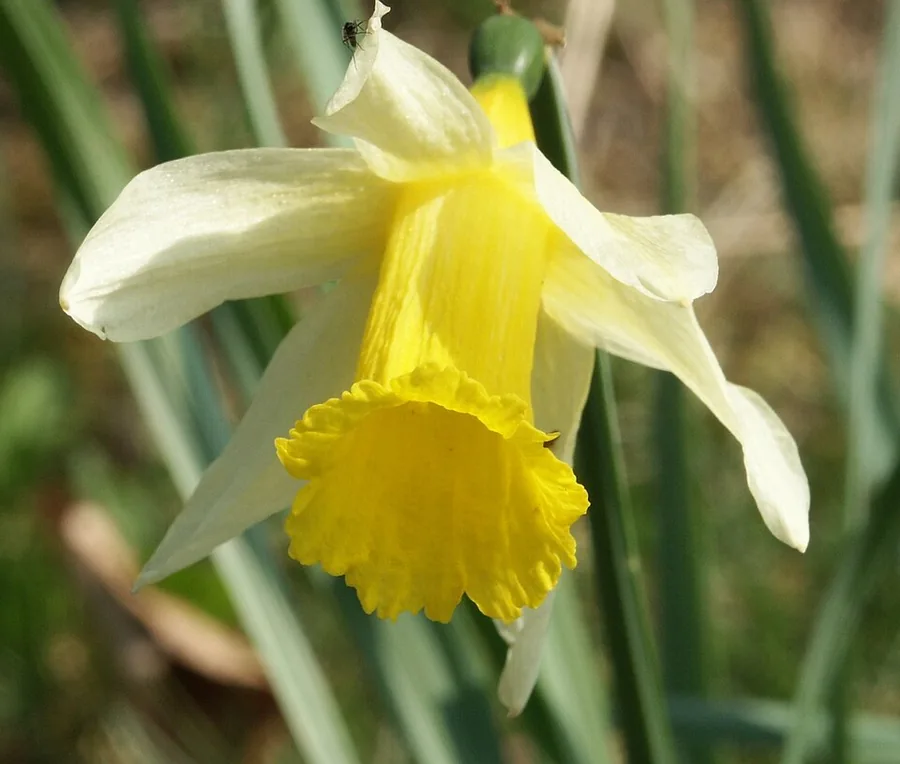
Daffodils are the bulb most people start with, and it's easy to see why. You plant them once in autumn, and up come the trumpet flowers in early spring while the rest of the garden's still rubbing its eyes. They're part of the genus Narcissus, they come back on their own each year, and they spread into wider clumps as they go, so you end up with more for free.
The best part? They barely ask for anything. They take cold right down to -29°F (-34°C), settle into just about any well-draining soil, and they shrug off the deer and rodents that wreck other bulbs, since every part of the plant is poisonous. Give them sun and good drainage and there's not much else to fuss over.
And there's way more than the plain yellow trumpet on offer. Some carry several blooms on one stem, some pair white petals with a colored cup, and some open up ruffled and double. Whatever you go for, the rule stays the same: let the leaves yellow and die back on their own, because that slow fade is how the bulb feeds next year's flowers.
Care
The short version: full sun to part shade, soil that drains well and never sits soggy, a light low-nitrogen feed in fall and again in spring, and the patience to let the leaves die back before you tidy up.
Light
Daffodils flower best in full sun, though they'll take partial shade in stride, which makes them a great pick under trees that leaf out after the bulbs have already bloomed. And the more sun they get? Stronger stems and fuller flowers.
Water
Keep the soil moist but never soggy while they're growing, and give them a little extra during a hot or dry spring to stretch out the bloom. Once the foliage dies back the bulb goes dormant and barely wants a thing, since wet summer soil is the quickest way to rot it.
Soil
Plant them in well-drained loam, clay, or rich soil, and the one thing you can't skimp on is the drainage. A pH of 6.0 to 7.0 suits them just fine, but it's standing water at the bulb that does daffodils in faster than anything else.
Temperature
These are tough, cold-hardy bulbs that handle anything from -29°F to 86°F (-34°C to 30°C). They actually need a cold winter stretch to set their flowers, so that deep chill is a good thing here, not something to worry about.
Humidity
Air moisture isn't something you need to babysit with daffodils, so there's no number to chase. What does matter is air moving freely around the leaves, since crowded, damp foliage is what invites in the fungal troubles they're prone to.
Feeding
Go with a low-nitrogen complete fertilizer like 10-10-10 plus a bit of bone meal, worked in during fall and again as the shoots break ground in spring. Once flowering starts, stop feeding, because extra nitrogen at that point just encourages bulb rot.
Pruning
Deadhead the spent flowers, but leave the foliage standing for at least six weeks after bloom, until it yellows and browns on its own. Don't cut or tie the green leaves early, since that slow die-back is exactly how the bulb stocks up for next year.
Repotting
Daffodils are happiest left alone, and they only need lifting every 5 years or so, or sooner if a clump gets too crowded to flower well. Packed bulbs, smaller blooms, and lots of leaves with hardly any flowers are your signs it's time to divide.
Size & spacing
Plants reach 12 to 18 inches (30 to 46 cm) tall and spread 9 to 12 inches (23 to 30 cm) wide. Set the bulbs 6 to 8 inches (15 to 20 cm) deep, about two to three times their height, and space them 4 to 8 inches (10 to 20 cm) apart.
When to plant
Daffodils run on a fall-to-spring schedule, and it's an easy one to keep. Get the bulbs in the ground in mid-autumn, around six weeks before the first frost once the soil drops below 60°F (16°C), and they'll quietly root through winter before opening up in early spring.
Northern hemisphere
Southern hemisphere
Typical months for a temperate climate: start earlier in warm zones, later where spring frosts linger.
- Plant: Mid-autumn, about 6 weeks before first frost, once soil temperature stays below 60 degrees F
- Harvest: Early spring
Hardiness
USDA hardiness zones: 4–8
Temperature: down to -34°C
Troubleshooting
A healthy daffodil hardly ever gives you grief, and when it does, the trouble usually kicks off underground in the bulb. Mostly it shows up as rot, scorched leaves, or a clump that just stops flowering out of nowhere. Match what you're seeing below and step in early, before it spreads to the bulbs next door.
Stunted plants and bulbs gone soft and rotten
What you're looking at is basal rot, a Fusarium fungus that gets into the bottom of the bulb and is happiest when the ground stays soggy and the feeding's been heavy. Dig one up to be sure, and you'll find a soft brown base with white or pink mold sneaking between the scales. So toss anything that's infected, replant only firm, healthy bulbs in fresh, well-draining ground, and go a little easier on the fertilizer.
Fix:
- Discard infected bulbs
- Plant only firm, healthy or hot-water-treated bulbs
- Improve drainage and replant in a new site
Twisted leaves, soft light bulbs, barely any flowers
Here's the tricky part: two different pests cause this exact look, and both eat the bulb out from the inside. Slice one across and brown rings point to stem and bulb nematodes, while a hollow middle with a fat grub sitting in it means narcissus bulb fly larvae. Either way the bulb feels light and soft, so dig up and destroy whatever's infested and start over with certified clean stock.
Fix:
- Dig and destroy infested bulbs
- Plant only treated, healthy bulbs
Tan spots on the flowers that spread when it's wet
That's fire disease, and it gets the name from the scorched look it leaves on the blooms, starting as little tan flecks that creep out until the flowers brown and the leaves streak yellow. Damp, crowded beds? That's exactly where it takes off. So pull and burn anything infected, give the plants some breathing room so air can move, and clear away the faded blooms before the spores get a chance to travel.
Fix:
- Remove and destroy infected plants and flowers
- Apply a protective fungicide
New leaf tips looking spotted and singed
Those reddish-brown spots with yellow rings on the tips of fresh leaves are leaf scorch, and yes, they really do look like someone took a match to them. Just snip off the marked foliage, plant hot-water-treated bulbs next time around, and keep the water off the leaves so the fungus has nowhere comfy to settle.
Fix:
- Remove affected foliage
- Plant hot-water-treated bulbs
- Apply a labeled fungicide
Toxicity
Every part of a daffodil is poisonous, and the bulb is the worst of the bunch. It's got lycorine and other alkaloids in it along with sharp calcium oxalate crystals, and it looks so much like an onion that people have actually been poisoned by accident. Keep the bulbs and plants away from pets, livestock, and kids, and slip on gloves when you handle them.
Toxic to
Cats · Dogs · Horses · Rabbits · Livestock · Birds · People
Cats Severe
If a cat takes a bite of a daffodil, you'll usually see drooling and vomiting inside the hour, and diarrhea isn't far behind. The bulb's the dangerous bit, and a big mouthful can drop the blood pressure and kick off tremors or a heartbeat that's all over the place, so don't sit on it, get help.
Dogs Severe
Dogs that dig up and chew a bulb get hit hardest, with loads of drooling, vomiting, and an upset stomach. Once a bigger amount goes down, it can spill over into convulsions, low blood pressure, and a heart that races or skips, so that's a call-the-vet-right-now moment, not a wait-and-see one.
Horses Severe
Horses out grazing hardly ever bother with daffodils, but if one does, the alkaloids hit hard, bringing on drooling, retching, and colic. A big dose can stir up tremors and some scary changes in heart rhythm, so it's worth keeping them out of the field altogether.
Rabbits Severe
Every part of the plant carries that same lycorine that makes other animals sick, so a rabbit having a nibble can end up drooling, with an upset tummy and tremors. Keep daffodils well out of reach, and whatever you do, don't toss the trimmings in as a snack.
Livestock Severe
Cattle, goats, and sheep can all be poisoned by the leaves or by bulbs that get turned up in a pasture. Keep an eye out for drooling, diarrhea, staggering around, and in the bad cases a heartbeat that's gone unsteady.
Birds Severe
The alkaloids are bad news for birds too, and even a small chunk of bulb is way more than a little body can handle. So keep daffodils and their bulbs well away from any pet bird or backyard flock.
People Caution
None of a daffodil is food, and the bulb's the real trap because it looks so much like an onion, doesn't it? Swallow any part and you're in for vomiting and drooling, and handling the cut stems can leave your skin itchy, so it's gloves on for that job.
Bulbs can be mistaken for onions but are poisonous; keep bulbs away from pets and children. Wear gloves when handling, since the sap can cause skin irritation known as daffodil itch.
Helpline numbers

United States
ASPCA Animal Poison Control: (888) 426-4435 (fee applies)
Poison Control: (800) 222-1222



Canada
Poison Centres: 1-844-764-7669
Varieties
Daffodils come in thousands of named forms, all sorted into divisions by their flower shape. A few classics keep popping up again and again, and they're a nice way to get a feel for the range.
King Alfred
It's the classic big daffodil, all golden yellow with a bold trumpet, and it's the one most folks picture the second they hear the name.
Thalia
This one's a triandrus type, and it hangs several nodding white flowers on each stem for a softer, woodland kind of look.
Actaea
It's a poeticus daffodil, with crisp white petals wrapped around a small yellow cup that's neatly rimmed in red.
Tahiti
Instead of one trumpet, this double-flowered variety fills up with ruffled yellow and orange segments.
How to propagate
Daffodils multiply all on their own, so most of the job is just dividing what you've already got. You can grow them from seed too, but only if you've got years to spare.
Offsets & pupsEasy
After foliage yellows and dies back, in late spring or early summer · 1-2 years to reach flowering size
Want more daffodils? The easy way is to let the plant handle it for you. Once the foliage has yellowed and died back in late spring or early summer, lift a crowded clump and gently pull apart the little offset bulbs that have formed around each mother. Pop them back in at the right depth straight away, or keep them cool and dry until fall, and most will hit flowering size in 1 to 2 years.
DivisionEasy
Every 5 years when clumps become crowded, after foliage dies back · 1-2 years
When the blooms start thinning out and the clumps look packed, which is usually about every 5 years, that's your cue to dig and divide them once the foliage has died back. Splitting up the crowded bulbs takes the pressure off and brings the flowers back, and the pieces you replant settle in over 1 to 2 years.
SeedDemanding
Sow ripe seed in autumn · 5 years or more to flowering
Growing daffodils from seed? That's one for the patient. Sow the ripe seed in autumn and the seedlings take 5 years or more to reach blooming size, which is why this route mostly gets left to breeders chasing new varieties.
Myths
Daffodil bulbs are safe to eat because they look like onions.
Funny thing is, that resemblance is exactly what makes them dangerous, and people really have been poisoned cooking a daffodil bulb instead of an onion. The bulb's the most toxic part of the whole plant, packed with lycorine and other alkaloids. No part of a daffodil is food, so keep those bulbs well away from the kitchen.