Tree · Arecaceae
Date Palm
Phoenix dactylifera
Give it full sun, sharp drainage, and desert heat, and the date palm will pay you back with sweet fruit for decades.
Full sun
USDA 8–11
49–79 ft · 15–24 m
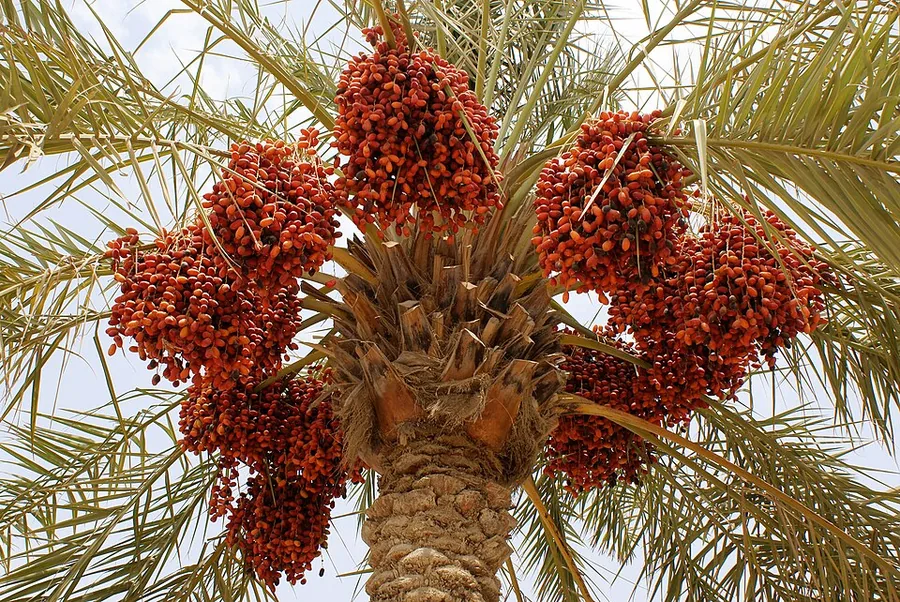
Overview
For thousands of years the date palm has kept people fed across the desert world, and it's still pulling double duty today as a fruit tree and a real eye-catcher in the landscape. It's a true palm in the family Arecaceae, with roots in the dry country running from the Arabian Peninsula into South Pakistan. Give it the right climate and it'll grow into a towering tree, climbing to around 80 feet under a crown of long, arching fronds.
At its core, this is a desert plant. It barely notices drought once its roots have gone deep, soaks up full sun happily, and copes with poor, sandy ground that would stop most trees in their tracks. It also takes more cold than you'd expect from a palm, hanging on down to about 16°F (-9°C), which is exactly why it does well outdoors across USDA zones 8 to 11.
Here's something worth knowing before you plant: the date palm is dioecious, so every tree is either male or female. Fruit only shows up when a female has a male nearby to pollinate her, which means a single tree on its own will stay good-looking but barren. The lower leaf bases carry stiff spines too, so it'll want space away from paths and play areas.
Care
The short version: full sun, fast-draining soil, and warmth are pretty much the whole deal. Give young trees water to get them rooted, then back right off once they're settled, and feed them a real palm fertilizer to keep those fronds nice and green.
Light
Put a date palm in full sun. It'll get by in partial sun, but it really hits its stride and fruits best in an open spot that bakes all day long, the same way it would back in its native desert.
Water
This tree is highly drought-tolerant. Water young ones regularly so they can establish, then ease right off, because a grown palm in the right climate hardly needs any extra watering. It turns up naturally both in deserts sitting over deep groundwater and along rivers, so it copes with dry ground far better than soggy.
Soil
Go with well-drained soil, and plain sand works perfectly fine. It prefers ground that's on the acidic-to-neutral side, somewhere around pH 5.5 to 7.0. The one thing it really can't stand? Water sitting around its roots.
Temperature
A date palm copes with a big range, somewhere between 16°F to 100°F (-9°C to 38°C). That kind of cold tolerance is rare in a palm and lets it grow outside well past the tropics, though it'll still want long, hot summers to ripen its fruit.
Humidity
Low humidity won't bother it one bit. This is a desert tree, so dry air suits it best, which is what separates it from the jungle palms people keep as houseplants.
Feeding
Feed it a proper slow-release palm fertilizer right through the warm growing season, ideally one with an 8-2-12 plus 4 magnesium analysis and micronutrients. That mix keeps off the potassium, magnesium, and manganese shortages palms run into. Plain lawn fertilizer? It'll do more harm than good here.
Pruning
Only cut the fronds that have turned completely brown and dead, and leave the green ones alone, because over-pruning just wears the tree down. Some growers snip a few lower leaves to keep fungus in check. Whatever you cut, gear up with heavy protection, since the leaf bases carry sharp 3- to 4-inch spines.
Repotting
A date palm is built to grow in the ground as a large landscape tree, not in a pot. Only repot it while it's young and still in a container, and even then do it infrequently. Roots circling the pot or water running straight through are the signs a young one has outgrown where it's living.
Size & spacing
This is a serious tree, reaching 50 to 80 feet (15 to 24 m) tall under a crown that spreads 20 to 25 feet (6 to 7.5 m) wide. Give it plenty of room away from walkways, foundations, and play areas, and plan ahead for fronds and fruit dropping down.
When to plant
Think of the date palm as a long-lived perennial rather than a seasonal crop, so there's no sowing window you have to nail. Get it in the ground during the warm growing months so the roots can grab hold, and once it's mature the edible dates ripen from late summer into autumn, but only where a male and a female tree are sharing the same garden.
Northern hemisphere
Southern hemisphere
Typical months for a temperate climate: start earlier in warm zones, later where spring frosts linger.
- Harvest: Edible dates ripen in late summer to autumn; both male and female trees must be present for fruit set
Hardiness
USDA hardiness zones: 8–11
Temperature: down to -12°C
Troubleshooting
Most of what goes wrong with a date palm is either a disease you can't fix or a nutrient gap you can, and the trick is telling them apart by where the trouble shows up. New growth at the crown is telling you one story, while the oldest lower fronds are telling you another.
Why is the whole tree fading with fronds dying off?
What you're looking at is lethal yellowing, a disease date palms are prone to catching, and it can finish off a tree completely. Once a palm is infected, there's no rescuing it, so the move is to take it down and destroy it before it passes the disease along. Your best bet is really about location: don't put date palms anywhere lethal yellowing is already a known problem.
Fix:
- Avoid planting where lethal yellowing is present
- Remove and destroy confirmed infected palms to limit spread
Why does the newest growth at the crown look frizzled and weak?
If the newest fronds emerge frizzly and dying back while the older ones seem fine, you're dealing with frizzle top, a manganese shortage that high soil pH tends to trigger. Supply manganese through a complete palm micronutrient feed, and get a high pH back down so the tree can actually absorb it. Ignore it and the crown just keeps deforming until the palm starts to slip.
Fix:
- Apply manganese as part of a complete palm micronutrient fertilization program
- Address high soil pH that reduces manganese availability
What's causing yellow edges on the oldest fronds?
When the lowest fronds yellow along their edges but the fresh growth stays green, that's usually a magnesium deficiency, and the wrong feed is often behind it. Move over to a complete palm fertilizer, the type with an 8-2-12 plus 4 magnesium analysis and micronutrients, then keep to a steady schedule. Lawn fertilizer tends to be the troublemaker, so keep it well away from the root zone.
Fix:
- Apply a complete palm fertilizer such as 8-2-12 plus 4 magnesium with micronutrients
- Continue regular scheduled feeding to correct and prevent recurrence
Toxicity
If you've got pets or kids at home, here's the reassuring part: the date palm doesn't carry any toxin. The fruit is a food everybody knows, and ASPCA lists Phoenix palms as non-toxic to cats, dogs, and horses. The one real hazard isn't chemical at all, it's physical, those sharp 3- to 4-inch spines at the leaf bases can leave deep puncture wounds, so keep everyone away from the lower fronds.
Safe for
People · Cats · Dogs · Horses · Rabbits · Livestock · Birds
Cats None
Nothing to worry about here. Since the date palm is a true palm bearing edible fruit, and ASPCA puts Phoenix species in the non-toxic column for cats, your cat can hang around it just fine.
Dogs None
The plant itself poses no poisoning risk, because Phoenix palms don't carry any toxin a dog has to steer clear of. The only thing to keep an eye on? A nosy dog wandering into those spiny lower fronds.
Horses None
Neither the leaves nor the fruit hold anything toxic to horses, and ASPCA has Phoenix species down as non-toxic.
Rabbits Safe
If a rabbit grabs a bite of a frond, it'll be fine, since there's no harmful compound in the plant for it to react to.
Livestock Safe
Cattle, goats, and sheep can graze around a date palm with no toxic trouble from the foliage or fruit.
Birds Safe
There's no toxic risk to birds in either the fruit or the leaves, and birds happily go for ripe dates out in the wild anyway.
People Safe
Dates are a beloved food you can eat fresh or dried without a second thought. The only true risk is a physical one: those stiff 3- to 4-inch spines at the leaf bases can give you a deep puncture wound, so handle the lower fronds carefully.
Wear thick gloves, long sleeves and eye protection when handling or pruning: the lower leaf bases carry very sharp, stiff 3- to 4-inch spines (modified leaflets) that can cause deep puncture wounds and infections. Male trees release abundant airborne pollen that is highly allergenic.
Varieties
Most named date palms are grown with their fruit in mind, and just a handful of cultivars take up most of the market. Here are the ones worth getting to know.
Medjool
One of the top commercial dates out there, loved for its big, soft, sweet fruit.
Deglet Noor
A semi-dry date that's grown mostly for export, and it's what fills a lot of the packaged dates on store shelves.
How to propagate
You've got two ways to grow a date palm: from seed, or from the offshoots that pop up at the base of a mature tree, and that choice matters more here than it usually would. Seed is a gamble on both sex and quality, while offshoots hand you a known, true copy.
SeedEasy
Sow ripe seed in warm conditions; viable for long periods · Several months to germinate and establish a seedling, with many years before fruiting maturity
Drop ripe seed into warm conditions and it'll sprout without much fuss, since the seed holds its viability for a long stretch. You'll need patience, though: a seedling wants several months just to establish, and it's many years to reach fruiting age. Seed-grown plants are a bit of a gamble too, since they vary in sex and fruit quality, so they're a better fit for landscaping than for a dependable harvest.
Offsets & pupsModerate
Remove rooted basal offshoots from an established mother palm during warm growing weather · Several months to a year to root and establish after separation
Pull rooted basal offshoots off an established mother palm while the weather's warm and growing, then allow several months to a year for them to root and settle once they're separated. That's how cultivars are kept true to type, and it means you know the new plant's sex right away, which is something seed can never guarantee.
Myths
Any palm sold as a date palm will reliably produce edible dates on its own.
Because date palms are dioecious, a female tree only sets fruit when there's a male close enough to pollinate it. Named fruiting cultivars come from offshoots, not seed, since only offshoots stay true to the parent and carry a known sex. So a lone seed-grown palm is a roll of the dice on both fronts.