Tree · Arecaceae
Pindo Palm
Butia capitata
Picture a feather palm tough enough to take real cold, its gray-green fronds arching above fruit so sweet it's bound for jelly.
Full sun
USDA 8–11
15–35 ft · 4.6–10.7 m
Overview
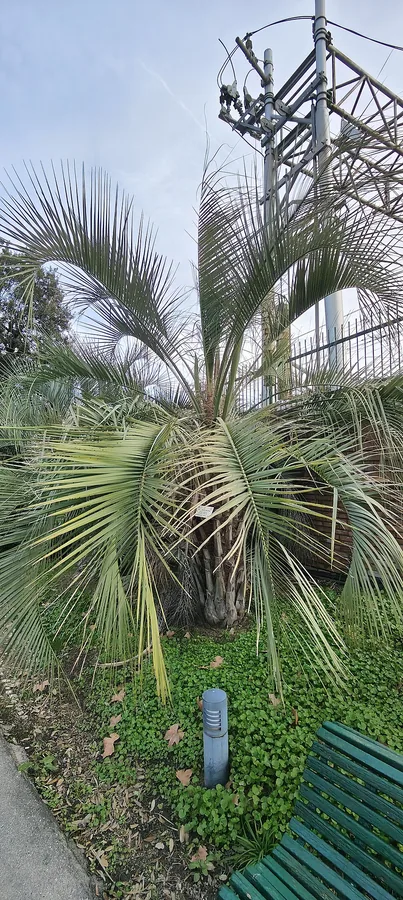
The pindo palm gives you that tropical look even in a garden that sees proper winters. It's part of the true palm family and comes from South America, growing on one thick trunk topped with arching, blue-gray to gray-green fronds that curl back down toward the ground. It's a slow grower, so it takes its time, but eventually it settles into a tough, long-lived landscape palm.
What really makes it stand out is how it handles cold. It'll shrug off temperatures down to around 10°F (-12°C), which is more than most palms can say, so it grows in spots where hardly anything else palm-like would make it. Give it full sun and ground that drains, and once those deep roots are in, it copes just fine with drought, poor soil, and a good bit of salt.
And then there's the fruit, right? Clusters of edible orange fruit ripen through summer with a sweet, tart taste, and people cook them into jelly or ferment them into a homemade wine. Those fruit are exactly why it's also called the jelly palm and the wine palm.
Care
The short version: it wants full sun and well-drained soil, regular water till it's established and a lot less after that, plus a controlled-release palm fertilizer a few times a year so it doesn't run into the nutrient deficiencies palms tend to get.
Light
Give the pindo palm full sun if you want the best, fullest crown out of it. It'll get by in partial sun or even partial shade, sure, but more light means a thicker head of fronds and stronger growth overall.
Water
Water it regularly while it's still settling in, so those deep roots have a chance to form. Once it's established, though, it's got good drought tolerance and won't need much from you. The one thing it really can't stand is wet, poorly drained soil that leaves its roots sitting in water.
Soil
This palm will take just about any well-drained soil, including sandy, dry, or alkaline ground, which is a big part of why it fits so many yards. It does grow best in moist, fertile soil with some organic matter mixed in, but honestly, good drainage matters more than how rich the soil is.
Temperature
It handles a pretty wide range, from about 10°F to 100°F (-12°C to 38°C), and that's exactly what lets it grow where most palms just can't. The cold end is its real limit, though, and a longer freeze below that can hurt the bud.
Humidity
Regular outdoor humidity is totally fine for it, so there's no magic number to hit. Where the air stays muggy and still, airflow matters way more than the humidity does, since damp, crowded fronds are what invite leaf spot.
Feeding
Feeding is the one part you really can't skip with this palm. Go with a controlled-release palm fertilizer that's got micronutrients, something like an 8-2-12 with 4% magnesium, spread out over the growing season. About three feedings a year keeps the potassium and manganese deficiencies that give palms so much trouble from setting in.
Pruning
Prune as little as you can get away with. Only take off the fully dead, all-brown fronds, and leave anything that's still green or part green alone, because cutting live fronds stresses the palm and can make a nutrient shortage worse. Old fruit and flower stalks are fine to clip off, though.
Repotting
Since it's really a landscape palm, the pindo hardly ever needs repotting. A young one in a container can get potted up every 2 to 3 years until it goes in the ground, and after that it just stays put for good.
Size & spacing
Figure on a grown palm somewhere around 15 to 35 feet (4.5 to 10.5 m) tall, with a crown spreading 10 to 15 feet (3 to 4.5 m) wide. Give it that kind of open room so the arching fronds have space and air can move through them.
When to plant
The pindo palm isn't a seasonal crop, it's a slow grower that keeps going all year. Plant it out when it's warm so the roots can settle in before the cold shows up, and then look for fragrant flowers in spring and summer, with ripe orange fruit coming along through the summer.
Northern hemisphere
Southern hemisphere
Typical months for a temperate climate: start earlier in warm zones, later where spring frosts linger.
- Harvest: Blooms spring to summer (creamy yellow, fragrant); edible orange fruit ripens in summer
Hardiness
USDA hardiness zones: 8–11
Temperature: down to -12°C
Troubleshooting
Most of what goes wrong with a pindo palm comes down to feeding, freezing, or fungus. The fronds usually give you the first heads-up, so once you learn to read them you can jump in early. Find the match below, then act while it still does some good.
Hard, shelf-like growths right down at the trunk's foot
Those hard, fan-shaped shelves down at the base? That's Ganoderma butt rot, a fungus that quietly rots the trunk from the inside. Here's the hard truth: once it's in there, no spray will fix it. The best move is to take the palm out and destroy it, roots and stump included, and then plant something that isn't a palm in that spot.
Fix:
- Remove and destroy the affected palm including as much of the stump and root as possible
- Do not replant another palm in the same location
Older fronds going yellow-orange, their tips frizzled and browning
Seeing the oldest, lowest fronds go yellow-orange? That's almost always potassium deficiency, and sometimes a magnesium shortage tags along too. Give the palm a controlled-release palm fertilizer that's got potassium, magnesium, and micronutrients in it. And don't snip off those tired fronds, because the palm's still pulling nutrients out of them to feed the new growth up top.
Fix:
- Apply a controlled-release palm fertilizer containing potassium, magnesium and micronutrients
- Do not remove the discolored fronds, as the palm translocates nutrients from them
Fronds gone brown and floppy once a hard freeze hits
After a long freeze below about 10°F (-12°C), the fronds brown out and flop, and the thing to really keep an eye on is bud rot sneaking in behind it. Give the central spear a gentle tug, and if it slides out soft, hit the bud with a fungicide to keep secondary rot from taking over. Leave any green you've still got and just let the palm grow back on its own time.
Fix:
- Leave any remaining green tissue in place and wait for new growth
- If the spear is soft, treat the bud with a fungicide to limit secondary rot
Little dark specks dotting the fronds when it's muggy out
Little dark bumps showing up on the fronds when the weather turns muggy? That's fungal leaf spot, which some folks call false smut, and it likes to settle in where humid air just sits around damp leaves. Good news is it's mostly a looks thing and won't really hurt the palm. Just give your plants some breathing room and water at the base so the fronds can stay dry.
Fix:
- Improve air circulation by proper spacing
- Avoid wetting the fronds during irrigation
Toxicity
Good news on this front: the pindo palm is safe across the board. The orange fruit is fine to eat by the handful or turn into jelly, and no part of the plant is known to hurt pets, livestock, or people. So go ahead and plant it anywhere you like without stressing about it.
Safe for
People · Cats · Dogs · Horses · Rabbits · Livestock · Birds
Cats None
There's nothing toxic on record here, and the palm isn't on any ASPCA toxic list. So if a nosy cat takes a bite of a frond, it'll be just fine.
Dogs None
Nothing in this palm is known to bother a dog. Whether it's a chewed frond or a bit of ripe fruit, both are safe if one gets swallowed.
Horses None
No documented danger to horses at all, and there's no known toxin hiding in the foliage either.
Rabbits None
It's fine to have around rabbits, since the leaves hold nothing toxic. That said, these tough fronds aren't exactly a treat they'd go for.
Livestock None
Cattle, goats, and sheep can wander and browse near it no problem, because there's nothing poisonous anywhere on the palm.
Birds None
Birds are perfectly safe around it, and wild ones will happily raid the sweet fruit once it's ripe.
People None
That orange fruit is great fresh, and it's what jelly and palm wine get made from. Everything else on the plant is harmless too.
Varieties
Pindo palms get sold under a bunch of different names, and there's a popular hybrid that makes it even more confusing. These are the two you'll want to know.
Butia odorata
Here's the thing: most of the landscape pindo palms you'll see for sale are really this hardier species, even though they spent years going by the B. capitata name.
x Butiagrus nabonnandii (mule palm)
It's a sterile cross of pindo and queen palm that grows faster than either parent but still hangs onto a lot of the pindo's cold hardiness.
How to propagate
There's basically just one way to make more pindo palms, and honestly it asks for patience more than any real skill.
SeedModerate
Sow fresh seed in the warm season · Germination takes about 3 months in warm conditions (around 95-105°F), with several years to reach landscape size.
Want more pindo palms? Seed's really your only option, because this palm grows on one trunk and never sends up pups or offsets you could split off. Sow fresh seed in the warm season, and crack that hard endocarp open first to help things along. Even so, don't expect anything quick: the seed takes about 3 months to sprout in warmth near 95°F to 105°F (35°C to 41°C), and then it's a few more years before the palm gets to any real size.
Myths
That pindo palm at the nursery is really just Butia capitata.
Not quite. Most of the palms that sold for years as B. capitata are now treated as Butia odorata, which is the hardier garden species. Real B. capitata is a rarer, more tropical plant that can't take as much cold. Both names still get thrown around like they mean the same thing, and that's why the mix-up won't go away.
Pindo palm fruit is poisonous.
Nope, the sweet orange fruit is totally safe to eat, and it's actually where the jelly palm and wine palm nicknames come from. People eat it fresh, cook it down into jelly, and even ferment it into wine. Nothing on the plant is listed as toxic.