Ornamental · Berberidaceae
Barrenwort
Epimedium grandiflorum
Tough, deer-proof, and happy in dry shade, barrenwort covers the spots where pretty much nothing else will grow.
Partial shade
Every 7–14 days
USDA 5–8
10–18 in · 25–46 cm
Overview
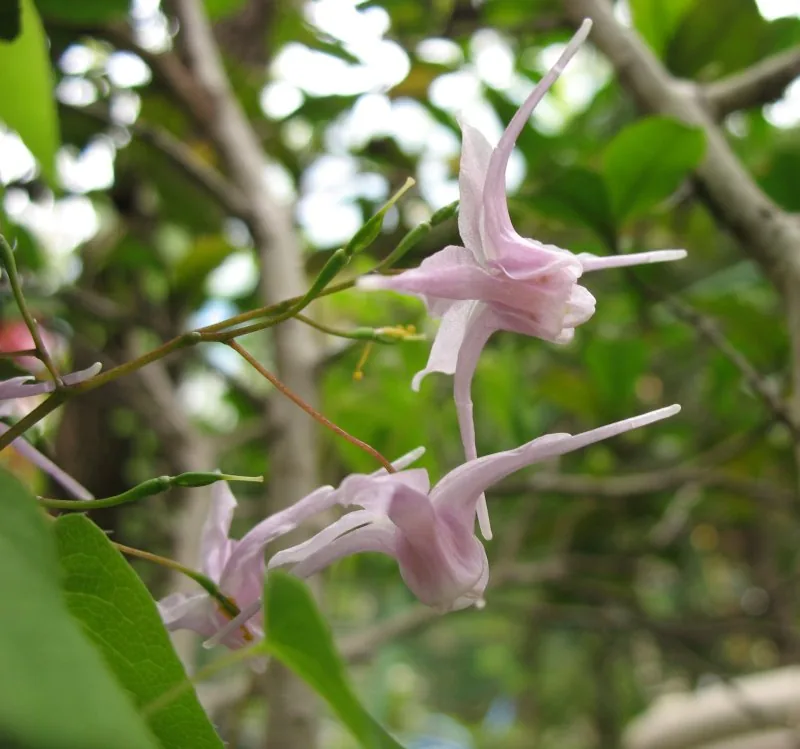
Got a shady, root-filled patch under trees and shrubs where everything else just sulks? Barrenwort is exactly what you want there. It's part of the barberry family, and it forms slow, neat clumps of wiry stems and heart-shaped leaflets. Then in spring it sends up airy little sprays of small spurred flowers, which is how it picked up names like bishop's hat and fairy wings.
The leaves, though, are the longer show. New ones often open with a red or bronze tint before they settle to green, and lots of types hang onto their foliage well into winter. Cut the tired old growth right to the ground in late winter, and the fresh spring flush comes up clean with the flowers standing clear above it.
Best part? Once it's settled in, barrenwort barely asks for anything. It shrugs off deer and rabbits, handles the dry shade under big established trees, and spreads at its own pace by rhizome into a low groundcover. Give it a couple of seasons to find its feet and it'll earn its keep for decades.
Care
The short version: pop it in part to full shade in loose, acidic, organically rich soil, keep it watered while it settles in, and split the clumps every few years so they stay vigorous.
Light
Barrenwort's happiest in part to full shade, that dappled light you get under trees or on the north side of a wall. A bit of morning sun is fine, but hot afternoon sun will scorch the leaf edges, especially if the soil's dry.
Water
While new plants are rooting in, keep them evenly moist and water every 7 to 14 days as the top half of the soil dries out. Once they're established, the rhizomes hold enough moisture to handle dry shade and short droughts, though sunnier northern spots like a bit more water in summer.
Soil
Give it loose, well-drained, organically rich loam on the acidic side, somewhere around a pH of 5.0 to 7.0. It doesn't like heavy wet ground and won't put up with alkaline soil, so mix in some compost or leaf mold before you plant.
Temperature
This is a tough, cold-hardy perennial that takes roughly -20°F to 86°F (-29°C to 30°C). It needs zero winter protection anywhere in its range; it just goes dormant or hangs onto its tattered leaves through the cold.
Humidity
Regular outdoor humidity suits it fine, and there's no number to chase. What actually matters is steady soil moisture down at the roots, not dampness in the air.
Feeding
Feed it lightly in spring as the new growth comes up, using a balanced fertilizer or a top-dressing of compost or organic matter. It's a light feeder, so once a season really is plenty.
Pruning
Cut the old or winter-beaten foliage back in late winter, right before the new growth pushes up, so the spring flowers get to show off. Other than that one yearly trim, it doesn't need any pruning.
Repotting
In the ground, lift and divide the clumps every 3 to 4 years in early spring or fall to keep them going strong. Fading flowers, weaker growth, or a crowded, congested center are your hints that it's time.
Size & spacing
Plants get to about 10 to 18 inches (25 to 46 cm) tall and spread 12 to 24 inches (30 to 61 cm) wide. Set them a foot or two apart and they'll slowly close the gaps into one continuous cover.
When to plant
Barrenwort's hardy and patient, so you've got plenty of leeway on timing. Get new plants in the ground in spring or fall while the soil's cool and moist, then keep an eye out for those delicate flowers from April into June before the leaves take over the rest of the year.
Northern hemisphere
Southern hemisphere
Typical months for a temperate climate: start earlier in warm zones, later where spring frosts linger.
- Plant: Spring or fall
- Harvest: April to June (spring)
Hardiness
USDA hardiness zones: 5–8
Temperature: down to -29°C
Troubleshooting
Honestly, barrenwort stays out of trouble most of the time, and when it doesn't, the leaves are where you'll spot it. A few pests and the odd virus cover nearly all of it. Find the match below, then jump on it before it spreads.
Why are the leaves mottled, streaked, or twisted?
Patchy yellow-green mottling like that? That's usually mosaic virus, and aphids are the ones ferrying it from plant to plant. Nothing cures it, so the badly hit clumps need digging out and binning, not composting. Keep aphids off the new growth, and whatever you do, don't take a division from a plant that's showing the pattern.
Fix:
- Remove and destroy severely infected plants since there is no cure for the virus
- Control aphid vectors to limit spread
- Avoid propagating from infected plants
What's chewing ragged holes in the leaves?
See holes and torn edges with slime trails nearby? That's slugs, and they do their munching after dark, while vine weevils leave their own tidy notches around the edges. The easy fix is to head out in the evening and pick the slugs off by hand, or ring the clumps with bait or a barrier. Clear away the damp leaf litter too, since that's the cool hideout both of them count on.
Fix:
- Hand-pick slugs in the evening
- Use slug baits or barriers around clumps
- Remove debris that shelters pests
Why have the leaf edges gone brown and crispy?
That's leaf scorch, and it shows up when a plant's stuck in hot afternoon sun, with dry soil making it worse. Notice how the clumps in real shade stay clean? That's the clue. Move the unhappy one into dappled or full shade, give it more water where it's sunny, and tuck some mulch around it to hold the moisture in.
Fix:
- Move or site plants in part to full shade
- Provide additional summer water in sunnier locations
- Mulch to conserve soil moisture
Toxicity
Good news if you've got pets or little ones running around: barrenwort is not poisonous. There's no toxin in it that'll harm cats, dogs, horses, or livestock, and the young leaves even get eaten as a cooked green. So plant it wherever you like and don't sweat a curious nibble.
Safe for
People · Cats · Dogs · Horses · Rabbits · Livestock · Birds
Cats None
Got a curious cat? No problem here, because barrenwort is safe for cats. A nibble won't poison them, since there's no toxin to bother a feline.
Dogs None
Dogs can dig and chew around it with nothing to worry about, because not a single part of the plant is poisonous to them.
Horses None
Horses are fine here too. If one grabs a mouthful while grazing, the foliage is not toxic and won't do any harm.
Rabbits None
Rabbits mostly walk right past it, and honestly that's a bonus, not a worry. It's rabbit-resistant and non-toxic, so even a stray bite is harmless.
Livestock None
Cattle, goats, and sheep grazing nearby? There's no poisoning to worry about, since the plant holds nothing that upsets them.
Birds None
Birds pecking the leaves or foraging close by are in no danger at all from this plant.
People None
People are safe around it, and here's a fun one: the young leaves are actually eaten as a cooked green once they're soaked and boiled. Just keep it as an ornamental until you know that preparation.
No special handling precautions needed for a non-toxic ornamental groundcover.
Varieties
There are hundreds of barrenwort selections out there, bred for flower color and leaf shape. A handful keep showing up in shade gardens, and those are the ones worth knowing by name.
Epimedium × rubrum
The red barrenwort puts on crimson and pale-yellow bicolor flowers over spring leaves that go red as they unfurl.
Epimedium × youngianum Niveum
Want something neat for a shady corner? This snowy barrenwort stays compact and opens pure white flowers.
Epimedium × versicolor Sulphureum
It's a vigorous spreader with soft sulphur-yellow flowers, and it usually hangs onto its leaves through mild winters.
Amber Queen
Amber Queen keeps going for a long stretch, carrying amber-yellow flowers on tall, spurred stems.
Companions
Plant near
Hosta: Shares the same part-to-full-shade, moist, organically rich woodland conditions and contrasts in foliage texture.
Ferns: Thrives in the same shaded, humus-rich sites and complements the delicate barrenwort foliage.
Hellebore: Another shade-loving, deer-resistant perennial that pairs well in woodland borders with similar care needs.
How to propagate
Barrenwort makes more of itself the easy way, just by splitting a settled clump. Lift it, divide it, replant the pieces, and one plant turns into several.
DivisionEasy
Early spring or fall · One to two growing seasons
Want more barrenwort? Just split a clump, it really is that simple. Lift an established one in early spring or fall, slice the rhizomes into pieces that each keep some healthy roots and buds, and get them back in the ground straight away. Do this every 3 to 4 years so the parent stays strong, and give each new piece one to two growing seasons to settle in before it flowers freely.
Myths
Barrenwort is poisonous to cats and dogs.
Not so, and it's easy to check: the ASPCA doesn't list barrenwort among its toxic plants, and trusted horticultural sources find no toxicity at all. It's a deer- and rabbit-resistant shade groundcover, and its young leaves even get eaten as a cooked green. Barrenwort is safe to grow around pets and children.