Houseplant · Cactaceae
Fairy Castle Cactus
Acanthocereus tetragonus
A slow, sculptural cactus that just wants bright light and very little water, and otherwise to be left alone.
Full sun
Every 14–21 days
50–86°F · 10–30°C
USDA 9–11
Overview
Ever wonder how the fairy castle cactus got its name? It comes from that cluster of upright, turret-like stems that slowly stack up over the years into a little green castle. What you're actually looking at is the monstrose form of Acanthocereus tetragonus, a mutation that people grow for its weird, branching shape, not for flowers. It's slow, it's forgiving, and it's happy on a sunny sill with hardly any fuss.
Keep in mind this is a desert plant through and through, so it tucks water away in those ribbed stems and likes long dry spells between drinks. Indoors it stays small for years, but with enough light and time it can climb well over a foot. The catch? Those clusters of sharp spines, which are really the only thing on this laid-back plant you've got to respect.
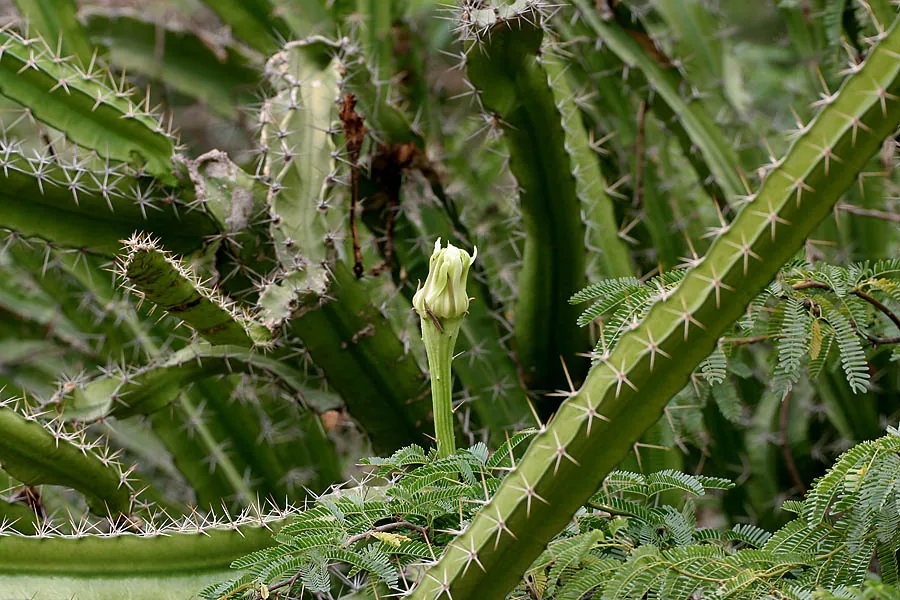
Most of the ones you'll see in shops show up with a bright flower stuck on top, and here's the thing, that bloom isn't real. The monstrose form barely ever flowers indoors, and the actual flower on the wild species is a big white one that only opens at night, so nothing's wrong if yours stays bare.
Care
The short version: give it the brightest light you've got, water it only when the soil's bone dry, pot it up in gritty fast-draining mix, and keep your hands away from the spines.
Light
Give it the brightest spot you've got, ideally a south- or west-facing window where it can grab several hours of direct sun. It'll manage in bright indirect light too, but if the light's too low, the stems start stretching pale and thin as they reach for more, so scoot it closer to the glass.
Water
Water it well, then hold off until the soil's completely dry before the next round, which usually works out to about every 2 to 3 weeks in spring and summer. In winter it barely needs anything, just enough to keep the stems from shriveling. And don't let the pot sit in water, because soggy roots are what finishes this plant off.
Soil
Pot it in a fast-draining cactus or succulent mix, like equal parts potting soil and coarse sand or grit. It's not picky about pH and does fine anywhere from 6.0 to 7.5. What really counts is that water drains straight through instead of hanging around the roots.
Temperature
Regular room warmth is perfect, anywhere from 50°F to 86°F (10°C to 30°C), so if you're comfortable, so is it. It can't take frost, though, not even a little, so keep it inside or bring it in well before those first cold nights.
Humidity
Dry air is exactly what this desert plant's after, around 20% to 40%. No need to mist it, really, and keeping the air damp just invites the rot it's already prone to, so leave it be.
Feeding
Feed it lightly during the growing season, late spring into early fall, about once a month. Go with a diluted low-nitrogen cactus fertilizer like a 5-10-5, since too much feed pushes out soft, weak growth that pests can't get enough of.
Pruning
You'll hardly ever need to prune, and when you do it's mostly just tidying up. Cut off any damaged, rotted, or unwanted segments with a clean, sharp blade, and pop on thick gloves first so you stay clear of the spines.
Repotting
Bump it into a fresh pot every 2 to 3 years, and spring is the best time, right as growth gets going. Roots sneaking out the drainage holes, a top-heavy plant, or soil that dries out way too fast all mean it's ready for more room.
Size & spacing
Indoors it grows slowly and stays small for a good while, but given time it can reach from 6 inches to nearly 6 to 71 inches (15 to 180 cm) tall and spread around 6 to 12 inches (15 to 30 cm) wide. Give it a bit of breathing room and a spot where nobody's going to brush past the spines.
Troubleshooting
Here's the good news: almost everything that goes wrong with this cactus comes down to water or light. Soft, discolored stems? That's too much water. Pale, stretched growth? That's not enough light. Find what looks familiar below and tweak it before things get worse.
Soft brown mush creeping up from the base
What you're seeing is root and stem rot, and it almost always comes from water hanging around the roots too long. Quit watering, slide the plant out of its pot, and cut off every soft, discolored bit with a clean blade. Let the healthy cuttings callus for a few days, pot them up in dry, fast-draining mix, and go easy on the water until they settle in.
Fix:
- Stop watering immediately
- Remove the plant and cut away all rotted tissue with a clean blade
- Let healthy cuttings callus for several days, then repot in dry, fast-draining mix
- Resume watering only sparingly once re-established
White fuzz or stubborn brown bumps dotting the stems
Those fluffy white tufts are mealybugs, and the hard brown bumps that won't budge are scale. Dab each one with a cotton swab dipped in 70% isopropyl alcohol, then do it again every week until they're gone. Keep it away from your other plants while you sort it out, and ease up on feeding, because that soft, overfed growth is exactly what these pests are after.
Fix:
- Dab insects with a cotton swab dipped in 70% isopropyl alcohol
- Repeat treatment weekly until no pests remain
- Isolate the plant from others while treating
Pale, leggy stems reaching for the window
That's etiolation, which is just the plant straining toward light it isn't getting enough of. Move it to a bright south- or west-facing window with several hours of direct sun, and give the pot a turn now and then so it grows evenly instead of all to one side. The stretched bits won't bounce back, but the new growth will come in tight and firm.
Fix:
- Move to a brighter spot with several hours of direct sun
- Rotate the pot regularly so growth stays even
Toxicity
Good news on the safety side, because this cactus has no poison in it at all, and the wild species even grows edible fruit, so a nibble won't hurt a pet, a kid, or a grazing animal. The thing to watch is physical, not chemical. The stems come loaded with sharp spines that go right into skin and paws, so keep it out of reach and only handle it with thick gloves.
Safe for
People · Cats · Dogs · Horses · Rabbits · Livestock · Birds
Cats Safe
There's nothing in the plant that'll poison a cat that takes a bite. The real risk is the spines, which can jab a curious nose or stick in a paw, so keep the pot somewhere a climber can't get to.
Dogs Safe
A dog won't get poisoned chewing the stems, but a mouthful of spines can prick the lips and tongue. Set the plant well out of reach of a nosy snout.
Horses Safe
No toxin here to worry a horse. A grazing muzzle could still snag the spines, though, which is plenty of reason to keep this one out of the barn and paddock.
Rabbits Safe
Rabbits aren't in any chemical danger from the plant. The sharp spines are the only thing to think about, so don't leave it where a rabbit hops around or might nibble.
Livestock Safe
Cattle, goats, and sheep can't be poisoned by it. It's the stiff spines you've got to watch, since a curious animal could wind up with one stuck in its mouth.
Birds Safe
Pet birds won't be hurt by the plant itself, and the wild species even grows edible fruit. Just keep a perching bird clear of the spines, which can scratch delicate feet and skin.
People Safe
Nothing in the plant is poisonous to handle, or, if it's the ripe wild fruit, to eat. Just mind the spines, since they puncture skin easily, and wear thick gloves any time you move or prune it.
Handle with thick gloves or a folded strip of newspaper wrapped around the stem, and remove any embedded spines from skin promptly. The danger is mechanical, not chemical.
Varieties
What gets sold under this name is really just one mutation in a couple of looks. Here are the two you're most likely to run into.
'Fairy Castle' (monstrose)
A slow-growing mutation whose bunch of irregular, turret-like stems is what gives the plant its castle shape, and it's the one you'll spot on just about every shelf, even though it hardly ever flowers indoors.
'Ming Thing'
A compact blue-green cultivar made of short, tightly packed columns that huddle together instead of stretching up.
How to propagate
Want more of these? They're easy to grow from their own pieces, though seed is another story. Take cuttings or offsets during the warm growing months, and just let them callus before they ever go near soil.
Offsets & pupsEasy
Spring to summer during active growth · 4 to 8 weeks
The easiest way? Just snap off one of the small offsets or side branches in spring or summer while it's growing. Let the cut end callus for a few days, set it in dry cactus mix, and hold off on water until it roots, which takes about 4 to 8 weeks.
Stem cuttingsEasy
Spring to summer · 4 to 8 weeks
Take a stem segment in spring or summer, with thick gloves on so the spines don't get you, and let the wound dry and callus for 1 to 2 weeks before potting so it won't rot. Stick it in dry mix and it usually roots within 4 to 8 weeks.
SeedDemanding
Warm season · Several months to over a year
Seed's honestly not worth the hassle, since the monstrose form doesn't come true from seed and just goes back to the plain species. Sow it in the warm season and it germinates and grows slowly, taking several months to over a year to turn into a usable plant.
Myths
That cheery flower sitting up top on a fairy castle cactus is the real deal.
Nope, that flower's fake. Sellers glue a dried strawflower or a dyed paper one onto the tip to help the plant sell. The monstrose 'Fairy Castle' almost never flowers indoors anyway, and the real flowers on the species are big, white, and open at night, nothing like that little colored button on the crown. Peel the fake bloom off, because it traps moisture against the stem and can kick off rot.
A fairy castle cactus is toxic to your pets and your family.
Not at all, since cacti carry no toxin and this species isn't on the ASPCA toxic plant lists. The ripe fruit on the wild form is even edible. The only real danger here is the spines, which prick skin and paws, not anything that's going to poison you.