Houseplant · Cactaceae
Moon Cactus
Gymnocalycium mihanovichii
Two cacti in one, the moon cactus shows off a bright chlorophyll-free cap that leans on the green stem below for everything.
Bright indirect
Every 14–21 days
59–86°F · 15–30°C
USDA 10–11
Overview
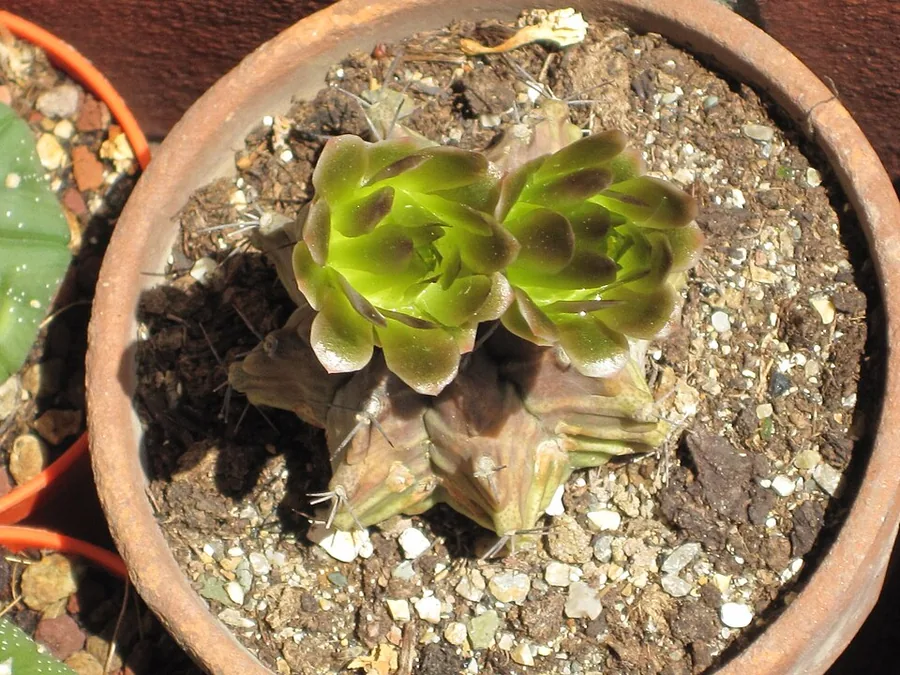
So what exactly is a moon cactus? It's a fun little houseplant that's really two different cacti grown together as one. That bright red, yellow, pink, or orange ball up top is a Gymnocalycium with no chlorophyll, which means it can't make its own food. To keep it going, growers graft that colored cap onto a green columnar rootstock, usually a Hylocereus, and the base handles turning light into food for both of them.
Because the cap's got no green tissue, it can't live on its own roots, and that one detail shapes pretty much everything. It stays little, somewhere around 4 to 12 inches (10 to 30 cm) tall, and it grows slowly. The graft union tends to weaken after a few years too, so a moon cactus is usually a short-lived novelty rather than a plant you'll hang onto for decades.
Care really boils down to two things: bright filtered light and roots that stay dry. Too much harsh sun bleaches the colorful top, and too much water rots either half of the graft. Sort those two out and the plant barely asks for anything else.
Care
The short version: bright indirect light, a gritty fast-draining mix, and water only once the soil's fully dry, because both the colored cap and the green rootstock rot the second they sit wet.
Light
Give it bright but indirect light, like a spot near a window that skips the hottest midday sun. Since the colored cap has no chlorophyll to shield itself, harsh direct sun will scorch and bleach it pretty fast, so a bit of filtering really helps.
Water
Only water once the mix has dried out all the way, which usually works out to every 14 to 21 days and even longer in winter. Never let the pot sit wet, because both the cap and the rootstock rot quickly, and if you're not sure? Just wait.
Soil
Plant it in a gritty, sharply drained cactus mix that lets water run straight through. A pH between 6.0 and 7.0 works nicely, and a pot with a drainage hole really isn't optional for a plant that rots this easily.
Temperature
Regular room warmth is perfect, anywhere from 59°F to 86°F (15°C to 30°C). Just keep it clear of cold drafts and frost, since this tropical graft won't make it through either.
Humidity
Low household humidity is exactly right, so there's no number you need to hit. Dry air actually does it a favor by keeping the cap and rootstock from staying damp.
Feeding
Only feed it through the spring and summer growing season, about once a month, with a diluted balanced or low-nitrogen cactus fertilizer. Once the cooler dormant months roll in, you can skip feeding altogether.
Pruning
There's barely any pruning to do. Take off any pups or offsets that show up on the rootstock so its energy stays with the colored cap, and trim off any shriveled or rotted tissue with a clean blade.
Repotting
Repot every 2 to 3 years into a slightly bigger pot with fresh gritty mix. You'll know it's time when roots poke out the drainage holes, the soil dries out weirdly fast, or the plant feels loose and top-heavy.
Size & spacing
It's a small, slow grower that tops out at just 4 to 12 inches (10 to 30 cm) tall and only 2 to 4 inches (5 to 10 cm) across. One small pot on a bright sill is all the room it'll ever need.
Troubleshooting
Almost every moon cactus hiccup comes back to light, water, or the graft itself. Keep an eye on the colored cap and the green base for the first clues, then find your symptom below and sort it before it spreads.
Soft, mushy base or rootstock
Soft dark tissue with a sour smell? That's root rot, and it almost always comes from a pot that stayed wet too long. Stop watering right away and cut back to firm, healthy flesh with a clean blade. Then pop it into dry, gritty mix and hold off until the soil's bone dry, because both halves of this plant rot in no time.
Fix:
- Stop watering immediately
- Cut back to firm, healthy tissue with a clean blade
- Repot into dry, gritty, fast-draining mix
Colored top loosening or pulling away from the rootstock
When the cap starts to wobble or lean, that's graft failure, and honestly it's how most moon cacti bow out. After a few years the join between the two plants dries up, goes hollow, and comes apart. If the cap still feels firm, you can re-graft it onto fresh rootstock, but here's the thing: no care routine really stops a graft from giving out with age.
Fix:
- Re-graft the colored top onto fresh rootstock if the scion is still healthy
- Accept that the plant may have reached the end of its grafted lifespan
The whole plant shriveling or refusing to grow
A wrinkled body sitting on a thin, weak base usually means underwatering or a failing rootstock that can't feed the cap anymore. Get back to a steady rhythm of letting the mix dry, then watering it well. And take a look at the graft union and green base too, because the cap runs entirely on whatever the rootstock can give it.
Fix:
- Resume a careful dry-then-water routine
- Check the graft union and rootstock health
Brown or bleached patches on the colored top
That's sunscald, and it happens because the bright cap has no chlorophyll to look after itself. Notice how the marks show up on the side catching the strongest light? That's usually a sign the plant just moved somewhere sunnier. Slide it back to bright filtered light, and if you do want a brighter window later, ease it in over a week or two instead of all at once.
Fix:
- Move to bright indirect light away from intense midday sun
- Acclimate gradually to any brighter spot
Toxicity
Good news if you've got pets or kids at home: the moon cactus has no known toxins, and cacti in general don't turn up on the ASPCA's poison lists. The only thing to watch is the small spines, which can prick a nose, paw, or finger, so just keep it somewhere out of easy reach.
Safe for
People · Cats · Dogs · Horses · Rabbits · Livestock · Birds
Cats None
If a cat sneaks a nibble, there's no poison in here to worry about. The one catch is the spines, which can prick a curious nose or paw.
Dogs None
A dog's totally fine around this one, and a bite won't bring any toxin with it. The only real snag is a mouthful of spines, which just leaves a sore mouth rather than poisoning.
Horses Safe
There's nothing here that'll poison a horse. It's really just the stiff spines to think about, since they can jab a soft muzzle.
Rabbits Safe
Nothing in the plant is going to make a rabbit sick. Even so, keep it out of reach, because those spines can hurt a small animal that likes to chew.
Livestock Safe
Cattle, goats, and sheep won't run into any chemical danger from this cactus. It's the prickly spines that could cause trouble, usually just a poke to the mouth.
Birds Safe
There's no toxin here that would bother a pet bird. A bird could catch a spine if it lands on it, though, so where you put it matters more than any poison.
People Safe
Nothing here is toxic to people, kids included. The spines can scratch or splinter skin, so handle it with care and keep it somewhere small hands can't grab.
Spines can prick skin, so handle with care and keep out of easy reach of curious pets.
Varieties
Moon cacti get sold by the color of the grafted cap rather than by real cultivar names, so picking one is basically choosing a shade you like. Here are the ones you'll bump into most.
Red Hibotan
This is the classic bright red cap, and it's easily the most common moon cactus you'll find for sale.
Yellow/orange Hibotan
Same plant, just with its chlorophyll-free top in a yellow to orange shade instead of red, and it grows exactly the same.
Pink moon cactus
This one's got a pink-toned cap, picked purely for the fun color and not for anything different in how it grows.
How to propagate
You can't grow a moon cactus from seed or root it like a normal plant, since its colored top has no chlorophyll. Both ways of making more come down to grafting onto a green rootstock.
GraftingModerate
Warm active growing season in spring or summer · A few weeks for the graft union to fuse
Ever wonder how a moon cactus gets made? It's all about grafting. During the warm growing season in spring or summer, the colored cap gets joined onto a green columnar rootstock like Hylocereus, and the union takes a few weeks to knit together. Since the cap has no chlorophyll, this is the only way it can survive, because it can't grow on its own roots.
Offsets & pupsModerate
Spring to summer · Several weeks once grafted onto rootstock
Sometimes colored pups pop up on the scion, and you can take them off in spring or summer to grow new plants. They can't root on their own since they can't photosynthesize, so each pup gets grafted onto fresh rootstock, where it settles in over several weeks.
Myths
The moon cactus is a single naturally colorful cactus.
It's actually two plants stuck together, a colorful chlorophyll-free Gymnocalycium cap grafted onto a separate green rootstock. That bright cap can't survive on its own, because it hasn't got any green tissue to feed itself, so it leans completely on the plant underneath.