Tree · Theaceae
Franklin Tree
Franklinia alatamaha
Check this out: a tree that vanished from the wild way back in the early 1800s still gives you late-summer flowers and blazing autumn color.
Full sun
Every 3–7 days
USDA 5–8
10–25 ft · 3–7.6 m
Overview
The Franklin tree is one of the true rarities in American gardens, a small flowering tree in the tea family that no longer grows anywhere in the wild. John and William Bartram came across it beside Georgia's Altamaha River in the 1760s and brought seed back with them, and that one collection is where every Franklinia now living comes from. By the early 1800s, the wild population had disappeared entirely.
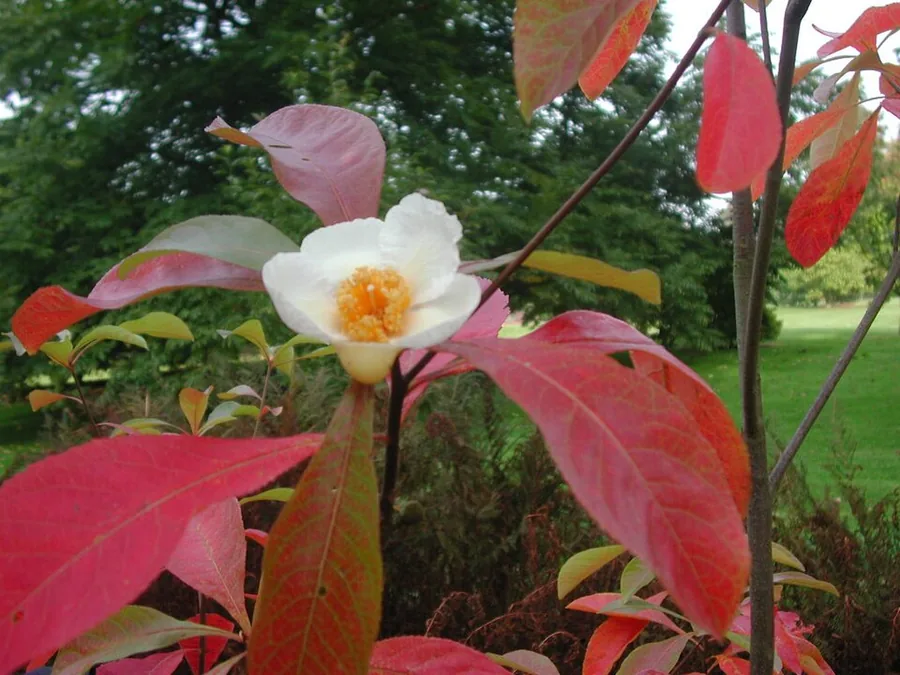
So why grow it? For the show it puts on late in the year. Cup-shaped white flowers, each with a knot of gold stamens, open from late summer into early fall, and they often arrive while the leaves are already shifting to deep red and orange. The tree keeps to a modest size, topping out around 10 to 25 feet (3 to 7.6 m) as a slow-growing single trunk or a multi-stemmed small tree.
None of that means it's easy, though. The Franklin tree is demanding to grow, picky about drainage, and quick to die of root rot when it's in the wrong spot. Set it in cool, moist, sharply drained acidic soil, keep it away from clay and heat, and you've got a shot at one of the most unusual trees you can own.
Care
The short version: full sun to part shade in rich, acidic, sharply drained soil that never stays soggy. Keep the soil evenly moist, protect the tree from heat, drought, and clay, and above all watch out for root rot.
Light
Give the Franklin tree full sun to partial shade. Good light brings out the best flowering and color, but a bit of shade during the hottest stretch of the day helps it get by where summers turn warm.
Water
Here's the whole knack with this tree: keep the soil consistently moist but never waterlogged. It can't cope with drought or with wet feet, so water it through dry spells while making sure the ground drains freely. Let the soil turn sodden and you're inviting the root rot that finishes off most Franklin trees.
Soil
Plant it in organically rich, well-drained, acidic sandy loam at a pH of 4.5 to 6.0. Sharp drainage counts just as much as fertility here, so mix in plenty of organic matter and stay well away from heavy clay.
Temperature
This tree handles a broad range, roughly -20°F to 95°F (-29°C to 35°C), which lines up with USDA zones 5 through 8. It doesn't like drawn-out heat, so it really shines toward the cooler end of that span.
Humidity
Everyday outdoor humidity suits it just fine, with no target number to hit. What matters far more is good drainage and air movement, not moisture in the air.
Feeding
Feed it in spring using an acidic, slow-release fertilizer meant for acid-loving plants. A single seasonal feeding does the job, and matching the fertilizer to the tree's taste for acid soil keeps it ticking along nicely.
Pruning
The Franklin tree wants very little pruning. Cut away dead, damaged, or crossing branches in late winter, and that's also the time to shape it if you're training it as a single-trunk tree.
Repotting
A tree in the ground never needs repotting, and even a container plant gets moved up only rarely. Roots winding around the pot, roots poking out the drainage holes, or water rushing straight through are your signs that a potted tree has finally run out of room.
Size & spacing
Plan on a mature height of 10 to 25 feet (3 to 7.6 m) and a spread of 6 to 15 feet (1.8 to 4.6 m). Give it space to stand alone as a specimen, where its late flowers and fall color can grab all the attention they deserve.
When to plant
The Franklin tree keeps a slow, cool-climate rhythm. Sow seed in late winter to early spring once it's had its cold stratification, put young trees out in spring after the last frost or in early fall, and expect flowers from late summer right through the first frost.
Northern hemisphere
Southern hemisphere
Typical months for a temperate climate: start earlier in warm zones, later where spring frosts linger.
- Sow: late winter to early spring after cold stratification
- Plant: spring after last frost or early fall
- Harvest: late summer to early fall (July to first frost)
Hardiness
USDA hardiness zones: 5–8
Temperature: down to -29°C
Troubleshooting
Nearly every Franklin tree that fails comes down to the roots and the water sitting around them. It pays to tell rot apart from wilt and from plain drought, because each one needs a different fix. Find what you're seeing below and move on it early, since this tree doesn't give you much room to wait.
Quick droop and dieback when roots turn dark and mushy
If a Franklin tree wilts fast, yellows, and drops branches, you're most likely looking at Phytophthora root rot, which is what kills more of these trees than anything else. It settles into soggy, packed, or clay ground that keeps water pooling around the roots, and digging down shows dark, mushy roots and a stained stem base. A tree that's already far gone can't be rescued, so fix the drainage right away, shift any survivors onto a raised mound of freely draining acidic soil, and remove and destroy the worst ones before the rot travels.
Fix:
- Improve drainage immediately and stop overwatering
- Plant or transplant into a raised bed or mound of well-drained, organically rich acidic soil
- Remove and destroy severely affected plants to limit spread
Branches wilting even when the ground drains just fine
What if the tree wilts but the soil drains well and stays nicely moist? Then think wilt disease, which really goes after this species, or just drought stress, since a Franklin tree can't handle dry ground at all. Prune out the affected branches and bin them, and hold the soil evenly damp without ever letting it turn wet. Your best protection is a cool, moist, well-drained acidic home where the tree steers clear of heat, drought, and pollution.
Fix:
- Remove and dispose of affected branches
- Maintain even soil moisture without waterlogging
- Avoid stressing the plant with drought, heat, or transplanting
Leaves gone ragged and chewed right down to the veins
Torn-up, lacy leaves through the growing season usually point to sawfly larvae chewing away. If the tree is small, you can just pluck them off or blast them loose with a hard stream of water. Hold the insecticide in reserve for a bad outbreak, and keep an eye on the foliage so you spot the larvae as soon as they turn up.
Fix:
- Hand-pick larvae from small trees
- Use a strong spray of water to dislodge larvae
- Treat with an appropriate insecticide only if infestation is heavy
Toxicity
Here's the good news if you've got animals around: the Franklin tree is not toxic. It doesn't turn up on the lists of plants that poison cats or dogs, and that clean bill of health carries over to the other animals in a garden too. A pet that chews a leaf might get a quick stomach upset from the roughage, but that's about it.
Safe for
People · Cats · Dogs · Horses · Rabbits · Livestock · Birds
Cats Safe
There aren't any known toxins in a Franklin tree, so a nosy cat that tastes a leaf is perfectly fine. Wolf down a big helping of any non-food plant and you might see a bit of drooling or a passing tummy grumble that sorts itself out.
Dogs Safe
A dog can gnaw the leaves without any trouble, because the tree doesn't appear on the lists of plants that poison them. If one really overdoes it, the worst you'll usually see is some mild vomiting that settles quickly.
Horses Safe
The leaves, bark, and flowers hold nothing that's toxic to horses, so a nibble while grazing won't do any harm.
Rabbits Safe
It's safe for rabbits to browse the leaves. Like any fresh green, start them on just a little so their stomach has time to get used to it.
Livestock Safe
Cattle, goats, and sheep won't be poisoned by this tree, and a random mouthful out in the pasture won't bother them either.
Birds Safe
There's no chemical danger to birds here, whether they roost in the branches or peck at the seed capsules.
People Safe
None of the Franklin tree is poisonous to people. That said, it isn't a food plant, so there's really no point in eating any of it.
No special handling precautions are required for pets, though ingestion of any non-food plant can cause mild stomach upset.
Varieties
There aren't any garden cultivars of the species itself, but one hybrid and a handful of close relatives in the tea family are worth getting to know.
x Gordlinia grandiflora (Mountain Gordlinia)
This semi-evergreen hybrid came out of NC State in 2002, where Franklinia was crossed with Gordonia, and it outpaces both parents in growth while opening bigger blooms up to 5 inches (13 cm) wide.
Gordonia lasianthus (Loblolly Bay)
This is a closely related evergreen from the same tea family, and its toughness is exactly what it passed along as a parent of the Gordlinia hybrid.
Schima and Stewartia relatives
Schima and Stewartia are the Franklin tree's other close cousins in the tea family (Theaceae), with Schima, Gordonia, and Franklinia all sitting together in the tribe Gordonieae.
How to propagate
Making more Franklin trees calls for patience and a thick skin about failure. Seed is the dependable path, while cuttings are a real gamble that's only worth a try if you've got plants to spare.
SeedModerate
Sow in late winter to spring after cold stratification · Several years to reach flowering size
Seed is the tried-and-true way to grow a Franklin tree, taken from the woody capsules the same way every cultivated plant descends from the Bartrams' first collection. Chill the seed through a stretch of cold stratification, then sow it anywhere from late winter into spring. And you'll need patience here, since a seedling wants several years before it's big enough to flower.
Stem cuttingsDemanding
Softwood cuttings in summer · Slow and challenging to root
Softwood cuttings taken in summer are another option, though don't expect much to take. They root slowly and stubbornly, and this tree is a headache to get going by any route, so figure on losing plenty before one actually roots.
Myths
You can still spot Franklin trees growing wild by the Altamaha River in Georgia.
Not anymore. The tree vanished from the wild back in the early 1800s, and search after search has never come up with even one wild plant. Every Franklin tree living today goes back to seed the Bartrams gathered before the species disappeared from the one place it ever grew.
Something this rare and celebrated has got to be a breeze to grow at home.
Being rare tells you nothing about how easygoing a plant is, and this one has a reputation for being tough to keep. It drops fast to root rot and simply won't tolerate clay, wet feet, drought, heat, or pollution. Hand it cool, moist, sharply drained acidic soil, or plan on losing it.