Shrub · Theaceae
Tea
Camellia sinensis
Give it acidic soil, dappled shade, and steady moisture, and this easygoing evergreen shrub grows the leaves that end up in your teapot.
Partial shade
Every 5–10 days
USDA 7–9
3–7 ft · 0.9–2 m
Overview
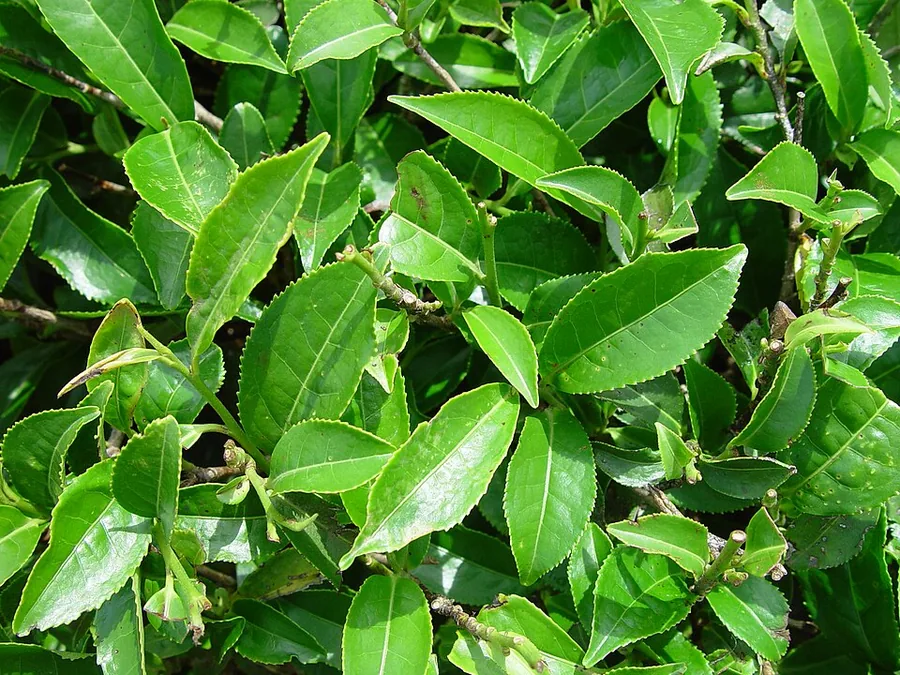
Here's a fun one: every cup of tea, green or black or oolong, comes from the same evergreen shrub, Camellia sinensis. It's a close relative of the garden camellia, so it wants the same things they do, mainly acidic soil and dappled shade. Leave it be and it'll shoot up past head height, but most folks just keep it clipped to a low, leafy hedge.
Tea likes to take its time, and that's fine. The new growth shows up as little flushes of a bud and the top two leaves, and those soft tips are the part you pick. Then in fall you get a bonus you didn't sign up for: fragrant white flowers on a plant you're really growing for its leaves.
Worried it's too tender for your winters? Probably not. The China type handles light frost once it's settled and does fine outdoors in USDA zones 7 to 9, and if your winters are harsher you can just grow it in a pot and move it inside. Get the soil acidic and the drainage sorted, and the rest is mostly just waiting it out.
Care
The short version: part shade, acidic well-drained soil kept evenly moist, a seasonal acid feed, and a late-winter trim so it stays easy to pick from.
Light
Tea's happiest in part shade, that soft dappled light you get under bigger trees. It'll take more sun where things are cooler, and even full sun if the roots stay moist, but a hot afternoon blast in a warm climate? That'll scorch the leaves.
Water
Keep the root zone evenly moist but never waterlogged, which usually works out to a drink every 5 to 10 days, and a bit more when it's dry or the plant's pushing new leaves. A little mulch helps keep that moisture around. Just don't let it sit in soggy ground, because that's how you end up with root rot.
Soil
This one's a real acid lover, and it does best in well-drained, organic-rich loam sitting around a pH of 4.5 to 6.5. Mix in a good amount of organic matter, and stay away from any spot where water tends to puddle.
Temperature
Once it's established, tea's pretty easygoing about temperature, somewhere around 5°F to 86°F (-15°C to 30°C). The China type takes light frost without much fuss, but a hard freeze will nip the tender new growth, so tuck young plants somewhere sheltered or move pots under cover when it gets really cold.
Humidity
Average humidity of 40% to 60% is plenty, and that's about what most temperate gardens run anyway. Outside there's nothing to measure, but a plant kept indoors will appreciate a bit more moisture in the air.
Feeding
Feed it seasonally from spring through summer while it's actively growing, and reach for an acidic azalea or camellia fertilizer. That keeps the soil nice and acidic like the roots want, and it helps fuel the leaf flushes you'll be picking.
Pruning
A trim in late winter to early spring keeps it at a handy hedge of around 90 to 120 cm. And here's the neat part: pinching back the young flushes as they come shapes the plant and hands you the exact leaves that become tea, all in one go.
Repotting
A potted tea wants bumping up every 2 to 3 years, or sooner if you spot roots circling the pot, sneaking out the drainage holes, or water zipping straight through. If growth stalls out, that's your cue too, so give it fresh acidic mix and a bigger pot.
Size & spacing
As a hedge it gets to about 3 to 6.5 feet (90 to 200 cm) tall and nearly as wide, with a spread of 3 to 5 feet (90 to 150 cm). Give each one that much room so air can get around it and pruning doesn't turn into a chore.
When to plant
There's no tight window to stress about here, since tea moves at its own slow pace. Start seed or cuttings in late winter, put young plants outside in spring once the frost's gone, and pick the young leaf flushes from spring through summer. The white flowers turn up in fall.
Northern hemisphere
Southern hemisphere
Typical months for a temperate climate: start earlier in warm zones, later where spring frosts linger.
- Sow: late winter in a warm propagator
- Plant: spring after the last frost
- Harvest: Fragrant white flowers in fall; harvest young leaf flushes (bud and top two leaves) from spring through summer.
Hardiness
USDA hardiness zones: 7–9
Temperature: down to -18°C
Troubleshooting
Good news: most tea hiccups come down to just two things, soil that's drifted out of the acidic range or ground that's stayed too wet, with scale insects a distant third. The leaves and roots usually tell you which one it is. Find your symptom below and deal with it early, before it gets around.
Wilting and dieback where the soil stays wet
When the ground never drains and the roots are basically sitting in water, that's root rot, and you'll often see the plant sag even more after a heavy rain. Dig around and check for dark, mushy roots to be sure. If it's too far gone there's no bringing it back, so pull it, fix the drainage, and replant somewhere the water actually moves through.
Fix:
- Improve drainage and stop overwatering
- Remove and discard severely affected plants
- Replant in raised or amended well-drained beds
Yellow leaves, but the veins stay green
That's interveinal chlorosis, and it basically means the soil's gone too alkaline for the plant to grab the iron and manganese it needs. Bring the pH back down with elemental sulfur or an acidifying feed, then mulch with pine bark or pine needles to keep it there. A shot of chelated iron greens up the new leaves fast while the soil sorts itself out.
Fix:
- Lower soil pH with elemental sulfur or an acidifying fertilizer
- Apply chelated iron for quick correction
- Mulch with pine bark or pine needles
Sticky leaves, black film, little bumps underneath
That's tea scale and its cousins, which park on the undersides of the leaves and drip honeydew, and the honeydew is what turns black with sooty mold. Flip a few leaves and look for tiny white or brown bumps near the stem. Hit it with horticultural oil at the label rate, cut out the worst branches, and let the good bugs handle the stragglers.
Fix:
- Treat with horticultural oil following label rates
- Prune out heavily infested branches
- Encourage natural predators
Toxicity
The leaves are totally fine for people, they're the whole reason this plant is grown, but they've got the same caffeine and theobromine that's in your mug. That stuff doesn't sit well with animals, so keep cats, dogs, horses, and the rest away from the leaves. And be even more careful with brewed tea, dried leaves, and old grounds, since those are a lot stronger.
Toxic to
Cats · Dogs · Horses · Rabbits · Livestock · Birds
Safe for
People
Cats Caution
Those leaves pack the same caffeine and theobromine as your cup, and cats are pretty sensitive to both. A quick nibble might not do much, but any more than that can bring on vomiting, restlessness, a racing heart, and tremors.
Dogs Caution
If a dog chews the leaves, it's taking in caffeine and theobromine, the same stuff that makes chocolate a no-go. After a bigger mouthful, keep an eye out for vomiting, hyperactivity, a fast heartbeat, and the shakes.
Horses Caution
Horses don't do well with caffeine, so it's best to keep them clear of the hedge. A graze on the leaves can leave one jittery, with a racing pulse and muscle tremors.
Rabbits Caution
Those same methylxanthines that get to cats and dogs get to rabbits too, and a little critter doesn't need much to feel it. Better to keep the plant out of reach than risk a racing heart or the jitters.
Livestock Caution
Cattle, goats, and sheep really shouldn't be nibbling tea, since the caffeine can upset their stomachs and get their hearts racing. A fence around the shrubs keeps grazers out of trouble.
Birds Caution
Birds are especially touchy about caffeine, and even a little bit of leaf can be too much for a small body. Keep pet birds away from the plant and any tea that's been left lying around.
People Leaves safe
This is the very plant behind your morning cup, and the leaves get picked, processed, and brewed no problem. For people the caffeine's the whole point, not something to worry about.
Keep brewed tea, dried tea leaves, and used grounds well out of reach of pets, as these are the most concentrated and dangerous forms.
Helpline numbers

United States
ASPCA Animal Poison Control: (888) 426-4435 (fee applies)

United Kingdom
Animal PoisonLine: 01202 509000 (fee applies)

Australia
Animal Poisons Helpline: 1300 869 738
Varieties
Nearly all tea traces back to just two varieties of this one species, plus a handful of selections bred to take the cold. These are the ones worth knowing about.
var. sinensis
The China type is the tougher one, with smaller leaves and a real knack for cooler climates, and it gives you both green and black teas.
var. assamica
The Assam type has big leaves, comes from warm tropical places, and mostly ends up as black tea.
'Sochi'
'Sochi' is a cold-hardy Russian pick, and it's the one to grab if you're after tea in a temperate garden.
Companions
Tea grows best among the other acid-loving shrubs that want the same soil and the same dappled light.
Plant near
Azalea: Shares the same acidic, well-drained soil and part-shade preferences.
Camellia japonica: Same Theaceae cultural needs for acidic soil and dappled shade.
Rhododendron: Acid-loving understory shrub with matching light and moisture requirements.
How to propagate
Want more plants? You can go with cuttings or seed, though neither is quick. Both take a few years to get to a size you can actually harvest, and cuttings give you something more predictable to work with.
Stem cuttingsModerate
Late summer from semi-hardwood growth · Several months to root, then 2-3 years to harvestable size
Cuttings are the safe bet. Take semi-hardwood pieces in late summer, dip the ends in rooting hormone, and keep them somewhere warm and humid. They'll take a few months to root, and then the young plant needs 2 to 3 years before it's big enough to pick from.
SeedModerate
Sow fresh seed in late winter to spring · Germinates in weeks; plants take about 3 years before leaf harvest
Seed works too, but you never quite know what you'll get. Soak fresh seed and sow it from late winter into spring, and it'll come up within weeks. Since seedlings all turn out a little different, most people stick with cuttings for matching clones, and either way you're looking at about 3 years before your first leaf harvest.
Myths
Green tea and black tea come from different plants.
Nope, they both come off the same shrub, Camellia sinensis. It's all down to the processing, with black tea fully oxidized and green tea barely oxidized at all.
The tea plant is strictly tropical and cannot survive frost.
Not really. Tea's an evergreen shrub that's hardy to about USDA zone 7, and it shrugs off light frost once it's settled in. Sure, the Assam type likes it warm, but the China type and picks like 'Sochi' do just fine in a temperate garden.