Ornamental · Geraniaceae
Rozanne Cranesbill
Geranium 'Rozanne'
One of the longest-blooming perennials around, and it barely asks for a thing in return.
Full sun
Every 5–10 days
USDA 5–8
12–18 in · 30–46 cm
Overview
Looking for a border plant that just works? Hardy geranium 'Rozanne' is a great shout. It's one of the true cranesbills, named for those slim beak-shaped seed pods that show up after the flowers, and it's not the same thing as the tender scented Pelargonium that people also call geranium. This one's a cold-hardy perennial, so it comes back on its own every year through zones 5 to 8.
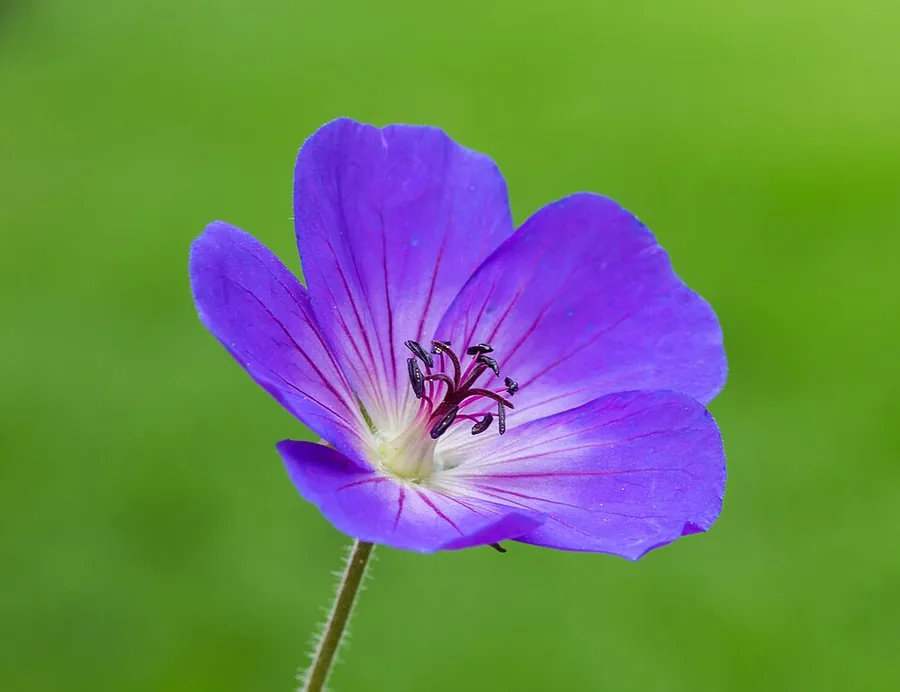
The real draw here is the flowers. From late spring all the way to fall, it keeps putting out violet-blue blooms with pale white centers, often with hardly a pause, spilling across a low mound that weaves through the bed and covers up bare ground. That kind of showing is exactly why it picked up Perennial Plant of the Year back in 2008.
And it's tough, too. It shrugs off heat better than most cranesbills, and deer and rabbits usually walk on by. Give it some sun, soil that drains, and one midseason trim, and 'Rozanne' hands you months of color for barely any effort.
Care
The short version: pop it in full sun to part shade in average, well-drained soil, water it during dry spells, and shear it back after the first flush to keep the flowers coming into fall.
Light
'Rozanne' flowers best in full sun, but it's happy enough in partial shade and partial sun too. In hot areas, a bit of afternoon shade actually does it a favor, taking the edge off the heat stress that can make it flag come midsummer.
Water
Aim for average, medium moisture and let the top inch or so of soil dry out between drinks, which works out to about every 5 to 10 days. Once it's established it can take a bit of drought, but don't let it go bone-dry, and be sure to water through dry spells so the flowers keep coming.
Soil
It's not picky at all and grows in loam, clay, or sand, as long as the ground drains well. It does its best in moist, organic-rich soil, though, so work in a little compost if you can. As for pH? It doesn't really care.
Temperature
This is one tough perennial, handling winters down to -20°F (-29°C) and summer heat up to around 90°F (32°C). That's exactly the range that lets it do well across zones 5 to 8 without any special fuss.
Humidity
Regular outdoor humidity suits it just fine, so there's no number to chase here. Airflow matters way more than humidity, because still, damp air around crowded leaves is what brings on leaf spot and rust.
Feeding
It's a light feeder, so keep it easy. Work some compost or organic matter into the soil as the season kicks off, or give it a balanced general-purpose feed in spring, and that'll see it through. No need to keep feeding all summer.
Pruning
This is the one job that really pays off. Once that first flush of flowers fades, cut the whole plant back hard to neaten it up and kick off a fresh late-summer or early-fall rebloom. Any stray side stems? Snip them whenever to keep the spread under control.
Repotting
Plants in the ground hardly ever need lifting and just divide on their own schedule. In a container, though, repot when you spot roots circling the pot, flowering dropping off, or the soil drying out way faster than usual.
Size & spacing
Expect a low mound about 12 to 18 inches (30 to 46 cm) tall that spreads out 12 to 24 inches (30 to 61 cm) wide. Space plants toward the wider end of that so air moves freely and the leaves stay clean.
When to plant
There's no frost clock to beat with 'Rozanne', since it's a hardy perennial and the whole game is just getting it settled in. Set new plants out in spring once the last frost's gone, or in early fall while the soil's still warm, and you'll get flowers from late spring right through to early autumn.
Northern hemisphere
Southern hemisphere
Typical months for a temperate climate: start earlier in warm zones, later where spring frosts linger.
- Plant: Spring after the last frost, or early fall
- Harvest: Late spring (May) through summer to early fall, often nearly continuous
Hardiness
USDA hardiness zones: 5–8
Temperature: down to -29°C
Troubleshooting
Here's the thing about 'Rozanne': it's famously easy, and the little trouble it does run into mostly shows on the leaves when things get wet and crowded. Learn the handful of signs below and you can jump in early, while the fix is still simple. Good airflow and watering at the base take care of nearly all of it.
The whole plant flopping over even though the soil is wet
Now this one's more serious. If a clump collapses in hot weather while the soil is still plenty moist, it's probably southern bacterial wilt, which loves warm, soggy ground and can't be cured. The only thing to do is dig the plant up, get rid of it, and skip planting another susceptible perennial there. But here's the reassuring part: in hot spots, a little afternoon shade and soil that drains well keep the plant well out of harm's way.
Fix:
- Remove and destroy affected plants
- Avoid replanting susceptible species in the same soil
- Reduce afternoon heat stress by providing some afternoon shade in hot climates
Brown or tan spots turning up on the leaves
Seeing spots? That's just fungal leaf spot, and it usually shows up when wet weather or overhead watering keeps the leaves damp. Pick off the marked leaves, give the clump a bit more room so air can move through, and start watering down at the soil. It won't do any real damage, and the plant gets over it once things dry out.
Fix:
- Remove and discard affected leaves
- Improve air circulation by thinning or spacing plants
- Water at the base rather than overhead
Rusty orange bumps hiding under the leaves
Turn a leaf over and those little raised orange bumps are rust fungus, which spreads quickest when the foliage is crowded and damp. Just pull off the leaves that have it and toss them, open the plant up so air can get around, and try to keep water off the leaves. The good news? It's only skin deep, so the clump keeps right on blooming.
Fix:
- Remove and destroy infected foliage
- Increase spacing and air circulation
- Avoid overhead irrigation
Toxicity
Good news if you've got pets: true hardy geranium is safe. The cranesbills don't carry any toxin that's dangerous to cats, dogs, horses, or other animals, and there's no poison rating for people either. The only one to keep an eye out for is the unrelated scented Pelargonium, which sometimes gets sold under the same common name.
Safe for
People · Cats · Dogs · Horses · Rabbits · Livestock · Birds
Cats None
Got a cat? No problem, because true hardy geranium is safe for cats. One that chews a leaf or flower isn't going to get poisoned, though a really big mouthful of any plant might leave it a little queasy for a bit.
Dogs None
Dogs are totally fine around cranesbill too. There's no toxin in it, so if yours chews on a stem or bloom, the worst you'll see is the mild tummy grumble that any plant can cause.
Horses None
Horses can graze right nearby without any trouble, since the plant has nothing in it that would hurt them. And honestly, grazers usually walk past the aromatic leaves anyway.
Rabbits None
Rabbits won't be poisoned either, and here's a bonus: it's one of the plants they tend to leave alone. So if bunnies wander through the garden, this is a pretty smart thing to plant.
Livestock None
Cattle, goats, and sheep are in the clear with true geranium. There's nothing in it that bothers farm animals, so a chewed-up clump just means you lost a plant, not that anyone got sick.
Birds None
Backyard and pet birds are safe around it as well. The leaves and flowers don't hold any toxin, so a peck or two won't do a thing.
People None
For people, kids included, true cranesbill has no poison rating at all. It's smart to wash your hands after handling any plant, sure, but there's nothing specific to worry about with this one.
Wash hands after handling as a general gardening practice; no specific toxicity hazard is reported for true Geranium.
Varieties
'Rozanne' is the headliner, but a couple of close relatives are worth a look if you'd rather have a lighter shade or a different flower color.
Geranium 'Rozanne' (syn. 'Gerwat')
This is the patented sterile hybrid everyone's after, a clump-former that just keeps cranking out violet-blue, white-centered flowers from late spring to fall and takes summer heat in stride, which is how it landed Perennial Plant of the Year in 2008.
Geranium 'Azure Rush'
Want something softer? This sport of 'Rozanne' blooms just as long but shows off paler, lighter blue flowers on a neater, more compact mound.
Geranium sanguineum (Bloody Cranesbill)
This one's a true cranesbill species instead of a hybrid, grown for its bright magenta-pink flowers and often planted right next to 'Rozanne' so you can compare them.
Companions
'Rozanne' shines as a long-blooming groundcover at the feet of taller plants, weaving between shrubs and upright perennials that enjoy the same sun and average moisture.
Plant near
Roses: Mounding hardy geranium foliage covers bare lower rose stems and provides a long-blooming groundcover at the base.
Ornamental grasses: Contrasting upright form pairs well with the sprawling mound and extends seasonal interest in borders.
Daylilies and other clumping perennials: Similar culture (full sun to part shade, average moisture) and complementary bloom times in mixed borders.
How to propagate
Since 'Rozanne' is a sterile hybrid, seed just isn't going to happen. Every new plant comes from dividing a clump you've already got or rooting a cutting, and both copy the parent exactly.
DivisionEasy
Spring or early fall · One growing season
Dividing is the easiest and surest way to get more of this sterile hybrid. Just lift a mature clump in spring or early fall, pull it apart into pieces that each keep some healthy roots, and pop them back in the ground right away. Each division settles in and fills out over a single growing season, and that's really all there is to it.
Stem cuttingsModerate
Spring to early summer · Several weeks to a few months to root and establish
You can also root basal or softwood cuttings taken from spring through early summer, though it does take a bit more patience than dividing does. Give them several weeks to a few months to root and get going. And seed? That's off the table here, since the plant is sterile.
Myths
Hardy geranium 'Rozanne' is toxic to cats and dogs.
It all comes down to a mixed-up name. The 'Geranium' sitting on the ASPCA toxic list is actually Pelargonium, the tender scented bedding plant, and that's a whole different genus. True hardy Geranium, the cranesbill, including 'Rozanne', isn't listed as toxic to pets, so it's fine to grow around your animals.
You can grow more 'Rozanne' from its own seeds.
Tempting, but no. 'Rozanne' is a sterile hybrid that sets little or no viable seed, and whatever it does drop won't come out looking like the parent. The dependable way to make more is to propagate it vegetatively, so you're either dividing a clump or rooting basal cuttings.