Houseplant · Aizoaceae
Lithops
Lithops
Tiny living stones that get by on almost no water, and give you grief the moment you overdo it.
Full sun
41–77°F · 5–25°C
USDA 10–11
1–2 in · 2–4 cm
Overview
Ever seen two little pebbles wedged in a pot and done a double take? That's a lithops, and the pebble look is exactly the disguise it evolved out on the dry grasslands of southern Africa. Each plant is really just two fused, water-filled leaves with a little window on top that lets light down inside. They stay tiny their whole lives, hardly ever more than 2 inches (5 cm) across, and if you mostly leave them alone they'll stick around for decades.
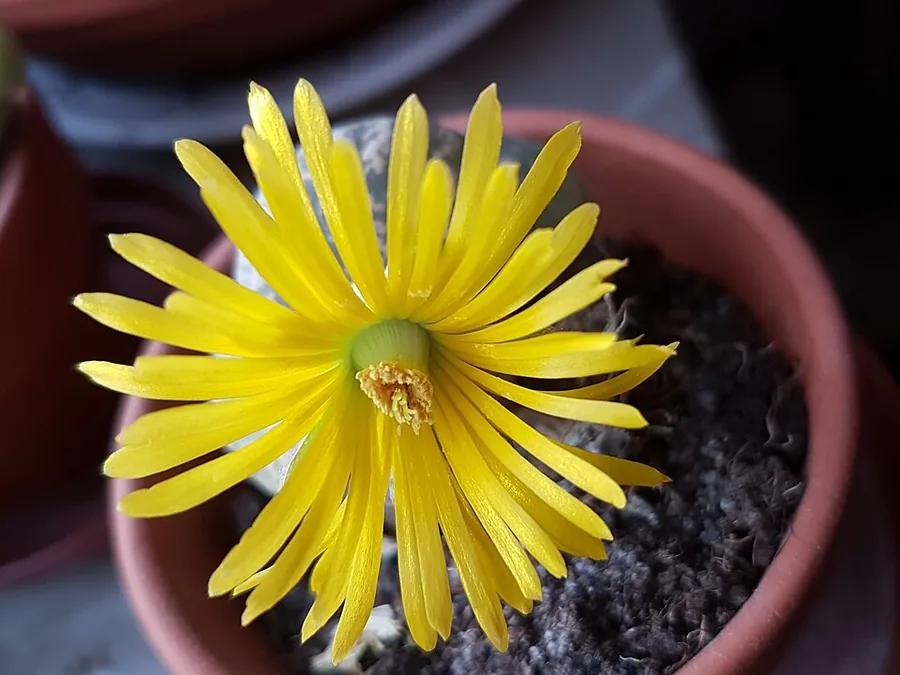
The neat part is the cycle they run on. Through the hot months they go dormant and don't want a drop of water. Then a fresh leaf pair forms inside the old one, splits it open, and drinks it dry, so the whole plant sort of renews itself from the inside. Come late summer and autumn, a single daisy-like flower, white or yellow, pops up from the seam between the leaves.
They're not really hard once you get them, but they'd much rather you sit on your hands than fuss over them. The whole trick is just learning when to water and when to leave them bone dry. Get that down and you've got one of the toughest, longest-lived little plants you can keep on a sunny sill.
Care
The short version: give them the brightest sun you can, pot them in a sharply draining gritty mix, and water only during their autumn and spring growth while keeping them bone dry through summer dormancy and the leaf split.
Light
Lithops want full sun or the brightest light you can give them, all year, and a south-facing window is about as good as it gets indoors. Short them on light and the bodies stretch up tall and pale instead of staying flat and compact.
Water
Here's where most lithops live or die, honestly. Water only during active growth in autumn and spring, soaking the gritty soil and then letting it dry all the way out before the next drink. Through summer dormancy and the leaf split, keep them bone dry, because water at the wrong moment rots them fast.
Soil
Give them a very gritty, sharply drained mineral or cactus mix that water runs straight through. Any pH from 6.0 to 7.5 works fine. The quicker that soil dries, the safer they are.
Temperature
They're happy across a pretty wide range, from about 41°F to 77°F (5°C to 25°C). A cool, dry rest in winter suits them, but keep them away from hard frost and from baking heat that'd tempt them to drink when they shouldn't.
Humidity
These are desert plants, so they like low humidity and air that moves, and there's no number to chase here. Damp, stale air is really the thing to avoid, since it invites the rot that finishes them off.
Feeding
Lithops barely need feeding at all. A dilute, low-nitrogen, high-potassium cactus fertilizer during the autumn and spring growth is plenty, and even that's optional. Too much food just pushes soft, weak growth.
Pruning
There's nothing to cut, really. When the old leaf pair shrivels during renewal, just let it dry out and get absorbed on its own, and don't peel or pull it off, because that only sets the plant back.
Repotting
Only repot every 3 to 5 years, and only once the clump has crowded its pot or shoved roots out the drainage holes. They like a snug pot, so there's no rush to move them.
Size & spacing
Each plant stays tiny, just 1 to 2 inches (2 to 5 cm) tall and about as wide, though it slowly builds into a clump over the years. A small, shallow pot will hold a few of them with room to spread.
Troubleshooting
Just about every lithops hiccup traces back to water or light, and the good part is most of it is easy to head off. The plant wears its troubles on its body, going soft, stretched, or wrinkled, so it pays to read those signs against where it is in its yearly cycle. Match up what you're seeing below before you grab the watering can.
A squishy, see-through body that's starting to cave in
If the body's gone soft and glassy, that's rot, and it almost always comes down to a drink at the wrong time. Maybe it got water during summer rest or the leaf split, or maybe it's sitting in soil that just won't dry out. Stop watering right away, trim off the mushy parts with a clean blade, and pop it into dry, gritty mix until it firms up again.
Fix:
- Stop watering immediately
- Remove the plant and cut away any rotted tissue with a clean blade
- Repot into dry, gritty mineral mix and withhold water until firm growth resumes
A plant that's shooting up tall and pale instead of sitting flat
So it's growing tall and pale instead of staying nice and squat? That's a plant that's not getting enough light. Those flat, compact tops only hold up in strong sun, so give it the brightest window you've got. Just ease it into the brighter spot over a few days, or the sudden change can scorch the surface.
Fix:
- Move to the brightest available position
- Introduce stronger light gradually to avoid scorch
Old leaves sticking around while the fresh pair comes through
If the old leaves are hanging on while the new pair pushes up alongside them, that's a sign it got water during the leaf split. The new growth is supposed to feed off the old pair as it shrinks, not off the soil. So hold off on all water and let those old leaves dry out and get absorbed on their own.
Fix:
- Withhold all water until the old leaf pair fully dries and is absorbed
A wrinkly, deflated look showing up in the autumn or spring months
Wrinkling up while it's actively growing? That's just thirst, and a careful drink during growth will fill it right back out. But timing is the whole story here. If it shrivels during summer rest or while the new leaves are coming in, that's totally normal, so leave it be.
Fix:
- Resume careful watering only if the plant is in active growth
Toxicity
Got pets or little ones? You can relax, because lithops are non-toxic straight down the line. Cats, dogs, rabbits, birds, and people can all live alongside them just fine. There's nothing harmful in the leaves, so a stray nibble really isn't a big deal.
Safe for
People · Cats · Dogs · Horses · Rabbits · Livestock · Birds
Cats None
Cats are fine around it. A nibble won't poison them, though if one gulps down a mouthful of gritty mix it might throw up for a bit, and that's the soil talking, not the plant.
Dogs None
A dog that chews one won't come to any harm, since there's nothing toxic in it. And honestly, those little squat bodies don't tend to catch a dog's eye anyway.
Horses Safe
Horses have nothing to worry about here, and the plant's so tiny there's hardly a bite to graze in the first place.
Rabbits Safe
Rabbits can have a taste without any risk, because those fleshy leaves don't carry anything harmful.
Livestock Safe
Cattle, goats, and sheep aren't in any danger from it, and a windowsill succulent this small hardly ever crosses their path.
Birds Safe
Pet birds can peck away at it all they like. There's nothing toxic in there to bother them.
People Safe
It's harmless to people, kids included. Nobody grows it to eat, but if someone's curious enough to taste it, no harm done.
Varieties
There are dozens of species in the genus, and growers go for them because of the colors and surface patterns on their windowed tops. A handful keep turning up in collections.
Lithops aucampiae
It's one of the easier ones to grow, with reddish-brown to coppery tops crossed by darker, branching lines.
Lithops lesliei
You'll know this common one by its finely netted, rusty-brown windowed tops and its yellow flowers.
Lithops optica 'Rubra'
Collectors love it for those striking purple-red bodies.
Lithops karasmontana
Its pale grey to pinkish bodies are covered in an intricate reddish pattern across the surface.
Lithops salicola
With grey-green tops and translucent windows, it puts up with a bit more moisture than most of its cousins.
How to propagate
Want more lithops? You can grow them from seed or split an older clump, though neither one is fast. Both just ask for a little patience and a light touch with water.
SeedModerate
Sow in spring or early autumn onto gritty mix and keep warm and lightly moist until germination. · 2 to 3 years to reach mature flowering size
Most lithops start out as seed, sprinkled over gritty mix in spring or early autumn and kept warm and just barely moist until they sprout. It's a slow one, so pack your patience, because a seedling takes 2 to 3 years to reach mature flowering size and wants a gentle hand with water the whole way.
DivisionModerate
Divide established multi-headed clumps at repotting during active growth. · Several months to root and re-establish
Got an older clump with a few heads on it? You can split it during active growth, and repotting time is the easiest moment to do it. Cut between the heads so each piece keeps some roots, let the cut ends dry out, then pot them up and give them several months to root and settle in.
Myths
Lithops are a type of cactus.
Nope, they're leaf succulents in the family Aizoaceae, and they're not closely related to true cacti in the Cactaceae at all. The two groups just hit on the same water-storing trick from totally different branches of the plant world.
Lithops do fine with a regular drink, the same as any leafy houseplant.
Treating them like a regular leafy plant on the sill is what does most of them in. They've got to stay bone dry through summer rest and the leaf split, and overwatering is by far the most common way they die.