Houseplant · Aizoaceae
Split Rock
Pleiospilos nelii
A pint-sized succulent that looks like a cracked pebble and honestly just wants sun and a long dry nap.
Full sun
50–86°F · 10–30°C
USDA 9–11
2–3 in · 5–8 cm
Overview
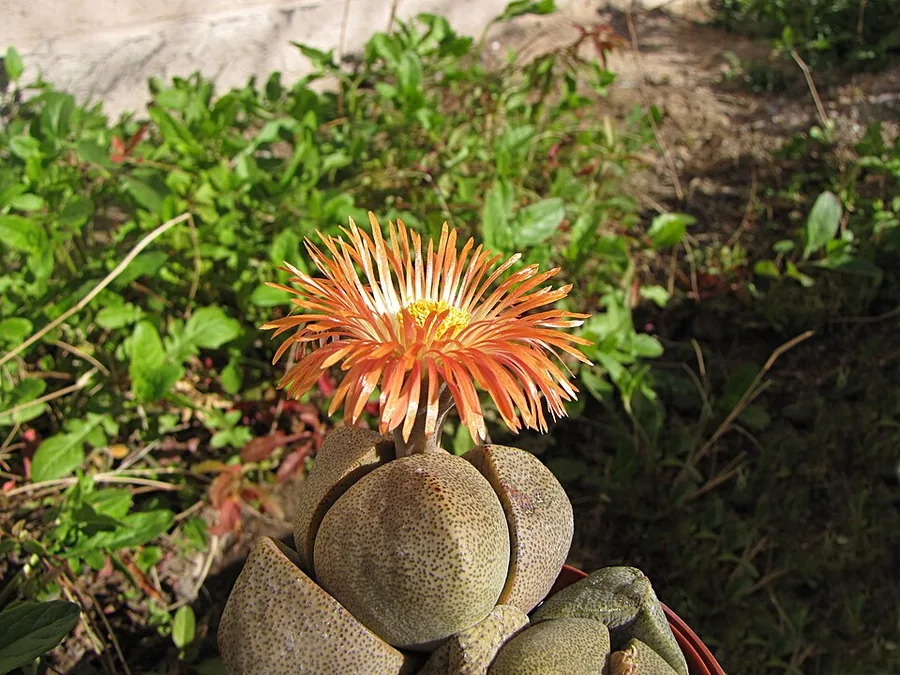
So here's a plant that pretends to be a rock, and it's pretty convincing about it. Split rock hails from South Africa, sits in the mesemb crowd of the family Aizoaceae, and packs its fat, cracked leaves into a little body about the size of a big pebble. Pop it in a gritty pot and honestly? It looks like a chunk of split granite, which is exactly the trick it learned to dodge hungry animals out in the wild.
Don't expect it to shoot up, because this is a slow, stay-small kind of plant, topping out around 2 to 3 inches (5 to 8 cm) tall. It's happy on a bright windowsill all year and only ever wears one or two leaf pairs at a time. Every year a fresh pair pushes up from inside the old one and drinks it dry until there's just a papery shell left behind, and yes, that's supposed to happen.
Now for the part that trips people up, and it's not feeding or trimming, it's watering. This little guy runs on a strict schedule and really needs a bone-dry summer break, so being too generous with the watering can is the quickest way to do it in. Get the timing right, though, and it'll surprise you with a cheery, daisy-like flower in late winter or spring.
Care
The short version: hand it the brightest light you've got, a gritty mix that drains fast, and water only when it's growing in spring and autumn, never while it's napping in summer or swapping out its leaves.
Light
Give it the brightest window you've got, and full sun on a south-facing sill is the dream. All that light is what keeps the body tight and stone-like, and skimp on it? It'll go pale, stretch out, and lose that neat shape.
Water
Okay, this is the big one with split rock. Water only while it's actively growing in spring and autumn, and only once the soil has gone dry all the way down. Keep it completely dry through summer dormancy and the whole time a new leaf pair is coming in, because water then just makes the leaves split open and rot.
Soil
Plant it in a really gritty, fast-draining mineral or cactus mix that won't stay wet on you. It's easygoing about pH anywhere from 6.0 to 7.5, so don't sweat the exact number, just make sure water zips right through.
Temperature
It's comfy anywhere between 50°F and 86°F (10°C to 30°C), which is basically normal room temperature all year. A cooler, dry spell in summer? That's a nice little rest for it, but nothing you need to engineer.
Humidity
Here's an easy one, since this desert plant actually likes low humidity, so there's no number to hit. Dry air suits it just fine, while damp, stuffy air is the stuff that leads to rot.
Feeding
Feeding is a now-and-then thing, and only during the spring and autumn growth spells. A weak, low-nitrogen cactus or succulent food does the trick, because pile on too much and you'll just get soft growth it doesn't really want.
Pruning
Good news, there's basically nothing to prune, and you should never cut into the plant itself. Just let the old leaf pair dry up as the new one soaks it up, then gently peel off the papery bits once they're done.
Repotting
You'll only need to repot it every so often, roughly every 2 to 3 years or whenever it's clearly outgrown its pot. See roots sneaking out the drainage holes or the plant heaving up out of the soil? That's your cue to move it into fresh gritty mix.
Size & spacing
It stays tiny, reaching only 2 to 3 inches (5 to 8 cm) tall and spreading maybe 3 to 4 inches (7 to 10 cm) across. One plant is plenty for a small pot, no crowding needed.
Troubleshooting
Just about every hiccup with split rock traces back to water at the wrong time, and the leaves will tell you all about it. Are they firm, or are they going soft, or piling up? Once you can read that, you'll catch problems early. Find the match below and don't dawdle.
Leaves splitting or going soft and see-through
If the leaves are splitting or turning to mush, that's rot from overwatering, plain and simple, and it usually means a drink landed at the wrong moment. The riskiest times? Summer dormancy and while a new leaf pair is pushing out, when the plant wants nothing to drink. So back off the water, trim any mushy parts with a clean blade, and move it into a grittier mix that drains quicker.
Fix:
- Stop watering immediately
- Cut away rotted tissue with a clean blade
- Repot into a much grittier, faster-draining mix
- Allow the plant to dry out fully before any further water
Leaf pairs piling up instead of shrinking down
A happy split rock keeps just one or two leaf pairs going. If you're counting three or more stacked up, it's usually been watered or fed during leaf renewal, so the old pair never got used up. Just hold off on water, let the plant feed on those old leaves, and once the extras disappear, pick the normal dry cycle back up.
Fix:
- Withhold water so the plant draws on the old pair
- Resume the normal dry-cycle once excess pairs are reabsorbed
Pale, stretched-out growth losing its rocky look
When a split rock starts reaching up and going pale, it's simply not getting enough light. That tight, stony shape only holds together under strong sun, and a dim windowsill slowly pulls it out of whack. Move it to the brightest spot you've got, ideally one with a few hours of direct sun.
Fix:
- Move to the brightest available position with several hours of direct sun
Toxicity
Got pets or curious kids? Good news, because split rock isn't toxic at all. The ASPCA doesn't list it, and its mesemb cousins don't carry any known poisons either. Worst case, a pet that swallows a bit of the gritty, fibrous leaf might get a quick tummy ache, and that's about it.
Safe for
People · Cats · Dogs · Horses · Rabbits · Livestock · Birds
Cats None
A nosy cat is totally fine around this one. Sure, if it chews a leaf it might get a quick, mild upset stomach from the fibrous bits, but there's nothing poisonous happening.
Dogs None
No poisoning worries for dogs here. The worst a committed chewer might deal with is a little short-lived drooling or loose stool from the gritty leaf, and that clears up on its own.
Horses None
Horses have nothing to fear from it either. And really, the plant's so tiny there's hardly anything for a horse to munch on anyway.
Rabbits None
Nothing here will poison a rabbit. A nibbled leaf might bring on a bit of gas, since that dense succulent tissue isn't exactly rabbit food.
Livestock None
Goats, sheep, and cattle are all in the clear, no toxins to worry about. At most, a grazer might get a mild, brief bit of tummy grumbling from the gritty mouthful.
Birds None
Pet birds are safe around it too, with no poisoning ever reported. A bird that pecks a leaf isn't in any danger beyond maybe an upset crop from the fibrous bite.
People None
Handling it or growing it is completely safe for adults and kids alike. It's just not a food plant, so there's really no reason to eat it.
Its sharp gritty soil and fibrous leaf tissue could cause minor mechanical or digestive upset if a pet chews and swallows large amounts.
Varieties
There really are only two forms you'll bump into, and they mostly just differ in color. Here's the quick lowdown on both.
Pleiospilos nelii (species)
The wild one has those grey-green, cracked leaves that puff up into a nearly round body, looking for all the world like a split stone.
Pleiospilos nelii 'Royal Flush'
This cultivar swaps the usual grey-green for deep purple to reddish leaves, but it keeps that same cracked-stone shape you'd expect.
How to propagate
It's a slow multiplier, so patience helps. Either grow new ones from seed, or split up a clump that's already settled in when you're repotting anyway.
SeedModerate
Sow in warm conditions during spring or autumn · Several months to over a year to reach a recognizable plant
To grow it from seed, sow in the warmth of spring or autumn, just scatter it on top of a gritty mix and keep it a touch moist until it sprouts. After that, switch over to the strict dry cycle. Fair warning, it's a slow one, taking several months to more than a year before a seedling looks like an actual plant.
DivisionModerate
During active growth when repotting an established clump · Several weeks to a few months
Got a clump that's spread out? You can divide it during active growth while you're repotting anyway. Gently tease off an offset with a few roots, let the cut ends dry and callus over, then pot it up in a dry gritty mix. It'll usually settle in within a few weeks to a couple of months.
Myths
Split rock is basically a Lithops.
Nope, they're two different genera, even though both hang out in the mesemb group. Split rock is a Pleiospilos, and it's got way fatter, fewer leaves than a true Lithops, so that resemblance really is only skin deep.
You can water it on a regular schedule, same as your other succulents.
Not this one, since it runs on a strict cycle and needs a bone-dry summer rest. Watering it on a routine all year makes the leaves burst and rot, which is honestly the fastest way to lose it.