Shrub · Hamamelidaceae
Chinese Fringe Flower
Loropetalum chinense
Pop loropetalum into acidic soil with good drainage and you'll get colored leaves and fringy blooms for barely any effort.
Full sun
Every 5–10 days
USDA 7–9
6–8 ft · 1.8–2.4 m
Overview
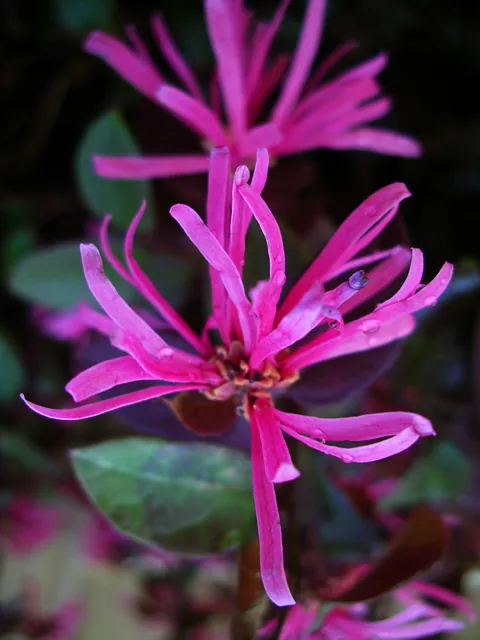
Loropetalum, or the Chinese fringe flower, is a laid-back evergreen shrub that gives you two nice things at once: its colored foliage and those spidery, fringed flowers that cover it every spring. On the popular kinds, the leaves run from burgundy to deep plum to almost black and keep that color all year, while the green-leaved ones just kind of blend in. The blooms look like little tassels, and they come in pink, red, or white.
So why's it such an easy plant? Because it barely asks for anything. Once it's settled in, it laughs off dry spells, doesn't mind full sun or part shade, and rarely needs more than a quick tidy-up after it flowers. The one thing it really won't budge on is acidic soil, and just about every problem people run into traces right back to ground that's gone too alkaline.
The one catch worth flagging up front is size. Those cute cultivar names make you picture tidy little mounds, but plenty of them grow way bigger than you'd expect, and a vigorous type can climb toward small-tree size in just a few years. So match the variety to the space you've got, and you'll save yourself a ton of pruning down the line.
Care
The short version: full sun to part shade, rich acidic soil that drains well, steady water while it's settling in and a lot less once it has, and a light trim right after the spring flowers finish.
Light
Loropetalum flowers best and hangs onto its leaf color most strongly in full sun, though it takes partial sun or partial shade in stride. Stick it in deep shade, though, and the dark-leaved types go dull and the blooms thin out.
Water
Water it regularly while it's getting established, roughly once a week and more often when it's really hot out. Once the roots are down, it turns drought tolerant and hardly needs anything extra, so just let the top inch or so of soil dry between drinks, and mulch to hold onto what moisture's there.
Soil
This is the big one, honestly. Loropetalum wants rich, moist, well-drained soil that leans acidic, ideally a pH somewhere between 5.0 and 6.5, with lots of organic matter mixed in. Neutral or alkaline ground locks up the iron and turns the leaves yellow.
Temperature
It's tough across a wide range, handling lows near 5°F (-15°C) and heat up to about 100°F (38°C). That covers USDA zones 7 through 9, where it lives outside all year round.
Humidity
Regular outdoor humidity suits it just fine, so there's no number you need to chase. What matters way more is keeping the roots out of standing water, because that's where its real headaches start.
Feeding
Feed it once in spring with an acidic, azalea- or camellia-type fertilizer, and it does well with a medium dose. That same feed pulls double duty by helping keep the soil on the acidic side it likes.
Pruning
Pruning's easy work. Since the flowers mostly form on old wood, prune right after the spring bloom wraps up, so you shape the plant without lopping off next year's show.
Repotting
A plant in a pot rarely needs moving. Only repot when you see roots circling or poking out the drainage holes, water running straight through, or new growth just stalling in the container.
Size & spacing
Figure on a shrub around 6 to 8 feet (183 to 244 cm) tall and roughly as wide, though the vigorous types push well past that. Give each one room for its full spread so air moves through freely and you're not fighting its size every single season.
When to plant
Loropetalum is a woody shrub you plant once and keep for years, so the timing that really matters is just getting it in the ground. Set new plants out in spring or fall, once frost danger's passed, and the main show of fringed flowers turns up from late March into April, with a bit of scattered rebloom through the warmer months.
Northern hemisphere
Southern hemisphere
Typical months for a temperate climate: start earlier in warm zones, later where spring frosts linger.
- Plant: Spring or fall after frost danger passes
- Harvest: Late March to April with sporadic rebloom into fall
Hardiness
USDA hardiness zones: 7–9
Temperature: down to -18°C
Troubleshooting
Give loropetalum the right soil and it pretty much looks after itself, so most problems are really soil problems in disguise. The leaves and roots will tip you off early. Just match what you're seeing below and fix the cause, not only the symptom.
Droopy, dying branches over roots that feel mushy and dark
Here's a confusing one: the plant wilts and drops branches even though the soil's soaking wet. That's usually root rot from ground that stays too soggy. Scrape down and the roots feel dark and mushy instead of firm. So ease off the water, sort out the drainage, and move any healthy survivors into a raised bed that drains well, though a plant that's rotted right through is honestly better pulled and swapped out.
Fix:
- Improve drainage and reduce watering
- Remove and discard severely rotted plants
- Replant in raised, well-drained beds amended with organic matter
Lumpy, corky growths on the wood and branches dying past them
Notice rough, swollen bumps sitting at the branch joints with dieback just past them? That points to bacterial gall disease. Cut each affected branch well below its gall, then burn or bin the bits you take off, and give your tools a wipe with disinfectant between cuts so you're not spreading it around. And if a shrub is absolutely covered in it, pulling the whole thing is the smart move.
Fix:
- Prune out and destroy galled branches well below the gall
- Disinfect pruning tools between cuts
- Remove and replace severely infected plants
Leaves going yellow while the veins keep their green
See yellow leaves where the veins are still green? That's chlorosis, and it almost always means the soil has gone too alkaline for the roots to grab iron. You'll notice it on the freshest leaves first. Grab a pH test, then work in some elemental sulfur or an acidic feed to nudge the pH down, and hand the plant some chelated iron for a quick fix while the soil slowly sorts itself out.
Fix:
- Acidify soil with elemental sulfur or an acidic fertilizer
- Apply chelated iron as a temporary correction
- Mulch with organic matter to lower pH over time
Toxicity
Got pets or kids? Good news, because loropetalum is not toxic. It doesn't show up in the big poison databases or on the ASPCA list, and the bitter tannins in the leaves tend to put animals off before they eat much. So you can plant it and not stress about who wanders past.
Safe for
People · Cats · Dogs · Horses · Rabbits · Livestock · Birds
Cats None
A cat can rub up against the leaves or take a nibble and be totally fine. Those bitter tannins usually turn them off before they eat enough to matter anyway.
Dogs None
A dog that's chewing on a loose branch? No danger there. There's nothing poisonous in it, though a huge mouthful of any plant can leave a delicate stomach a bit grumpy for a while.
Horses Safe
Horses can graze right next to the shrub without any worry, since there's nothing in it that would poison them.
Rabbits Safe
Rabbits aren't at any risk from the leaves or flowers, and the bitter taste tends to keep them from snacking on it too much.
Livestock Safe
Cattle, goats, and sheep can browse around it safely, because nothing in the plant is known to poison them.
Birds Safe
Garden birds can perch and root around in the branches with zero trouble.
People Safe
It's safe to have around kids. Nothing on it is poisonous, so a curious child who tastes a leaf is fine.
No special handling needed; foliage contains bitter tannins that discourage browsing.
Varieties
Most of what you'll see for sale is named for its leaf color and shape more than its flowers. So here are the cultivars you're most likely to bump into.
Ruby (var. rubrum 'Ruby')
The new leaves come out a deep burgundy-red, and the hot-pink fringe flowers really pop against them.
Purple Pixie
It's a low, weeping little dwarf with purple leaves and pink blooms that's just as at home in a pot or trailing over a wall as it is spreading out as groundcover.
Plum Delight
Its reddish-purple foliage makes a nice backdrop that really sets off the bright pink flowers.
Ever Red (Chang Nian Hong)
This one's the darkest of the lot, with near-black red leaves, red blooms, and a real knack for flowering again later on.
Zhuzhou
It's a vigorous purple-leaved type that'll grow big enough to hit tree-like size if you let it run.
Companions
Loropetalum pairs naturally with the other acid-loving shrubs, which want the same rich, well-drained ground and gentle shade it does.
How to propagate
Want more loropetalum? You can make it at home without much fuss, either by rooting a few cuttings or just pinning a low branch down to the soil and letting it root right there.
Stem cuttingsModerate
Late spring through summer · Roots in roughly 15 days to several months depending on cultivar and warmth
Anywhere from late spring through summer, you can take semi-hardwood cuttings from shoots that have just started to firm up. Warm soil around 75°F (24°C) really helps move things along, and roots show up anywhere from about 15 days to a few months later, depending on the cultivar and how warm you're keeping them.
LayeringEasy
Spring to summer · Several months to root
Honestly, the easiest way is layering in spring or summer. You just bend a low branch down, pin it into the soil, and leave it attached to the parent while it roots over several months, then snip it free to be its own plant.
Myths
Loropetalum's leaves are dangerous for a curious dog or cat to nibble.
Nope, it's not in the toxic-plant databases and it's not on the ASPCA list either. Loropetalum is treated as non-toxic to pets, so if your cat or dog nibbles a leaf, there's really nothing to worry about.
Once a Loropetalum is labeled dwarf, it'll stay tiny for good.
Not quite. Loads of so-called dwarfs outgrow the name, and the species and vigorous types can hit 10 to 20 feet or more. Give every plant room for its real mature size, and check the cultivar before you pick a spot for it.