Ornamental · Nelumbonaceae
Sacred Lotus
Nelumbo nucifera
Warm sun, quiet water, and a roomy tub to run in are about all it asks, and it'll thank you with blooms held high over the pond.
Full sun
USDA 4–10
3–6 ft · 0.9–1.8 m
Overview
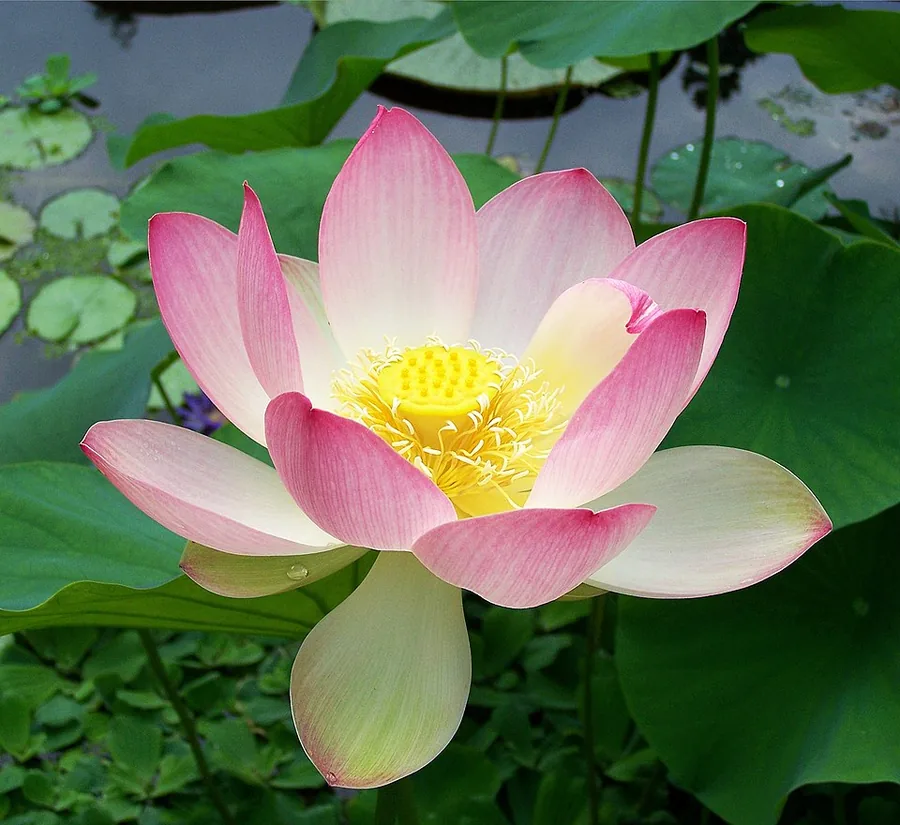
So here's the neat thing about sacred lotus: instead of floating on the water like you'd expect, it holds its leaves and flowers up high above it. It grows out of a creeping rhizome that sits down in the soft pond mud, and from there it pushes up round, water-shedding leaves and fragrant flowers on tall stalks. Each flower only sticks around about three days before it drops its petals and shows off the woody seed pod shaped like a showerhead, which is the dead giveaway that you're looking at a lotus.
It's an aquatic perennial, and it's tougher than you'd think, hardy right across USDA zones 4 to 10 as long as the rhizome stays below the freeze line all winter. People have grown it across Asia forever, both for looks and for the table, since the rhizomes, seeds, and young leaves all end up in the kitchen. In a garden, you'd sink a wide, sturdy container into a pond or a half-barrel, which is a handy way to keep those eager roots from running wild.
The main thing lotus asks of you is patience, not fuss. A plant you just divided might spend its whole first season simply growing roots and skip the flowers until year two, so hang in there. Give it heat, full sun, and still water, and it settles right in to become one of the boldest things you can grow on the water.
Care
The short version: give it full sun and still, warm water over a wide container of heavy clay loam, keep the rhizome below the freeze line through winter, and split it every year or two so it doesn't outgrow its pot.
Light
Lotus wants full sun, at least 6 hours a day and more if it can get it. Shortchange it on light and you'll end up with nice leaves but hardly any flowers, so hand it the brightest, most wide-open spot you've got.
Water
Grow it in still, calm water over a wide container of heavy clay loam. Start off with the crown about 6 inches deep, then let the water climb to 18 to 24 inches over the rhizome as the plant fills out. Keep that rhizome below the freeze line, and move shallow containers to deeper water or indoors before a hard freeze hits.
Soil
Plant it in heavy, organically rich clay loam, basically the mucky pond-bottom kind of stuff. Those light, fluffy potting mixes? They just float off and won't hold the rhizome down, so pack the container with dense, heavy soil and cap it with sand or gravel.
Temperature
This is a heat-lover that really gets going in summer, and it handles up to about 100°F (38°C). The dormant rhizome is way tougher than the leaves and stems on top, riding out cold down to roughly -29°F (-34°C) as long as it stays below the freeze line.
Humidity
Since it's growing in open water, lotus already sits in high humidity on its own, so there's really nothing for you to fuss with. The pond takes care of it, and the leaves never go thirsty.
Feeding
Feed it all through the summer growing season with aquatic fertilizer tablets poked down into the container substrate, about once a month. Then quit feeding as growth slows toward fall and the plant starts heading into dormancy.
Pruning
There's no real pruning to bother with. Just snip off yellowing or dead leaves and spent flower stalks to keep the water clean, and thin or split crowded rhizomes when the plant starts pressing at its edges.
Repotting
Plan on a divide and repot every 1 to 2 years in spring, since the rhizome fills its pot fast and can actually crack the walls. Rhizomes circling the pot, a warped container, or smaller, crowded leaves are your cues that it's time.
Size & spacing
A grown lotus gets 3 to 6 feet (91 to 183 cm) tall and spreads 3 to 4 feet (91 to 122 cm) wide. Give each one its own roomy container so the running rhizome has space and the leaves aren't elbowing each other for light.
When to plant
Lotus runs on warmth, so it won't do a thing until the water heats up. Get your rhizome divisions in the water in spring to early summer once the cold's gone for good, and then keep an eye out for flowers standing tall above the water from June into July.
Northern hemisphere
Southern hemisphere
Typical months for a temperate climate: start earlier in warm zones, later where spring frosts linger.
- Sow: Not typically started indoors; usually grown from rhizome divisions planted in spring
- Plant: Spring to early summer once water has warmed
- Harvest: Summer (June to July); flowers held high above the water, each bloom lasting about three days
Hardiness
USDA hardiness zones: 4–10
Temperature: down to -34°C
Troubleshooting
Just about every lotus problem comes down to one of three things: not enough sun, a rhizome that's outgrowing its pot, or old leaves doing their usual yellowing. Catch the early signs below and you can fix a little issue before it turns into a big one. Find what matches your plant, then jump on it while it still helps.
Plenty of leaves but few or no flowers
Leaves everywhere but no blooms? Lotus only flowers with full sun and real warmth, so a shady spot or a short, cool summer will keep even a healthy plant from opening a single flower. And if it's a young plant you just divided, it'll often sit out its first year while it settles in. Pop it somewhere sunny, plant it in a wide pot of heavy loam, give it a whole warm season, and the flowers show up.
Fix:
- Site the container in full sun with 6 or more hours of direct light
- Allow a full warm season; do not expect bloom from a freshly divided or first-year plant
- Move to a larger, wider container of heavy loam so the rhizome can run
- Handle rhizomes gently when dividing or planting to avoid breakage
Roots busting out of the pot or splitting it open
Those creeping rhizomes really move, and an unpotted lotus can basically fill a shallow pond in a year or two. Keep it in a pot that's gotten too tight, though, and all that push just cracks the walls instead. So keep it in a wide, sturdy container down in the water, split it every year or two, and if a runner sneaks out, pull it before it grabs hold of the pond bottom.
Fix:
- Confine plants to wide, sturdy submerged containers rather than open pond mud
- Divide and thin rhizomes every 1-2 years
- Remove escaped rhizomes promptly to keep them from rooting into the pond bottom
Fresh growth gone sticky and bent, with little bugs packed on it
Notice sticky, twisted new leaves? That's usually aphids, little soft-bodied bugs that pile onto the fresh stems and leaves, and in a hot, dry stretch you might get spider mites too, which leave behind fine webbing and pale speckles. Good news is a firm blast from the hose knocks most of them off, and if you've got fish in the pond, they'll handle the rest. Just don't reach for the chemical sprays, since those wipe out your fish and the helpful bugs right along with the pests.
Fix:
- Spray pests off with a strong jet of water
- Encourage fish and natural predators in the pond to control populations
- Avoid chemical pesticides that harm pond life and beneficial insects
Old leaves going yellow though the new ones look fine
If it's only the oldest leaves going yellow, don't sweat it, because that's just the plant getting older, and it happens most as the season winds down toward dormancy. Scoop the dead leaves out so they don't muck up the water, and ease back on the feeding once growth slows. Keep the rhizome below the freeze line and it'll rest through winter and pop back up in spring.
Fix:
- Remove yellow or dead leaves to keep the water clean
- Allow normal seasonal dieback; reduce feeding as growth slows
Toxicity
Good news here: sacred lotus is safe across the board. It's not on the ASPCA toxic-plant list, and honestly, far from being any kind of hazard, its rhizomes, seeds, and young leaves get eaten as food all over Asia. And despite the name, it isn't a true lily, so it carries none of the danger that group brings to cats.
Safe for
People · Cats · Dogs · Horses · Rabbits · Livestock · Birds
Cats None
Nothing to worry about with cats. Lotus isn't on the ASPCA toxic list, so if yours chews a leaf, it's totally fine.
Dogs None
Dogs are all good here. If one gnaws the leaves or a dropped seed pod, the worst you'll likely see is a soft stool from all that fiber.
Horses Safe
Horses can nibble the leaves along the water's edge and be perfectly fine, because there's no toxin anywhere in the plant.
Rabbits Safe
Rabbits are fine with it too. The tender young leaves make a nice treat now and then, just not the main thing they live on.
Livestock Safe
Cattle, goats, and sheep can graze lotus along the pond edge without any problem at all.
Birds Safe
Waterfowl and other birds actually love the seeds out in the wild, and the plant doesn't hurt them one bit.
People Safe
For people, lotus is just food. Folks across Asia eat the rhizomes, seeds, and young leaves, and it's all safe to cook up at home.
Edible and food-safe; the rhizomes, seeds, and leaves are used in cooking. No special handling precautions for pet households.
Varieties
A few named lotus are worth getting to know, from ones that change color to little dwarfs that fit in a half-barrel. Here's who's who.
Mrs. Perry D. Slocum
A favorite cross of sacred and American lotus, and its flowers pull a neat trick, opening pink and turning yellow as they age.
Momo Botan
A tiny dwarf at just 1 to 2 feet tall, with double, sweet-smelling rose-pink flowers about 5 inches wide that are perfect for half-barrels and small water gardens.
Chawan Basu
Another dwarf that's sized right for small containers and tub gardens.
American lotus (Nelumbo lutea)
The lotus that's native to North America, with pale-yellow flowers and enough toughness to handle winters down to USDA zone 4.
How to propagate
You've got two ways to make more lotus: split an established rhizome, or start the hard seeds, and which one you go with decides how soon you'll get flowers.
DivisionModerate
Spring, as growth resumes · One full growing season; bloom often does not occur until the second year
Want more lotus? Dividing is the way to go, and you'll do it in spring right as the plant wakes up. Cut off a piece of the creeping rhizome, lay it down flat near the edge of a wide pot of heavy loam, sprinkle sand or gravel over it, and sink it under the water. Be easy on the growing tips while you're at it, then let the plant take a full season to get comfortable, because those first flowers usually wait until year two.
SeedModerate
Spring to summer in warm water · Slower to flowering than division; may take more than one season
Seeds work too, if you don't mind waiting a while. You'll need to nick that hard seed coat before it'll sprout in warm water, and flowering can take longer than one season to show up. Just know that named cultivars won't come out true from seed, so if you want a copy of the parent, divide it instead.
Myths
Lotus and water lilies are the exact same thing.
They're actually from totally different families, and once you know what to look for, it's easy to tell which is which. A lotus holds its big round leaves and flowers way up on tall stalks and wraps up with a woody seed pod that looks like a showerhead, while a water lily just floats its leaves and blooms flat on the water and never grows that pod. And here's the kicker: you can eat lotus leaves and seeds, but not a water lily's.