Ornamental · Mazaceae
Creeping Mazus
Mazus reptans
A low, moisture-loving carpet that fills the cracks between pavers and breaks into purple-blue bloom every summer.
Full sun
Every 3–7 days
USDA 5–8
1–3 in · 3–8 cm
Overview
Creeping mazus is a low, quick-spreading groundcover that knits into a dense green mat only 1 to 3 inches (3 to 8 cm) tall. It's part of the family Mazaceae, and its rooting stems creep out and grab hold at every node, so it doesn't take many plants to fill a spot. Want a lawn alternative or a soft filler between stepping stones? This is a great pick, and it handles light foot traffic just fine.
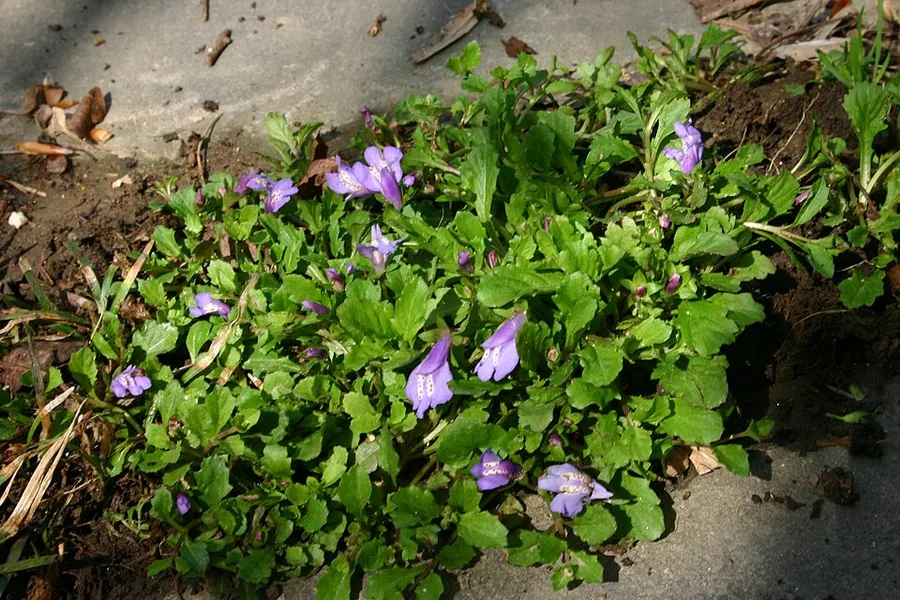
Then early summer rolls around and the mat pushes up small, two-lipped flowers that look like tiny snapdragons. Most of them bloom purplish-blue with white and yellow throats, while the 'Albus' form goes clean white. Here's the thing that sets it apart: while a lot of groundcovers bake happily in dry sun, mazus wants steady moisture and rich ground, and it pays you back with thicker cover and more flowers.
The best part is how little it asks for, though that same get-up-and-go will march it into the lawn if you're not paying attention. Some northern states list it as an invasive weed, so give it an edge or a contained spot. Plant it where you actually want a green carpet, not where you're after a crisp, tidy line.
Care
The short version: full sun to part shade, soil kept steadily moist and never bone dry, and an edge or a contained spot so it doesn't go wandering into the lawn.
Light
Mazus is fine in full sun to partial shade, and it flowers best with a good few hours of sun. If your summers get hot and dry, give it some afternoon shade, which takes the edge off the heat stress that browns the mat.
Water
This is the one thing mazus is a bit picky about. Keep the soil consistently moist and don't let it dry out, especially when it's hot, because it drinks more than most groundcovers do. Aim to water every 3 to 7 days, and more often when there's a heat wave.
Soil
Put it in moist, humus-rich, well-drained soil and it's happy. It's not fussy about texture, so clay, loam, or sandy ground all work, plus medium to wet sites, and it copes with a wide pH from 5.5 to 7.5.
Temperature
Hardy through USDA zones 5 to 8, mazus laughs off cold down to about -20°F (-29°C) and takes summer heat up to roughly 86°F (30°C). In the coldest bit of that range, don't be surprised by a little winter dieback.
Humidity
Regular outdoor humidity is all it needs, so there's no number to hit here. What matters more is soil moisture and airflow, since a soggy, stagnant corner is exactly what pulls in slugs.
Feeding
Mazus hardly ever needs feeding. If it's looking a bit weak, a light spring topdressing of compost or balanced fertilizer does the trick, and most plantings honestly do great on nothing.
Pruning
Upkeep is super light. An occasional mow or trim tidies the mat and it shrugs off light foot traffic, but the real job is edging it back so it doesn't creep into lawns and beds.
Repotting
not applicable as an in-ground groundcover
Size & spacing
Each plant stays low, just 1 to 3 inches (3 to 8 cm) tall, and spreads 6 to 12 inches (15 to 30 cm) wide. Space them out so the runners can weave into one solid mat over a season.
When to plant
Mazus is a tough perennial that's happy in zones 5 to 8. Pop the plants out in spring once the last frost is behind you, and they'll knit together over the season and flower from around June into July.
Northern hemisphere
Southern hemisphere
Typical months for a temperate climate: start earlier in warm zones, later where spring frosts linger.
- Plant: spring after the last frost
- Harvest: late spring to early summer (roughly June to July)
Hardiness
USDA hardiness zones: 5–8
Temperature: down to -29°C
Troubleshooting
Mazus is an easy one, and pretty much all its trouble comes down to either too little water or too much wandering. Learn to read the early signs in the mat and you can jump in before one thin patch turns into a bald spot. Find your match below, then go fix it.
The mat goes brown and thin when summer turns up the heat
Seeing brown, thinning patches in high summer? That's drought stress, and mazus feels it before tougher groundcovers do because it really wants steady water. It shows up fastest in full afternoon sun once the soil has dried out. So water it deeply, drop a light mulch around it to keep that moisture in, and if your summers get hot, slide it into a bit of part shade.
Fix:
- Water deeply and consistently to keep the soil evenly moist
- Site in part shade in hot climates to reduce heat stress
- Mulch lightly around the planting to conserve soil moisture
It wanders off into the lawn and the borders
Mazus gets around on rooting stems that grab hold at every node, and in rich, damp soil it doesn't waste any time. Leave it be and it'll slip into the turf and the beds next door, and a few northern states even call it an invasive weed. Not a problem though, since you can edge the bed, pull or mow the runners, or just plant it somewhere like between pavers where you actually want it to roam.
Fix:
- Install edging to contain the planting
- Pull or mow back stems that escape the bounds
- Site it where vigorous spread is desirable, such as between pavers
Thin spots showing up once winter's been rough
Right at the cold edge of where it grows, mazus is only semi-evergreen to deciduous, so it can thin out or die back after a really hard winter. You'll notice it most in the coldest part of zones 5 to 8 and in spots that are a bit exposed. An easy fix: lay a light winter mulch over it, tuck it into a sheltered, well-drained spot, and just patch up any thin bits in spring.
Fix:
- Apply a light winter mulch in marginal zones for protection
- Replant thinned areas in spring
- Grow in a sheltered, well-drained spot
Chewed-up leaves and shiny little trails
Damp, shady ground is basically a slug paradise, so those ragged holes and shiny slug trails aren't a shock. Good news is it's just cosmetic, and it's at its worst after a wet stretch. Pick the slugs off by hand at dusk, back off the watering where you can, and if they really pile up, scatter a little iron-phosphate bait. Other than slugs? Mazus barely gets bothered by anything.
Fix:
- Hand-pick slugs in the evening
- Reduce excess moisture and improve air movement
- Use iron-phosphate slug bait if pressure is heavy
Toxicity
Good news if you've got animals or kids around: creeping mazus is not listed as toxic and it's safe to grow near pets, livestock, and children. If a pet grabs a mouthful of leaves, the worst that happens is a quick, mild bit of stomach upset. No special handling needed at all.
Safe for
People · Cats · Dogs · Horses · Rabbits · Livestock · Birds
Cats Safe
Mazus isn't on the ASPCA toxic list, so if a nosy cat has a nibble, it's fine. The worst you'd get from a big mouthful is a quick bit of tummy upset.
Dogs Safe
Dogs can brush past it or grab a taste without any worry. Even if one really goes to town on the leaves, all you'd see is some brief stomach trouble that sorts itself out.
Horses Safe
There's nothing in here that bothers horses, so a horse can crop the mat or walk over it and be totally fine.
Rabbits Safe
Rabbits can munch the leaves all they want. There's just nothing poisonous in the plant for them.
Livestock Safe
Cattle, goats, and sheep can graze it no problem, since there aren't any known toxic compounds in the foliage.
Birds Safe
Backyard hens and other birds can peck away at it safely, because none of it is toxic to them.
People Safe
Weeding and handling it is completely safe, and it won't bug your skin either. It's not grown to eat, so there's really no reason to put it on a plate.
Not poisonous; pets that nibble foliage may at most have mild, temporary stomach upset.
Varieties
There are only a couple of forms of mazus, and they're mostly told apart by flower color. Either way, they grow and spread the same.
Species form (purple/blue)
The usual one has small, two-lipped flowers that look a lot like little snapdragons, purplish-blue with a splash of white and yellow in each throat.
'Albus'
'Albus' is the exact same plant, just with white flowers instead of the purple-blue ones.
How to propagate
Making more mazus is about as easy as it gets, since the plant's already spreading and rooting on its own. You can just hurry it along by lifting and splitting the mat.
DivisionEasy
Spring · A few weeks to a season
Want more of it? The easiest way is to dig up the rooted mat in spring and just pull it apart into chunks. Each chunk's already got roots, so it settles back in within a few weeks and fills in over the season.
LayeringEasy
Spring to summer · A few weeks
Honestly, mazus does most of this for you. From spring through summer its creeping stems root on their own wherever a node touches the ground, and you can lift those rooted bits after a few weeks and pop them wherever you want more.
Myths
Mazus is just creeping thyme with a different name.
Nope, they're two different plants, and mazus sits in the family Mazaceae, not with the thymes. Their needs aren't even close: thyme wants dry ground and hot sun, but mazus needs steady moisture and rich soil. And mazus puts out small snapdragon-like flowers in purple-blue or white with spotted throats, which is something thyme just doesn't do.