Shrub · Rosaceae
Raspberry
Rubus idaeus
Give it full sun, good soil, and a yearly haircut, and you'll be picking raspberries by the handful.
Full sun
Every 3–7 days
59–77°F · 15–25°C
USDA 3–8
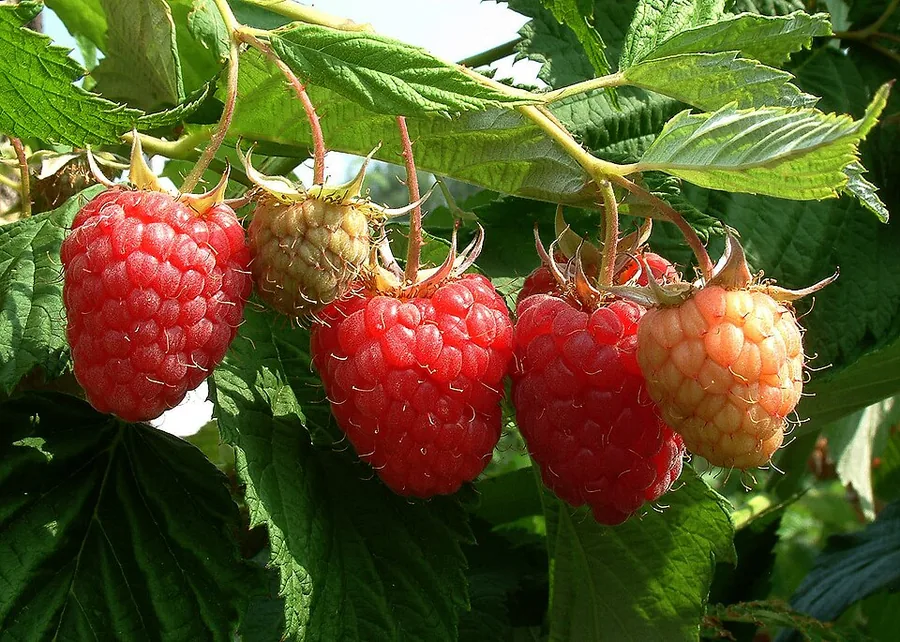
Overview
Honestly, not much beats a raspberry eaten straight off the cane while it's still warm. It's part of the rose family and grows wild all over the cooler parts of the world, so a rough winter barely fazes it. In the garden it turns into a leafy stand of upright canes that's hardy from zone 3 through zone 8, and it'll spread around once it's comfortable.
So which kind should you grow? That's really the first thing to sort out. Summer-bearing raspberries give you one batch, early to midsummer, on canes that came up the year before. Everbearing ones fruit on brand-new canes in late summer and fall, and once you know which you've got, pruning stops being confusing.
The nice part is that raspberries don't ask for much: sun, regular water, and some air moving through the row. Give them that and they'll keep cropping for years, though those roots do like to wander, so you'll be nudging the patch back into place now and then. Just remember the canes have sharp prickles, so gloves and covered arms make picking a lot friendlier.
Care
The short version: full sun, deep slightly acidic soil with plenty of compost worked in, and about an inch of water a week. Prune to whatever cane type you've got each year, and either let the roots roam or box them in, and that's pretty much it.
Light
Raspberries really want full sun, ideally six hours or more of direct light each day. They'll put up with a bit of shade, sure, but where the light's weak the canes get leggy and you won't get as many berries.
Water
Keep them at a steady inch of water a week, and give a little extra once the fruit's filling out. You want the soil damp but not swampy, because roots stuck in wet ground rot and the berries go soft.
Soil
Plant them in deep, well-drained loam with lots of organic matter mixed in. They like it a touch acidic, a pH of 5.6 to 6.5, and if the new leaves start yellowing, that's usually the soil telling you it's gone too alkaline.
Temperature
Cool to mild is their happy place, somewhere around 59°F to 77°F (15°C to 25°C). The canes are plenty tough for cold winters down to zone 3, but a really hot summer can wear the plants out and scorch the fruit.
Humidity
Don't sweat the humidity, since 40% to 70% is fine and you'll rarely be outside it. What actually matters is airflow, because still, damp air packed around the canes is exactly what gray mold loves.
Feeding
One feed a year does it. As things start growing in early spring, give them a balanced fertilizer like 10-10-10 or just top-dress with aged compost or manure. That one seasonal feeding is enough to see a whole crop through.
Pruning
Pruning depends on your type, and it's simpler than it sounds. With summer-bearing plants, cut out the old floricanes once harvest wraps up and thin the new primocanes; everbearing ones you can just mow flat in late winter for a single strong fall crop.
Repotting
Raspberries are really an in-the-ground plant, not a pot plant, so repotting hardly ever comes up. If you do have one in a container though, bump it up to a bigger pot when the roots start circling and the soil dries out too fast.
Size & spacing
Figure on canes around 3 to 6 feet (90 to 180 cm) tall and clumps spreading 2 to 4 feet (60 to 120 cm) wide. Give the rows some elbow room and set up a trellis, so the air moves through and those prickly canes stay off you.
When to plant
Timing's easy with raspberries. They go in the ground early, back when the canes are still dormant and the soil's barely stirring. Pop the plants in during early spring, and depending on the type, you'll be picking anywhere from early summer right into fall.
Northern hemisphere
Southern hemisphere
Typical months for a temperate climate: start earlier in warm zones, later where spring frosts linger.
- Plant: Early spring while plants are still dormant
- Harvest: Summer-bearing types ripen early to midsummer; everbearing types crop late summer into fall
Hardiness
USDA hardiness zones: 3–8
Temperature: down to -40°C
Troubleshooting
When something goes sideways, it's almost always in one of three spots: the fruit, the canes, or the newest leaves. Catch it early and a quick snip or a tweak to your watering usually sorts it out. Find your symptom below, then jump on it before it travels down the row.
Mushy berries wearing gray fuzz
That fuzzy gray stuff is gray mold, a fungus called Botrytis cinerea, and it shows up when wet weather teams up with crowded, stuffy canes. Pick often and toss any berry that's gone soft, since the spores will run through a whole basket once it's stored. Thin things out so air can move, and water down low at the base instead of over the top.
Fix:
- Remove and discard infected berries promptly
- Harvest frequently and keep fruit dry
- Improve air circulation by thinning canes
Wilting tips with a pair of rings
See two little rings circling a cane just under a wilting tip? That's the raspberry cane borer. Dark, sunken patches at the nodes are more likely a cane disease like spur blight. Either way, cut the cane well below the trouble and get rid of it, then clear out any wild brambles nearby that keep the pests around. Staying on top of old and infected canes each year, plus keeping the rows narrow, really does keep both from coming back.
Fix:
- Cut and destroy affected canes below the damage
- Remove all wild brambles nearby
- Maintain open, thinned plantings
Fresh leaves going yellow between the veins
When the newest leaves turn yellow but the veins stay green, you're usually looking at iron chlorosis, and it happens when the soil's gone too alkaline. A soil test will show the pH sitting too high, and chelated iron gives you a fast patch while you fix the ground itself. Work in some organic matter, bring the soil toward a pH of 5.6 to 6.5, and go easy on the lime.
Fix:
- Test soil and acidify toward pH 5.6 to 6.5
- Apply chelated iron as a short-term correction
- Incorporate organic matter
Toxicity
Worried about the pets? Good news, because the raspberry is safe from top to bottom. There's nothing toxic in the fruit or the leaves for animals or people, so a snatched berry or a chewed leaf really won't hurt. The only thing to watch isn't chemical at all, it's the sharp prickles on the canes that can catch your skin.
Safe for
People · Cats · Dogs · Horses · Rabbits · Livestock · Birds
Cats None
There's nothing on a raspberry that can poison a cat, so a nibbled leaf or a swiped berry is no big deal. The one thing to keep an eye on is the prickles, which might scratch a nosy little nose.
Dogs None
Dogs can happily munch the ripe berries, and the leaves and canes won't bother them either. What you'll want to watch is the sharp prickles, since that's the real risk.
Horses None
A horse can nibble the leaves and fruit no problem, because none of it's toxic. It's smart to fence off those thorny canes so a muzzle doesn't get scratched.
Rabbits None
Rabbits are fine with both the leaves and the berries, and a lot of them actually love the foliage. Just mind the prickly stems, which are really the only thing to avoid.
Livestock None
Cattle, goats, and sheep can all browse raspberry safely, since there's no toxin in it anywhere. The prickles are the one thing worth keeping an eye on.
Birds None
Birds go wild for ripe raspberries and end up spreading the seeds all over the place. Nothing about the plant can hurt them.
People None
For people, raspberries are a favorite fresh snack and totally safe to eat, leaves and all. The only heads-up is the prickles on the canes, so throw on some gloves before you prune or pick.
Most raspberry canes are armed with sharp prickles/thorns that can scratch or puncture skin; wear gloves and long sleeves when pruning or harvesting.
Varieties
There are hundreds of raspberries out there, but a few tough red ones show up in just about every backyard. These are the names worth remembering.
Heritage
An easygoing everbearing red that fruits on its first-year canes, so you get a dependable crop come fall.
Latham
A hardy summer-bearing red heirloom that folks in cold areas have grown for ages.
Boyne
A summer-bearing red that's so cold-hardy it does great even way up north.
Caroline
A vigorous everbearing type that keeps cranking out big, tasty berries into fall.
Companions
Raspberries do best beside aromatic plants that push pests away, and worst near their nightshade neighbors, which trade soilborne wilt back and forth.
Plant near
Garlic: Aromatic alliums may help deter some pests around the planting.
Marigold: Often interplanted to discourage nematodes and some insect pests.
How to propagate
Here's the thing: raspberries practically make more of themselves. There's a method for whatever type you're growing, from the suckers the reds throw up to the bendy tips on the black and purple ones.
DivisionEasy
Early spring or fall while dormant · One growing season
The easiest way to get more raspberries? Just dig up the rooted suckers popping up around the crown. Go for early spring or fall, when the plant's dormant, then replant the offsets and let them settle over one growing season.
LayeringModerate
Late summer · One season to root
Black and purple raspberries are more into tip-layering. Late in summer, bend one of the arching canes over and tuck its tip under the soil. Leave it alone and that tip roots over the season into a whole new plant you can snip free and move.
Stem cuttingsModerate
Spring to early summer · Several weeks to root
You can also take root cuttings or softwood cuttings from spring into early summer, and they root in several weeks. Most people don't bother, though, because the suckers give you new plants with way less hassle.
Myths
Raspberries are dangerous for dogs and cats.
Nope, not at all. The berries, leaves, and canes are all safe for cats and dogs, and a ripe raspberry is honestly a great little treat. The prickles are the only thing that can actually hurt them, and even then it's just a scratched nose or paw.
You have to chop every raspberry cane down every winter.
That's only true for the everbearing kinds, which fruit on first-year canes and don't mind being mowed right down. Summer-bearing types fruit on second-year canes, though, so cutting them all wipes out next summer's berries.