Ornamental · Asphodelaceae
Red-hot Poker
Kniphofia uvaria
Give it plenty of sun and soil that drains, and red-hot poker will light up the border with flame-colored spikes all summer.
Full sun
Every 7–14 days
USDA 5–9
2–4 ft · 0.6–1.2 m
Overview
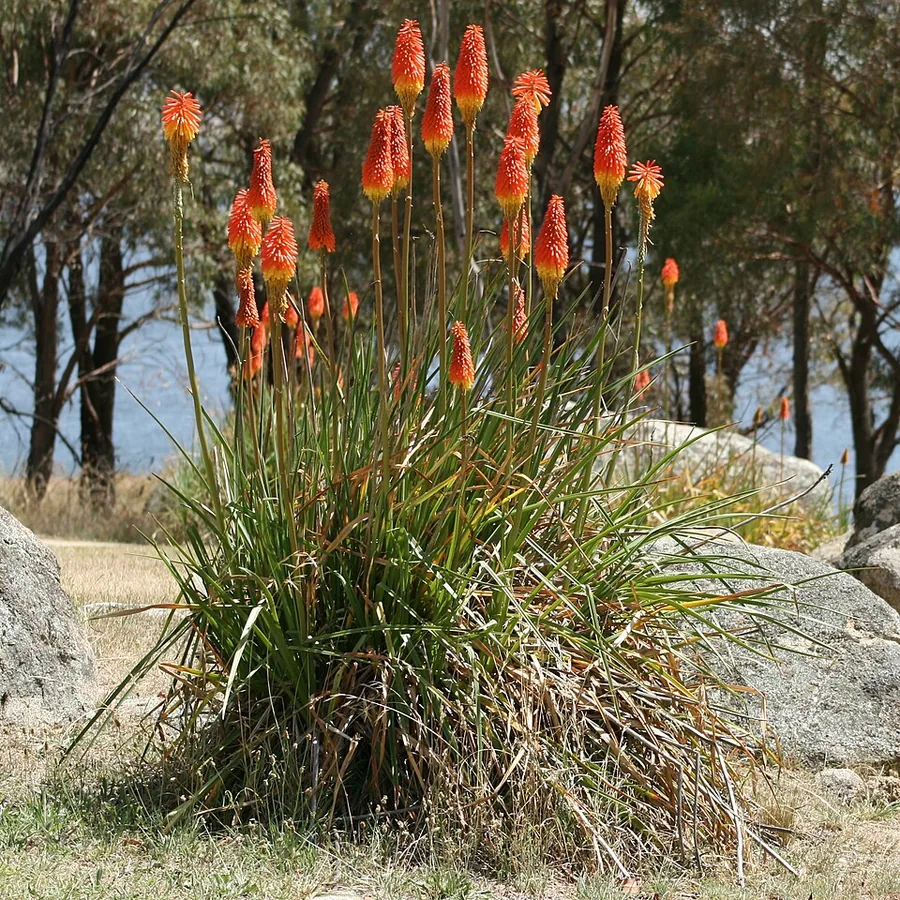
Red-hot poker really does earn that name. Every stem holds up a packed torch of tubular flowers that open red in bud and fade to yellow with age, so a single spike is wearing two colors at the same time. It grows as a grassy clump of arching leaves, and since it's related to the aloes, it's got that same tough, fleshy feel to it.
Honestly, it's about as laid-back as perennials get, and it's hardy all through USDA zones 5 to 9. Once it's settled it barely asks for anything, and it just shrugs off heat, drought, and thin sandy soil. The only thing it won't put up with? Wet, heavy soil sitting around its crown.
The pollinators are big fans. Hummingbirds and butterflies work the nectar-rich spikes all summer long, while deer and rabbits tend to wander past it. One thing worth a quick check first, though: it's gone invasive in some parts of the U.S., so look at your local guidance before planting.
Care
The short version: it's all about full sun and soil that drains fast. Water it while it's getting established, then pretty much leave it be, keep the crown dry over winter, and clip off the finished spikes to keep more coming.
Light
Red-hot poker wants full sun, so aim for at least 6 hours of direct light a day. It'll put up with a little partial shade, but skimp on the sun and guess what? You'll get loads of leaves and hardly any of those spikes.
Water
While it's settling in, keep the soil a bit moist, then you can ease off, because once it's rooted it shrugs off dry spells no problem. What it really can't handle is wet, heavy, or soggy ground, especially over winter, since that's what rots the roots.
Soil
Pop it into well-drained loam or sand, anywhere from average to rich, with some compost mixed in. It's not fussy about pH and takes 6.0 to 8.0, acidic or alkaline, so honestly the only thing that matters is that water drains away fast.
Humidity
No need to worry about humidity here, since ordinary outdoor air does the job. What actually counts is keeping the crown and roots on the dry side instead of damp.
Feeding
An all-purpose balanced fertilizer during the growing season is all it asks for, and only when it looks like it wants it. It's happy in lean soil, so there's really no reason to overdo the feeding.
Pruning
Clip off the spent flower spikes as soon as they fade and you'll get more blooms out of it. Leave the leaves standing through winter to keep the crown snug, and where it gets really cold, mulch over it or tie the leaves up so water can't sit and freeze in the crown.
Size & spacing
In flower these clumps hit 2 to 4 feet (60 to 120 cm) tall and spread out 24 to 35 inches (60 to 90 cm) wide. Give each one that much space and the leaves stay open with air moving through, which it likes.
When to plant
This one likes to move with the warm season, so here's the rhythm. Start seed indoors in late winter, then plant out or split clumps in spring once the frost's done, or just plant in fall instead. The spikes start showing off from early summer and keep going into early autumn.
Northern hemisphere
Southern hemisphere
Typical months for a temperate climate: start earlier in warm zones, later where spring frosts linger.
- Sow: Start seed indoors in late winter, about 6 to 8 weeks before the last frost
- Plant: Transplant or divide in spring after frost danger passes, or in fall
- Harvest: Late spring to early fall, with main flush from early summer; spikes are red in bud and mature to yellow
Hardiness
USDA hardiness zones: 5–9
Temperature: down to -29°C
Troubleshooting
Here's the good news: it's a tough plant, and nearly everything that goes wrong comes down to soil that's too wet. Keep half an eye on the crown, the leaves, and how many spikes turn up, and you'll spot trouble early. Find what matches below and deal with it before it spreads.
The crown's gone soft and brown and it's toppling
So this is root rot, and it's down to soggy soil, not some bug or disease. The plant hates heavy, wet ground, and water hanging around the crown over winter is usually what gets it. Mix some sand or compost into the bed, go easier on the watering, and if the ground just won't dry out, move the plant up to a raised, free-draining spot.
Fix:
- Improve drainage by amending with organic matter or sand
- Avoid overwatering and standing water
- Relocate to a raised or well-drained site if soil stays wet
Barely any flower spikes turning up
Nine times out of ten it's not enough sun. Give it a full-sun spot with at least 6 hours of direct light and the flowers usually show up. An old, packed clump can slow down too, so leave a settled plant where it is and only split it once it's gotten really crowded.
Fix:
- Site in full sun with at least 6 hours of direct light
- Leave established clumps undisturbed
- Divide only when clumps become overcrowded
Leaves going stippled with silvery streaks
Those silvery marks? That's thrips scraping away at the leaves. Get up close and you'll see the skinny little insects hanging around on the foliage. A good blast of water sorts out a light case, snip off the worst-looking leaves, and only bother with an insecticidal spray if they really won't quit.
Fix:
- Hose off light infestations with water
- Remove and destroy heavily damaged foliage
- Treat persistent infestations with an appropriate insecticidal control
Toxicity
Worried about the pets? Don't be, because red-hot poker is non-toxic all around. The ASPCA gives torch lily a pass for cats, dogs, and horses, and there's nothing here that'll poison other animals or kids either. The most that happens after a big mouthful is a bit of a stomachache, and that's true of most leaves.
Safe for
People · Cats · Dogs · Horses · Rabbits · Livestock · Birds
Cats None
The ASPCA says torch lily is non-toxic to cats, so a little nibble is nothing to stress about. A cat that scarfs down a lot of any plant might bring some back up, but there's no actual poison in the leaves.
Dogs None
Dogs can chew away at the foliage without any harm, since it's non-toxic to them too. About the worst you'll get from a leafy snack-attack is a quick bit of tummy trouble.
Horses None
Horses are totally fine around red-hot poker, and the ASPCA clears them as well. There's no toxin in the leaves or the flower spikes, so a stolen bite won't do anything.
Rabbits Safe
Nothing in the plant is poisonous to rabbits. They usually skip it anyway, since it's known to be rabbit resistant, so most clumps just sit there untouched in the border.
Livestock Safe
Grazers like cattle, goats, and sheep have nothing to fear from it. Those tough, fibrous leaves aren't really their thing, but a mouthful won't hurt them.
Birds Safe
There's no toxin here that'd bother a bird. If anything, hummingbirds and other pollinators love the nectar-rich spikes, which is honestly one of the best things about it.
People Safe
Red-hot poker is safe to handle and to have around kids. Nobody's eating it, but there's no poison to worry about if someone touches the leaves or a dropped flower.
Varieties
The named types mostly just switch up the color and size, from warm oranges to little compact ones. These are the ones you'll probably bump into.
Echo Mango
This one goes for warm, mango-orange spikes instead of the classic fiery red.
Redhot Popsicle
A little Popsicle-series plant that keeps pushing out bright red-and-yellow spikes over a really long bloom season.
POCO Orange
A dwarf at about 20 to 24 inches tall with clear orange flowers, perfect for a small bed or right up front in a border.
How to propagate
Want more red-hot poker? You can either split a clump or grow it from seed, though both need a bit of patience before you see flowers.
DivisionModerate
Spring or fall · One to two growing seasons
Splitting a clump is your best bet for more plants, and you'll do it in spring or fall. Fair warning, though: the roots are so tough and vigorous that you might need a shovel, a saw, or even an axe to get an old clump apart. The new bits take one to two growing seasons to settle, so leave anything that's already doing great right where it is.
SeedModerate
Start indoors in late winter or sow when ripe · Seed-grown plants may take a few years to reach flowering size
You can grow the species from seed too, either started indoors in late winter or sown fresh when it's ripe. Just don't expect quick results, because seed-grown plants often need a few years to reach flowering size. And seed off a hybrid? That's a gamble, since the seedlings hardly ever match the parent.
Myths
Red-hot poker will poison your cat or dog.
The fiery color throws people off, but there's honestly no poison in it. The ASPCA has torch lily (Kniphofia) down as non-toxic to dogs, cats, and horses, so a curious nibble isn't worth a vet trip.
You've got to cut the leaves right back in fall or the plant won't make it.
Nope, that backfires. Leave the leaves standing through winter so they cover the crown, and if your winters run cold, tie them together or throw some mulch over the top so water can't collect and freeze down in the middle.