Tree · Magnoliaceae
Southern Magnolia
Magnolia grandiflora
A big, easygoing evergreen with glossy leaves and lemon-scented white blooms that'll anchor a yard for generations.
Full sun
Every 7–14 days
USDA 6–10
60–80 ft · 18.3–24.4 m
Overview
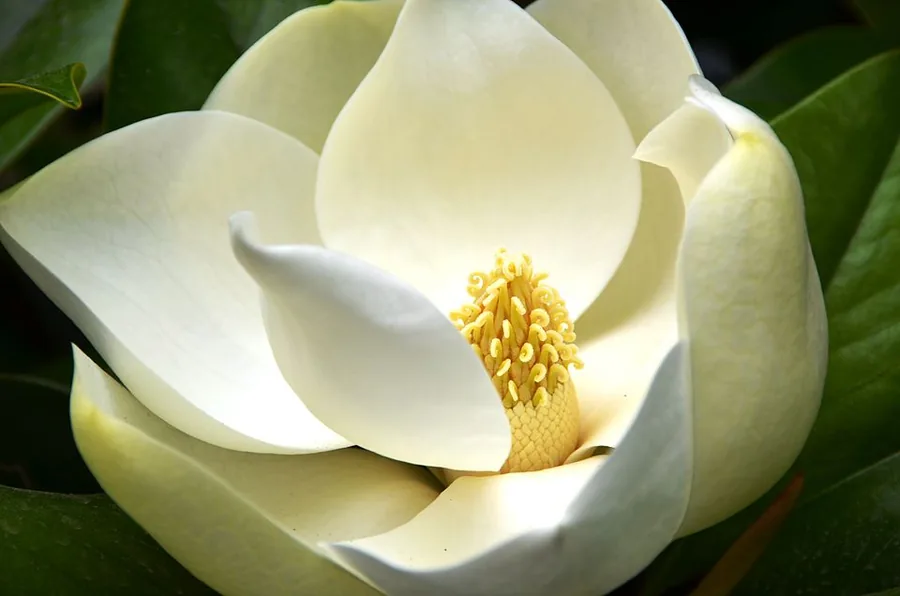
Ever notice how much of the American South looks the way it does? A lot of that is the southern magnolia, the broad-leaved evergreen that shows up everywhere down there. It grows into a big, stately tree of 60 to 80 feet (18 to 24 m), with thick, leathery leaves that shine dark green on top and often wear a rusty-brown felt underneath. From late spring into summer it opens huge white flowers, each one cup-shaped and lemon-scented, and honestly the whole yard ends up smelling wonderful.
Here's the thing, though: this is a tree for the long haul, and it wants space. It throws dense shade all year and pushes out wide, shallow surface roots, so good luck getting grass to grow underneath it. It also drops leathery leaves, old flowers, and cone-like fruit pretty much all year, so there's always a bit of cleanup. Just pop it somewhere the shade and mess don't matter, well away from lawns and foundations, and you're set.
Give it a decent spot and it barely asks for anything. It likes rich, moist, acidic soil and steady water while it's getting established, and after that it mostly runs itself, with no serious pests beyond the odd run-in with scale. And if you're up north where it supposedly can't grow? Newer cultivars have pushed it well past its old range, so cooler gardens can grow one too.
Care
The short version: full sun to part shade, rich and steadily moist acidic soil, a deep drink during dry spells while it's young, and hardly any pruning beyond snipping out dead or crossing wood.
Light
Southern magnolia loves full sun, but it's totally fine with partial sun and partial shade too. Give it more sun and you'll get denser growth and a heavier flush of flowers; tuck it somewhere shadier and you'll get a looser, more open tree instead. Either way works.
Water
Keep the soil consistently moist, and water deeply when things get dry, especially while the tree's still settling in. Once it's established, a good soak every 7 to 14 days in dry weather does the trick. Just don't let it sit in a long drought or in standing water, because it can't handle either one.
Soil
Plant it in rich, well-drained loam that stays a bit moist and has plenty of organic matter. It leans acidic, so it's happiest around a pH of 5.0 to 6.5. It'll deal with clay if it has to, but soggy or extreme soil is where it starts to sulk.
Temperature
This tree takes a wide range in stride, from about -9°F to 100°F (-23°C to 38°C), which covers Zones 6 through 10. If you're right at the cold northern edge, just go with a hardy cultivar and you'll worry a lot less.
Humidity
Regular outdoor air is plenty, so there's no humidity number to chase. Warm, muggy weather can bring on some algal leaf spot, but that's just cosmetic and nothing to stress about.
Feeding
Feed it once in spring with a balanced or acid-forming slow-release fertilizer made for acid-loving trees. Go easy, though, because too much nitrogen pushes out soft growth, and that's exactly what scale insects come looking for.
Pruning
Good news, it barely needs any pruning. Just take out dead, damaged, or crossing branches in late winter to early spring, and if you'd rather hide the leaf litter than show off a bare trunk, go ahead and let those low limbs sweep the ground.
Repotting
A tree in the ground never needs repotting, and even a potted one only gets moved rarely. How do you know a nursery plant has outgrown its pot? Look for roots circling the rootball, roots poking out the drainage holes, and water that runs straight through instead of soaking in.
Size & spacing
Plan for a big tree, 60 to 80 feet (18 to 24 m) tall and 30 to 50 feet (9 to 15 m) wide. Give it that whole footprint of open space, clear of buildings and lawn, so the canopy and those surface roots have room to spread out.
When to plant
This one's a plant-it-and-leave-it tree, not something you fuss over the calendar for. Set it out in spring or fall while the weather's mild and let it settle in. After that, the only dates that matter are its own: those big white flowers show up from late spring into summer, go all-out in May and June, then keep trickling along after.
Northern hemisphere
Southern hemisphere
Typical months for a temperate climate: start earlier in warm zones, later where spring frosts linger.
- Plant: Spring or fall
- Harvest: Late spring to summer (May to June, with sparse continued flowering through summer)
Hardiness
USDA hardiness zones: 6–10
Temperature: down to -23°C
Troubleshooting
A happy southern magnolia hardly ever causes drama, and when it does, it's usually right there on the twigs or leaves where you can spot it. Catch it early and most of it's an easy fix. Find whatever matches what you're seeing below, then deal with it before it spreads.
Whole branches wilting and dying back one at a time
When branches wilt and brown out one by one on their own, it's usually verticillium wilt, a soil fungus that clogs the wood from the inside. Cut into the bark and you might see dark streaks in the wood, but only a lab test gives you a real answer. There's no chemical cure, so just prune out the dead wood and keep the tree strong with steady water and feeding, and it can keep going for years.
Fix:
- Prune out and destroy affected dead branches
- Fertilize and water during dry weather to support recovery
- There is no chemical cure; keep the tree vigorous
Waxy white bumps on the twigs with a sticky black film below
See those raised, shell-like bumps? That's magnolia scale, one of the very few pests that ever bugs this tree. As the scales feed, they drip honeydew, and a black sooty mold grows on it across the leaves underneath. Prune out the worst twigs, hit the overwintering scale with horticultural oil in the dormant season, and go after the crawlers in late summer, and you'll have it handled.
Fix:
- Prune out and destroy heavily infested twigs
- Apply horticultural oil during the dormant season to smother overwintering scale
- Treat crawlers in late summer when young scales are active
Spots and blotches on the leaves, with a bit of early leaf drop
Most of the leaf spots you'll see are fungal or bacterial, and when it's warm and humid you might also spot the greenish-gray patches of algal leaf spot. None of it actually hurts the tree long-term, though. Rake up and bin the fallen leaves, open the canopy with a little light pruning so air can move through, and skip the sprays, because they're honestly rarely worth it here.
Fix:
- Rake up and dispose of infected fallen leaves
- Improve air circulation by spacing and selective pruning
- Chemical control is rarely needed
Toxicity
Got pets? Good news, because the southern magnolia is safe. The ASPCA has magnolia down as non-toxic to cats, dogs, and horses, and nothing in the tree is going to poison people, livestock, birds, or rabbits either. The worst that a big mouthful of leaves might do is a quick, mild bout of stomach upset, same as a lot of other plants.
Safe for
People · Cats · Dogs · Horses · Rabbits · Livestock · Birds
Cats None
The ASPCA lists magnolia as non-toxic to cats, so a nibbled leaf is no big deal. If a cat really goes to town on the foliage, it might drool or throw up once, but that's just the way any rough plant material can upset a stomach.
Dogs None
Dogs can chew the leaves without any poisoning risk at all. The most you'll probably see from a big mouthful is a quick bout of vomiting or a loose stool while the fibrous stuff passes through.
Horses None
Horses are fine too, since magnolia's on the ASPCA's non-toxic list. The tough, leathery leaves aren't exactly their favorite snack anyway, and a stray mouthful won't hurt them.
Rabbits Safe
There's no toxin here to worry a rabbit. Their gut only handles small amounts of new greenery well, though, so treat the odd leaf as a curiosity rather than part of dinner.
Livestock Safe
Cattle, goats, and sheep can graze right near a southern magnolia and be totally fine, because nothing in the tree is poisonous to them. They usually leave those stiff evergreen leaves alone anyway.
Birds Safe
The tree's no chemical danger to birds, and they'll often shelter and nest in that dense canopy. Some will even pick at the bright red seeds in fall without any trouble.
People Safe
Southern magnolia isn't poisonous to people, and no part of it is known to hurt anyone who handles it. That said, the leaves and flowers aren't food, so there's really no reason to eat them.
As with any plant, ingestion of plant material may cause mild, transient gastrointestinal upset even though the plant is non-toxic.
Varieties
A handful of named selections tweak the wild tree a little, swapping some height for extra cold tolerance, smaller leaves, or a tidier shape. Here are the ones worth knowing about.
Little Gem
A compact semi-dwarf that only gets to about 30 feet, with smaller leaves and flowers, and it starts blooming young, so it's perfect for a yard that's too small for the full-size tree.
Bracken's Brown Beauty
A cold-hardy, compact pick that holds up all the way to Zone 6, with smaller leaves backed by a thick, rusty-brown felt underneath.
Edith Bogue
One of the toughest choices for a rough site, and it's loved for just shrugging off cold, wind, and heavy snow.
D.D. Blanchard
A fast, vigorous grower that hits about 75 feet on a straight trunk, with dark glossy leaves and rich brown undersides.
How to propagate
Want more magnolias? You can grow one from seed or clone one you've already got, though every method here takes some patience. Which one's right for you really just depends on whether you need to keep a specific cultivar's traits.
SeedModerate
Sow cleaned seed in fall or after cold stratification · Several months to germinate; years to reach flowering size
First, strip off that red fleshy coat, then sow the cleaned seed in fall or give it a cold spell first. Germination takes several months, and a seedling needs years to reach flowering size while it builds up a strong taproot, so don't expect anything quick. And heads up, seed won't copy a named cultivar, so only go this route if you're happy with whatever you end up getting.
Air layeringModerate
Spring to summer on actively growing wood · Several months to root
Air-layering is the most reliable way to clone a southern magnolia and hang onto its cultivar traits. Work on actively growing wood from spring through summer, and give it several months to root before you cut the new plant free.
Stem cuttingsDemanding
Semi-hardwood cuttings in summer · Several weeks to months under mist
Take semi-hardwood cuttings in summer, dip them in rooting hormone, and keep them under mist. Rooting's slow and kind of hit-or-miss here, anywhere from several weeks to a few months, which is why this one really tests your patience.
GraftingDemanding
Late winter to spring · One or more seasons to unite
Grafting from late winter into spring joins a named cultivar onto seedling rootstock so the new tree keeps its parent's traits. The union needs one or more seasons to really knit together, and it takes a pretty skilled hand, so it's not the easiest place to start.
Myths
Southern magnolia is poisonous to dogs and cats.
Nope, and you can relax, because the ASPCA lists magnolia as non-toxic to dogs, cats, and horses, so a curious pet that chews a leaf is in no danger. Worst case, you get a quick, mild bout of stomach upset, the same thing any plant can cause. You can plant it around pets without worrying.