Tree · Magnoliaceae
Tulip Tree
Liriodendron tulipifera
A fast, towering shade tree that hangs tulip-shaped flowers way up in the canopy and lights up golden every fall.
Full sun
Every 7–14 days
USDA 4–9
60–120 ft · 18.3–36.6 m
Overview
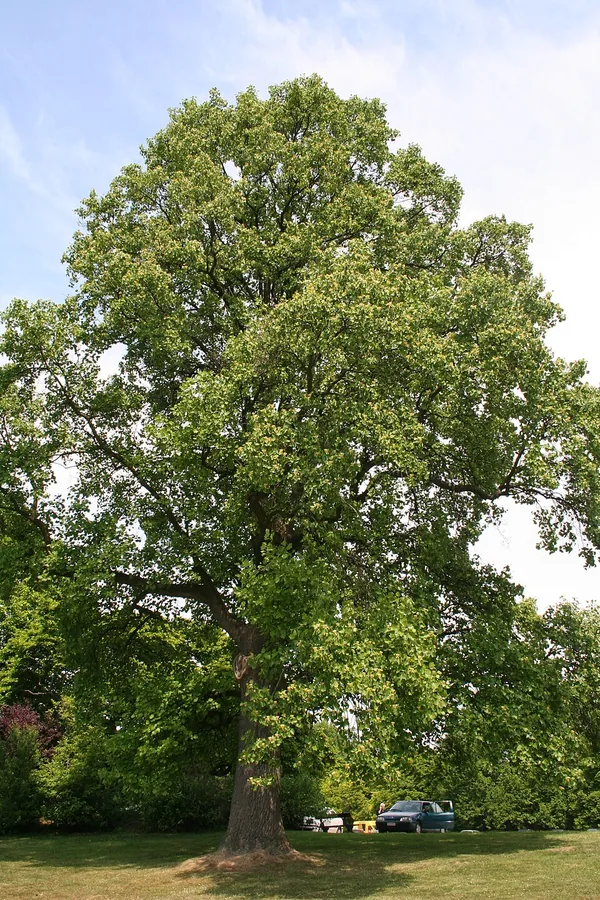
So here's the thing about the tulip tree: it's one of the tallest hardwoods in eastern North America, and despite the name it's actually part of the magnolia family. Give it enough years and it'll hit 60 to 120 feet (18 to 37 m). You'll know it by the four-lobed leaves, shaped a bit like a cat's face, that go clear yellow in fall. And those flowers? In late spring it puts out cup-shaped greenish-yellow blooms with an orange band, the ones it's named for, though they usually sit so high you'll barely notice them.
Don't let tulip poplar or yellow poplar throw you off, because it's not a poplar and not a true tulip at all. It grows fast and straight, and that soft, even wood has been turned into everything from canoes to crates over the years. The catch? All that speed leaves the wood brittle, so a limb can snap in wind, ice, or snow.
If there's one thing this tree asks for, it's elbow room. The roots stay shallow and the crown can spread 30 to 60 feet (9 to 18 m), so it really wants open ground away from the house, the driveway, and any tight little beds. Give it space and deep, moist soil, though, and you've basically planted a landmark that'll outlive whoever put it in the ground.
Care
The short version: full sun, deep and moist fertile soil that runs a little acidic, and lots of open space, since this thing gets huge. Keep the young trees watered when it's dry, prune that brittle wood in late winter, and plant it well away from anything a falling limb could land on.
Light
Tulip trees really want full sun to grow straight and flower well, though a young one will put up with a little partial shade. Too much shade and it just stretches out and gets thin, so an open spot is worth it.
Water
This tree loves deep, moist, fertile soil and doesn't handle drought all that well. When summer turns hot and dry it'll shed its inner leaves and drop foliage early, so water young and establishing trees deeply during dry stretches. A grown tree on good soil? It pretty much takes care of itself.
Soil
Plant it in deep, rich, well-drained loam with plenty of organic matter mixed in. It likes things a bit acidic, somewhere around a pH of 5.0 to 6.5, but it'll roll with a wider range than that. What it won't put up with is compacted or confined soil, so skip the cramped or paved-over spots.
Temperature
Cold's not really an issue here, since it's happy across USDA zones 4 to 9 and handles anything from about -29°F to 100°F (-34°C to 38°C). That covers most of the temperate parts of its home turf in eastern North America.
Humidity
Outside, humidity is just whatever the weather's doing, so there's no number to worry about. It grows in humid and drier places alike, and honestly it's the moisture in the soil that counts way more than the moisture in the air.
Feeding
On rich native soil, a tulip tree usually needs no feeding at all. If your dirt's on the poor side, mix in a balanced tree fertilizer in early spring, and otherwise just let the tree do its thing.
Pruning
Do your pruning in late winter, taking out anything dead, weak, or crossing. Since the wood's brittle and snaps pretty easily, getting the structure right early saves you from bigger limb breakage later on. Keep the cuts small and well timed and you're good.
Repotting
No repotting to think about here, because a tulip tree isn't a container plant. It's a big landscape and forest shade tree that lives in the ground, so once it's in its spot for good, that's that.
Size & spacing
Plan on a grown tree hitting 60 to 120 feet (18 to 37 m) tall with a crown spreading 30 to 60 feet (9 to 18 m) wide. Give it a home with that full size in mind, well clear of the house, power lines, and pavement, because crowding a tree this big just asks for trouble.
When to plant
Go ahead and plant in spring or fall, once the soil's workable, and leave it way more room than you'd think. The flowers show up in late spring, May into June, high up in the branches. Since it grows fast right from the start, where you put it matters a lot more than when.
Northern hemisphere
Southern hemisphere
Typical months for a temperate climate: start earlier in warm zones, later where spring frosts linger.
- Plant: Spring or fall, after the soil can be worked; give ample room for a very large mature canopy.
- Harvest: Cup-shaped greenish-yellow flowers with an orange band bloom in late spring (May to June), often high in the canopy.
Hardiness
USDA hardiness zones: 4–9
Temperature: down to -34°C
Troubleshooting
Most tulip tree problems turn up on the leaves, either from sap-feeding bugs or a dry summer. The good news? It's a big enough tree that a lot of the damage is just cosmetic, but the early signs will tell you whether to jump in or hold off. Find what matches below and take it from there.
Sticky leaves, black mold, and early leaf drop
If the leaves are sticky and turning black, you're probably looking at tuliptree scale or tuliptree aphid, both of which suck sap and drip honeydew onto the leaves below, where sooty mold moves in. Go after scale with dormant oil in early spring, or hit the crawlers from mid-August into September, and handle aphids with horticultural oil or insecticidal soap. Honestly, lady beetles and lacewings usually take care of the aphids for you by early summer.
Fix:
- Apply dormant horticultural oil in early spring to scale-infested twigs.
- Treat scale crawlers with an appropriate insecticide from mid-August through mid-September, or use a systemic soil application in early spring with adequate soil moisture.
- For aphids, use horticultural oil or insecticidal soap; natural enemies such as lady beetles, lacewings, and parasitoids often reduce aphid populations by early summer.
Crescent-shaped notches and burnt-looking leaves
Those half-moon notches with brown, scorched-looking leaves are the yellowpoplar weevil, a tiny black beetle that chews little crescents and plays dead the second you touch a leaf. On an established tree it's really just a cosmetic thing, so there's no need to spray. Keep the tree watered through drought, and only bother treating a young or small one that's getting hammered.
Fix:
- Damage is largely aesthetic on established trees; tolerate light feeding.
- Maintain tree vigor and adequate soil moisture so the tree can recover from heavy summer feeding.
- Treat only severe infestations on small or young trees following extension guidance.
Yellow leaves dropping early when it's hot and dry
Tulip trees drop their older, inner leaves first when drought stress kicks in, so dry soil in a hot spell is usually what's going on. Before you chalk it all up to the weather, though, check the rest of the leaves for honeydew, scale, and aphids, since those can speed the yellowing up. Water deep and slow during long dry spells, throw some mulch over the roots to hold moisture, and the tree will be fine.
Fix:
- Provide deep, slow watering during prolonged dry spells, especially for young trees.
- Mulch over the root zone to conserve soil moisture.
- Address any aphid or scale honeydew that is worsening leaf decline.
Toxicity
Got pets? Good news, because the tulip tree is totally safe. The ASPCA lists it as non-toxic to dogs, cats, and horses, and since it's a magnolia cousin and not a true Tulipa tulip, it doesn't have any of the bulb toxins that make garden tulips a problem. Nothing here to keep pets, livestock, or kids away from.
Safe for
People · Cats · Dogs · Horses · Rabbits · Livestock · Birds
Cats None
The ASPCA calls this one non-toxic to cats, so if yours chews on a fallen leaf, there's nothing to stress about.
Dogs None
Dogs are fine around it. Even with the tulip name, it's no real tulip and doesn't carry the bulb toxins that make actual tulips a worry.
Horses None
Horses can graze right next to a tulip tree, no problem, since the ASPCA rates it non-toxic to them too.
Rabbits Safe
Rabbits aren't in any danger from the leaves or twigs of this magnolia relative.
Livestock Safe
Cattle, goats, and sheep can browse the leaves without any known risk of poisoning.
Birds Safe
Birds nest and feed in these trees all they want, and the flowers, seeds, and bark are no threat.
People Safe
There's nothing toxic here for people either, though you wouldn't grow any part of it to eat.
No special handling precautions for toxicity; this is a very large landscape tree rather than a household plant.
Varieties
Most tulip trees you'll run into are just the plain species, but a few named types either shrink that giant size or add a little color. These are the ones you're most likely to actually find.
'Fastigiatum' (also 'Arnold')
This one stays narrow and upright, a columnar shape that'll squeeze into a tighter spot than the wide-spreading species ever could.
'Aureomarginatum' (Aureo-marginatum)
Its leaves are variegated, edged with yellow to greenish-yellow around a green middle.
'Little Volunteer'
It's a dwarf pick that stays a lot more compact, with smaller leaves and a much smaller size all around.
How to propagate
Making more tulip trees at home isn't exactly easy, which is why most of them come from a nursery. Seed's slow and kind of hit-or-miss, and the named types have to be grafted.
SeedDemanding
Sow stratified seed in fall to early spring · Several years to a sapling
Growing one from seed takes some real patience, just so you know. The seed comes from those cone-like samara clusters, but a lot of it never sprouts, so sow way more than you think you'll need and expect germination to come in dribs and drabs. Sow stratified seed from fall into early spring, and then it's several years before a seedling turns into a sapling.
GraftingDemanding
Late winter to early spring · 1-2 seasons to establish a graft
The named types won't come true from seed, so nurseries just graft them instead, usually from late winter into early spring. A graft takes about one to two seasons to really settle in. Softwood cuttings are technically an option, but good luck, since they're notoriously tough to root.
Myths
Since it's called a tulip poplar, it must be a real poplar and just as toxic to pets as garden tulips.
The names tulip poplar and yellow poplar really do trip people up. Liriodendron tulipifera is in the magnolia family, not the poplars, and definitely not the Tulipa tulips that grow from poisonous bulbs. The ASPCA lists it as non-toxic to dogs, cats, and horses, so it's got none of the bulb toxicity the name might make you expect.