Houseplant · Cactaceae
Star Cactus
Astrophytum asterias
Give it bright light and gritty soil, let it dry out completely before the next drink, and this little spineless star pretty much takes care of itself.
Bright indirect
Every 14–21 days
USDA 9–11
1–2 in · 3–6 cm
Overview
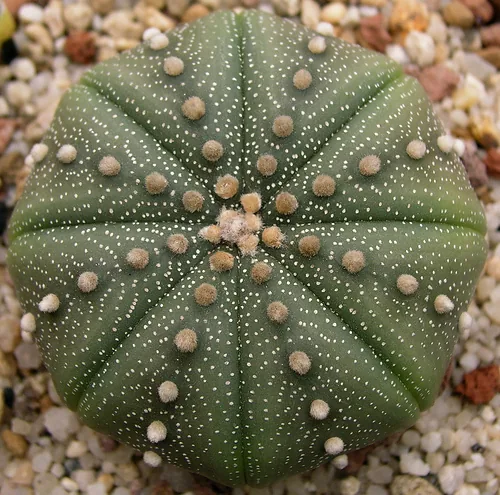
So what is a star cactus? It's a tiny desert plant that looks a lot like a sand dollar pressed flat into the dirt, smooth and ribbed with no spines. It only grows wild in a narrow slice of south Texas and northern Mexico, hugging the ground among the rocks. And it's in no hurry at all, so a plant the size of a coin might already be years old. Those pale woolly flecks dotted over its green body are what give it that starry look and its name.
It's a cactus, sure, but it throws out the rulebook by having no spines at all, which makes it really easy to pick up. That smooth top is also why folks keep mixing it up with peyote, and that mix-up has led to a lot of illegal collecting out in the wild. Come late spring, though, it puts on a show with yellow flowers that have red throats, sitting right on top of the body.
Here's the thing: this plant doesn't ask for much, as long as what it does get is the right kind of care. It's one of the most protected cacti out there, endangered in the wild and watched closely in trade, so whatever you grow should come from a nursery. Get the soil and watering sorted and honestly, the rest takes care of itself.
Care
The short version: give it bright light and a gritty mix that drains in a hurry, water it deeply only once the soil's bone dry, and pretty much leave it alone through winter.
Light
Above all, it wants bright light. Bright, indirect light is its happy place, and it'll take a bit of direct sun too, but ease it into strong sun slowly, because a plant that's used to shade can get scorched if you shove it straight into a hot window.
Water
This is where most star cacti meet their end, so go easy. Only water it deeply once the gritty mix has dried out completely, which usually works out to about every 14 to 21 days in the spring and summer growing stretch. In winter? Keep it nearly bone dry, because that plump body rots fast if it's sitting wet in the cold.
Soil
Pop it in a fast-draining mineral mix, the sandy or gravelly kind without much organic matter in it. A neutral pH somewhere around 6.5 to 7.5 works nicely, and all that grit is what lets water rush right through before it can rot the roots.
Temperature
It's pretty relaxed about temperature, comfy anywhere from about 23°F to 95°F (-5°C to 35°C), though that low end only counts if the plant's kept bone dry. Warmth is what gets it growing, while cold and damp together are the real troublemakers.
Humidity
Keep the air on the dry side, roughly 20% to 40%. It's a desert plant, remember, so muggy, stagnant air just invites the rot and fungus it can't really fight off.
Feeding
Feed it lightly, and only while it's growing in spring and summer. A dilute, low-nitrogen cactus fertilizer once a month is plenty, since too much nitrogen pushes soft growth that ends up splitting and rotting.
Pruning
Honestly, there's nothing to prune here. Grab a sterile blade only if you need to clear off spent flowers or rotted bits, never just to tidy its shape.
Repotting
Repot it every 2 to 3 years, or sooner if roots start creeping out the drainage holes or the body fills up the pot. Move it into fresh gritty mix, then hold off watering for a few days so any roots that got jostled have a chance to heal.
Size & spacing
This one stays tiny. It maxes out at just 1 to 2 inches (3 to 6 cm) tall and spreads to about 2 to 6 inches (5 to 15 cm) wide, and it grows so slowly that it'll happily sit in a small pot for years.
Troubleshooting
Good news: just about every problem a star cactus runs into comes down to water, and it shows up right on the body. Once you can spot whether the flesh has gone soft, wrinkly, or fuzzy with pests, you can jump in before a little slip turns into a big one. Find what matches below and deal with it quickly.
Soft, dark, mushy spots on the body or down near the base
Those soft, dark spots? That's rot, and with a star cactus it almost always comes back to too much water or a mix that stays soggy. It usually kicks off right at the soil line, where the damp keeps pressing against that fleshy body. Quit watering right away, cut back to firm green tissue with a sterile blade, let the cut dry and callus in some airy shade, then repot it into fresh gritty mineral mix.
Fix:
- Stop watering immediately
- Cut away all rotted tissue with a sterile blade until only firm green tissue remains
- Let the cut surfaces callus in dry, airy shade
- Repot into fresh fast-draining mineral mix and water only sparingly once healed
A wrinkled, shrunken, or saggy body
A shriveled body can go one of two ways. If the soil's totally dry and the roots are still good, it's just thirsty, and a nice deep soak will perk it right back up. But if the soil's still damp, the roots have probably rotted, so handle it like rot: trim back to healthy tissue and let it re-root in dry mineral mix.
Fix:
- If dehydrated, give a thorough soak and resume regular dry-down watering
- If roots are rotted, treat as rot: cut back to healthy tissue, callus, and re-root in dry mineral mix
White cottony fluff in the areoles with weak, faded growth
See that cottony fluff? Those are mealybugs, tucked into the woolly areoles where they're easy to miss. Give one a poke to check: a bug smears, but the plant's own white wool and flecks won't. Move the cactus away from your others, dab each pest with a swab of 70 percent isopropyl alcohol, then keep at it weekly and peek at the roots too, since root mealybugs like to hide down in the soil.
Fix:
- Isolate the plant
- Dab visible insects with a cotton swab dipped in 70 percent isopropyl alcohol
- Repeat weekly and inspect the roots, drenching with an appropriate insecticide if root mealybugs are present
Toxicity
Worried about pets or kids? No need, because the star cactus is safe around pets and people. There's no toxin in it, and even with that peyote nickname, there's no mescaline either. It's spineless too, so it won't poke a curious nose, but it's still not something anyone should be snacking on.
Safe for
People · Cats · Dogs · Horses · Rabbits · Livestock · Birds
Cats None
Totally fine to have in the same room. A curious cat that nibbles the body might drool a little or bring some back up, but that's just any plant matter upsetting the stomach, not a toxin.
Dogs None
No poisoning to worry about with dogs. One that chews a piece might get a quick upset tummy from the fibrous flesh, and since there are no spines, it won't prick the mouth either.
Horses Safe
There's nothing in this cactus that can poison a horse, so no need to fret about it being nearby.
Rabbits Safe
Harmless to rabbits. It's got no toxin, but it isn't a food plant, so it shouldn't end up in their diet.
Livestock Safe
Cattle, goats, and sheep can graze right next to it without getting poisoned, since there's nothing harmful in the plant.
Birds Safe
No toxic worry for birds either. A pet bird that pecks at the flesh won't come to any chemical harm.
People Safe
Safe to handle and to have around kids. Despite the peyote mix-up there's no mescaline in it, but it isn't grown to eat, so there's no reason to taste it.
Though spineless, handle this rare protected plant minimally and wash hands after contact with any houseplant; keep out of reach of pets or children inclined to chew it.
Varieties
A few named forms pop up among collectors, and most of them get picked for how their white flecks and wool show up across the body. Here are the ones worth knowing about.
'Super Kabuto'
A picked cultivar so heavily dusted with big white woolly flecks that they can just about hide the green body underneath.
var. nudum
A naturally fleckless one with a smooth, plain green body, and Kew counts it as its own separate variety.
'Ooibo Kabuto'
Known for the extra-large, raised wool spots that sit right up on its areoles.
How to propagate
Want more star cactus? There are two ways to go about it, and neither is fast. One grows the plant true from seed, and the other speeds things up by grafting it onto a tougher root.
SeedDemanding
Spring, in warmth · Several months to germinate and establish; years to reach flowering size
Seed's the main way to go, and it keeps the most genetic variety too. Sow fresh seed in spring on a sterile gritty mix, then keep it warm and humid until it sprouts. The seedlings are slow and rot easily, so harden them off little by little and settle in for the long haul, because it takes several months just to establish and years more to reach flowering size.
GraftingModerate
Spring-summer, during active growth · A few weeks for the graft union to take
A lot of growers graft star cactus onto a strong rootstock to speed up its growth and skip the rot that wipes out so many seedlings, which is handy for the prized cultivars especially. Do it in spring or summer while it's actively growing, and the union usually knits together in a few weeks.
Myths
Star cactus is basically peyote and is loaded with mescaline.
People muddle it up with peyote so often that one of its nicknames is actually star peyote, but they're two totally different plants, and this one has no mescaline at all. That confusion just keeps driving illegal collection of a species that's already endangered.
Since it's got no spines, it's tough and you can water it like a leafy houseplant.
A smooth, spineless body says nothing about how thirsty the plant is. Water it too often and that fleshy tissue rots quickly, so it needs the same dry-down and gritty soil as any other desert cactus.
You're allowed to dig up or buy wild star cactus.
It's federally endangered and sits on CITES Appendix I, so pulling plants from the wild or trading wild-collected ones is flat-out illegal. Only nursery-grown plants are legal to own.