Houseplant · Asteraceae
String of Pearls
Curio rowleyanus
Water it right and you'll watch this trailing succulent send a curtain of little green beads spilling past the pot.
Bright indirect
50–81°F · 10–27°C
USDA 9–12
1–3 ft · 0.3–0.9 m
Overview
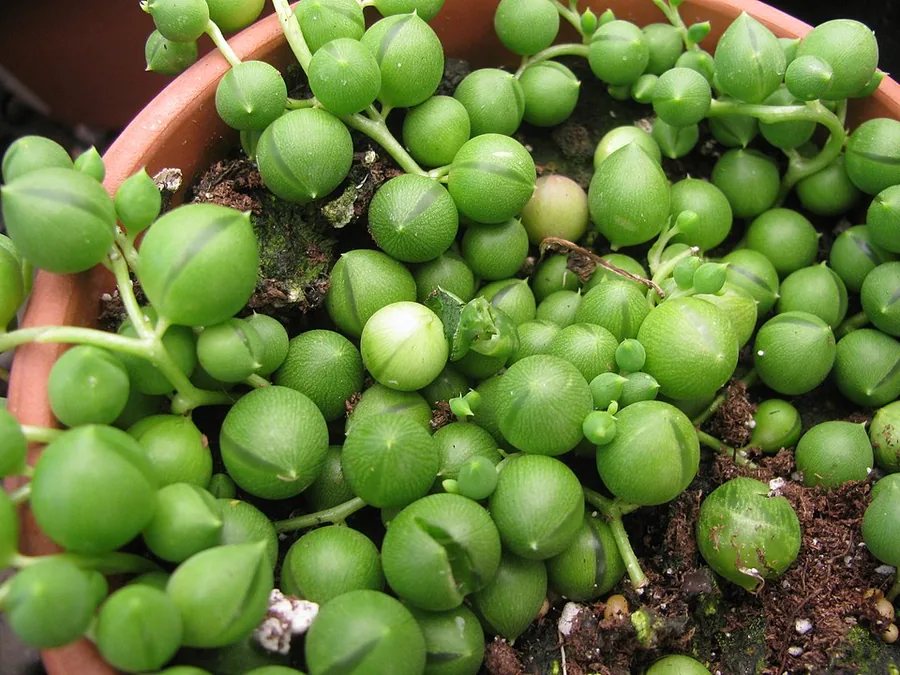
So where does string of pearls come from? The dry corners of South Africa, and those little bead-shaped leaves are basically built-in water tanks that get it through long dry spells. Each pearl even has a thin clear stripe on it, a tiny window that lets light reach the inside while the plant hangs onto its moisture. Indoors it's almost always hung up high, so the strands can spill down over the side of a basket.
Here's a fun one: it's actually in the aster family, so it's related to the daisy. Given a good summer it can pop out small white flowers with a light cinnamon scent, though honestly it barely ever blooms inside. It spent years labeled Senecio rowleyanus, and plenty of tags still say that, but the botanists have shuffled it into the genus Curio. Either way, you're getting the same trailing pearls.
Most of this really comes down to water, and the plant's pretty good at telling you what it wants. The pearls plump up when it's happy and go soft when it's thirsty, so you don't have to guess much. The fastest way to lose one, though? Leaving the soil wet. Give it bright light and a pot that drains fast, let it dry out all the way between drinks, and it'll trail along for years.
Care
The short version: bright indirect light, a gritty fast-draining mix in a shallow pot, and a good soak only once it's dried out completely, easing off in winter and giving it a light feed in spring.
Light
It likes bright indirect light, the kind you get near a window without hot sun landing right on the beads. Once it's used to it, a bit of direct sun is fine, but harsh midday rays will scorch the pearls. Not enough light, though, and the strands stretch out thin and bare, so brighter is better.
Water
This is the make-or-break part. Soak the mix until it drains, then just leave it alone until it's dried out completely, going a little heavier in summer and lighter in winter. The beads shrivel when they're thirsty, sure, but soggy soil is what brings on the root rot that takes out most of these plants, so when in doubt, wait.
Soil
Pot it in a gritty, fast-draining cactus or succulent mix so water doesn't hang around the roots. Anywhere from 6.0 to 8.0 on the pH scale is fine, and a shallow clay pot's a nice touch since it helps the soil breathe and dry out between waterings.
Temperature
Regular room warmth is all it needs, somewhere around 50°F to 81°F (10°C to 27°C). It actually likes a cooler rest in winter, down near the low end, and since it won't handle frost, keep it inside once the nights get cold.
Humidity
Dry household air? That's exactly what this succulent wants, so you can skip the misting and the pebble trays entirely. The dry air even works in your favor, keeping rot away from the stems and beads.
Feeding
It doesn't ask for much at all. Give it a light feed in spring with a dilute balanced or cactus fertilizer while it's growing, and then just leave it be through the winter rest.
Pruning
Trim back any leggy or bare strands and it'll fill out fuller, and pinching the longest stems keeps things looking tidy. Best part? The bits you snip off root easily into new plants, so you never really have to toss anything.
Repotting
No need to rush this. Repotting every one to two years is plenty, and a shallow container beats a deep one. When you spot roots crowding the pot, or the soil dries out almost the second you water it, that's your cue.
Size & spacing
The strands trail somewhere around 1 to 3 feet (30 to 91 cm) long, and it spreads out about as wide as it hangs. Pop it in a basket and those beaded stems drape well below the pot.
Troubleshooting
Almost every string of pearls problem comes back to one of two things: the watering can or the window. The nice part is the pearls basically tell on themselves, going soft when they're dry and mushy when they're too wet. Find what you're seeing below and tweak it early, before a soft stem has a chance to turn into rot.
Soft, mushy stems with pearls dropping or turning see-through
Soft, blackening stems and beads that drop off or go glassy? That's root and stem rot, and it's the number one way this plant checks out, usually because the mix stayed soggy and never dried. Stop watering right away, cut off the mushy bits, and start over by rooting a few healthy stem tips in fresh gritty mix instead of trying to save the old plant. It sounds harsh, but it works.
Fix:
- Stop watering and remove affected mushy sections
- Take healthy unaffected stem cuttings and restart in fresh gritty mix
- Repot into fast-draining cactus mix in a shallow, well-drained container
Pearls going wrinkly, soft, and kind of flat
When those plump beads start looking wrinkly and feeling soft, the plant's just thirsty, plain and simple, and that's underwatering showing up once the mix has dried out well below the surface. Give it a good drink until water runs out the bottom, then let the pot dry all the way down before the next one. Easy fix, and it perks right back up.
Fix:
- Water thoroughly until it drains, then let the mix dry completely before watering again
- Resume a regular dry-down cycle, watering more in summer than winter
Pale, brown, or crispy pearls on the sunny side
If the beads facing the window go pale or crisp up brown, that's just sun scorch from light that's too harsh and direct. The plant loves bright light, it just doesn't want blazing midday sun hitting beads that haven't toughened up yet, so move it back into bright indirect light. And whenever you bump it toward stronger sun, take a week or two to do it so it can adjust.
Fix:
- Move to bright indirect light
- Acclimate gradually before increasing sun exposure
Toxicity
Quick heads-up: this one's toxic, so give it a smart spot. The leaves and sap carry pyrrolizidine alkaloids, and if a pet eats the pearls it can end up vomiting and low on energy, while the milky sap stings skin and bothers the gut. Hang it well out of reach of pets and kids, and throw on some gloves before you prune.
Toxic to
Cats · Dogs · Horses · Rabbits · Livestock · Birds · People
Cats Toxic
If a cat chews on the pearls, it'll usually throw up and then go quiet and sluggish for a bit. You might see some drooling and loose stools too, and the sap can leave its mouth feeling sore.
Dogs Toxic
Dogs pretty much react the same way, with vomiting and low energy being the things you'll notice first. Some will also get a bit of diarrhea after chewing on the strands.
Horses Caution
Those pyrrolizidine alkaloids that run through this whole plant group are rough on a horse's liver, so keep the trailing stems out of reach. If a horse eats the leaves, it can wind up with an upset stomach and a dull, off-its-feed sort of mood.
Rabbits Caution
Just treat it as a no-go for rabbits. The same alkaloids that bother everything else make the leaves a bad, risky nibble, so don't let a bunny get at the dangling pearls.
Livestock Caution
Cattle, sheep, and goats are all sensitive to these Senecio-type alkaloids, which pile up and wear on the liver over time. A houseplant hardly ever ends up near a barn, but keep it well clear of any grazing animal just in case.
Birds Caution
There's not much solid info on birds, so the safe move is to keep a pet bird away from the strands and stick to greens you already know are okay.
People Caution
None of this plant is meant to be eaten, and swallowing the leaves can leave your stomach unsettled. The milky sap stings broken skin too, so glove up when you prune and keep little kids from popping the pearls in their mouths.
Wear gloves when handling or pruning, as the sap can irritate skin and cause a rash in sensitive individuals.
Helpline numbers

United States
ASPCA Animal Poison Control: (888) 426-4435 (fee applies)
Poison Control: (800) 222-1222



Canada
Poison Centres: 1-844-764-7669
Varieties
Pretty much everybody grows the plain green one, and it's great, but there's one named type that pops up now and then if you keep an eye out.
'Variegata' (variegated string of pearls)
Its round beads are marbled in green and creamy white, so the whole trailing strand looks a good bit paler than the regular green kind.
How to propagate
Want more string of pearls? Good news, it's easy, and you'll end up with spare strands to root basically every time you trim it.
Stem cuttingsEasy
Active growth, spring through summer · Roots typically develop at the nodes within a couple of weeks
Cuttings are the quick, no-fuss way to make more, and spring through summer is when to take them. Just snip 3 to 4 inch stem tips, strip the lower beads off, and lay the bare nodes on some moist gritty mix or tuck them in shallowly. Roots show up at each buried node within a couple of weeks, and you're set.
SeedModerate
Not commonly used in cultivation · Slow and uncommon in cultivation; less reliable than cuttings
You can grow it from seed, but is it worth it at home? Not really. The wind-borne seeds come with a little cottony tuft and are tough to find in stores, plus they're slow to sprout and way less reliable than cuttings, so most folks just don't bother.
Myths
This plant's real name is Senecio rowleyanus.
That name's still on most tags and shop listings, so it's an easy mix-up, but it's been reclassified since. Kew's Plants of the World Online now goes with Curio rowleyanus and keeps Senecio rowleyanus around as a synonym, so either name gets you to the same plant.
It's a succulent, so it lives on neglect and hardly ever needs water.
It's a bit needier than that reputation suggests, honestly. The pearls shrivel if it dries out too far, but it also rots and dies fast in wet soil, so what it's really after is a full dry-down between good soaks, not drought and not constant damp.