Houseplant · Cactaceae
Thanksgiving Cactus
Schlumbergera truncata
Hand it bright indirect light and cool fall nights, and this laid-back forest cactus will flower right when the holidays roll around.
Bright indirect
50–86°F · 10–30°C
USDA 10–12
4–20 in · 10–50 cm
Overview
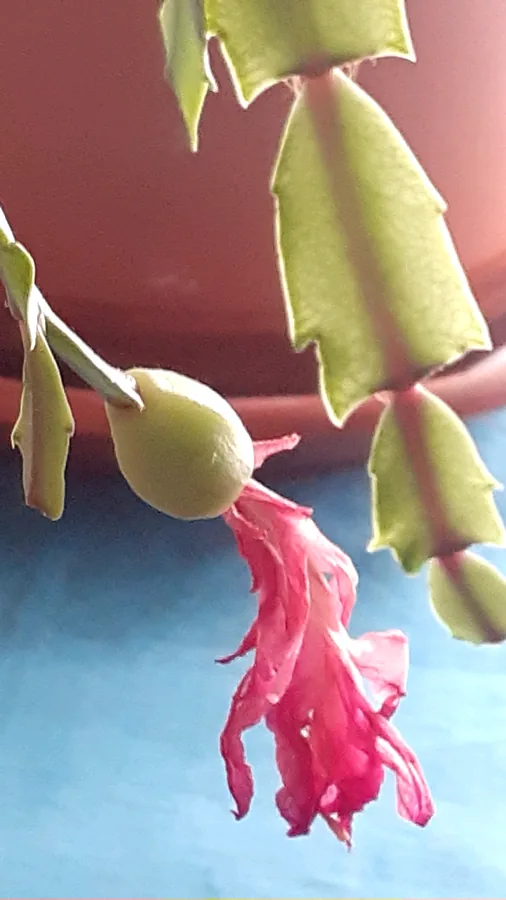
So it's called a cactus, but don't picture a spiky desert plant. The Thanksgiving cactus is really a forest cactus from the coastal mountains of Brazil, where it lives up in the trees. That's why it likes a bit more water and easier light than its desert cousins, and why it puts on a show of bright flowers in late fall, usually right when Thanksgiving comes around.
Want to know if you've got the real Thanksgiving type? Look at the stem segments. Each flat pad has pointed, claw-like teeth along the sides, which is exactly where crab cactus and claw cactus come from. The genuine Christmas cactus is a close relative with rounded, scalloped edges, and it flowers about a month behind. Funny enough, most plants sold as Christmas cactus are really this one.
The best part? It's an easy, decades-long plant that just blooms better the older it gets. It really only wants two things from you: keep things steady while it's budding, and let it feel those cool nights and short autumn days that kick off the buds. Handle that, and it'll shrug off the odd mistake.
Care
The short version: bright indirect light, a drink whenever the mix feels dry on top, and some cool fall nights to kick off the flowers. Leave it a little snug in its pot, and don't shuffle it around once the buds show up.
Light
It's happiest in bright, indirect light, not direct sun. A little partial shade or gentle sun is okay, but strong midday rays will wash the segments out to pale or red. A window that faces east or north is the sweet spot.
Water
Let the top half of the mix dry out before you water, then soak it properly. It wants more than a desert cactus would, but it can't sit soggy or the roots start to rot. Once buds show up, keep things evenly moist so they don't drop.
Soil
Go with a well-drained, organic-rich potting mix, the sort built for epiphytes that drains quickly but still holds a bit of moisture. Slightly acidic is what it likes, so aim for a pH of 5.5 to 6.5.
Temperature
It's pretty relaxed about temperature, happy anywhere from about 50°F to 86°F (10°C to 30°C). The one thing to watch is fall, when a run of cool nights and shorter days is what nudges it to start setting buds.
Humidity
Regular indoor air is plenty, so there's no humidity number to chase. A bit more moisture helps a new cutting settle in, but a grown plant really couldn't care less.
Feeding
Feed it once a month with a dilute balanced houseplant fertilizer all through spring and summer, then knock it off in late summer so it turns its attention to flowering. It's a bit hungry for magnesium, so an occasional Epsom-salt solution does the trick.
Pruning
After the blooms fade, go ahead and pinch or twist off a few stem segments. That one move gets it branching and, over time, fills it out into a fuller, bushier plant.
Repotting
You only need to repot it every 3 to 4 years, since it actually blooms better when it's a little cramped. Size up when you see roots poking out the drainage holes, water running straight through, or growth grinding to a halt.
Size & spacing
It stays small and tidy, only about 4 to 20 inches (10 to 50 cm) tall and wide. One plant will happily fill out a hanging basket, or perch on a windowsill, without crowding whatever's beside it.
Troubleshooting
Honestly, most problems here come down to two things: dropped buds, or stems that turn soft and off-color. Both usually trace back to how much you water and where the plant sits. Find what's happening below, then tweak things before it gets worse.
Soft, mushy stems turning black near the base
If the stems go soft and black, that's root rot, and it comes from soil that stays too wet. Snip off the rotted bits and any brown, mushy roots, move it into a fast-draining epiphytic mix, and go easy on the watering. Really the fix is prevention: wait for the top of the mix to dry before the next drink.
Fix:
- Reduce watering frequency
- Repot into a fast-draining epiphytic mix
- Remove rotted segments and affected roots
Buds shrivel up and fall before opening
Bud drop almost always means the plant got upset by some change. Once those buds are set, it wants one calm spot, steady watering, and no drafts or sudden temperature jumps. Move it just to admire the flowers and, sure enough, the buds fall within a few days, so it's smarter to leave it alone till they open.
Fix:
- Keep the plant in one stable spot once buds form
- Keep the mix evenly moist (not soggy) while in bud
- Avoid drafts and temperature swings
Segments washing out to pale yellow or red
When the segments turn pale yellow or red, it's usually too much direct sun, and it's at its worst in a hot, bright window over summer. Just move it somewhere with bright indirect light and keep the harsh midday sun off it. The color bounces back once the light's right.
Fix:
- Move to bright indirect light
- Shade from hot midday summer sun
Toxicity
Good news if you've got pets running around: this cactus is non-toxic to cats, dogs, horses, and everybody else in the house, and the ASPCA says the same. The only catch is pretty minor. If a pet eats a big helping of the fibrous stems, it might get a little stomach upset that passes quickly.
Safe for
People · Cats · Dogs · Horses · Rabbits · Livestock · Birds
Cats None
Cats are totally fine with it, since there's nothing toxic in the stems or flowers. If one chomps a big pile of the fibrous segments it might drool or bring a bit back up, but that sorts itself out.
Dogs None
Same story for dogs, no poison to worry about. The most a big mouthful of the chewy stems does is give them a short bout of mild tummy upset.
Horses Safe
Horses are cleared by the ASPCA too, so a stray nibble isn't going to cause any real trouble.
Rabbits Safe
Rabbits can hang out near it no problem. Like with any fibrous green, a big helping might loosen things up for a day.
Livestock Safe
Grazing animals won't hit any toxin in the stems or blooms. A lot of the fibrous segments might give them a short, mild bout of indigestion, and that's about it.
Birds Safe
Pet birds are fine around this cactus, since there's nothing poisonous on it.
People Safe
People are safe too, curious kids and all. Nobody's growing it for the dinner table, and the fibrous stems would just taste nasty rather than actually hurt anyone.
Varieties
Schlumbergera comes in a bunch of flower colors, plus a couple of close cousins. Here are the ones you're most likely to run across.
'White Christmas'
This truncata cultivar swaps the usual pinks and reds for clean white flowers.
'Cambridge'
A truncata cultivar that's all about warm blooms shading from pink into orange.
Schlumbergera × buckleyi
The real Christmas cactus, a hybrid you can spot by its rounded, scalloped segments and a bloom that shows up about a month after the Thanksgiving type.
How to propagate
Here's the fun part: this is about as easy as plants get to multiply, and one little cutting will happily grow up into a brand-new plant.
Stem cuttingsEasy
Late spring to early summer (May-June) · Roots in about 3-8 weeks
The sweet spot for cuttings is late spring to early summer, around May or June, while it's growing well. Just twist off a chunk of 3 to 5 jointed segments, let the cut end dry over for a day or two, then pop it into a moist, well-drained mix and keep it humid. Give it 3 to 8 weeks and you've got roots, and pretty soon a whole new plant.
Myths
That plant labeled Christmas cactus at the store is the real deal.
Truth is, most of what's sold as holiday cactus is actually Schlumbergera truncata, the Thanksgiving or crab cactus. Two easy tells give it away: the pointed, claw-like teeth along each segment and a bloom that opens in late fall, roughly a month before the genuine Christmas cactus.
Holiday cactus is dangerous for pets.
Nope. The ASPCA lists Schlumbergera as non-toxic to cats, dogs, and horses. The worst a pet might get from chewing the stems is a quick, mild bout of stomach upset, and even that takes eating a fair bit.