Ornamental · Pontederiaceae
Water Hyacinth
Pontederia crassipes
A pretty floating bloom that's surprisingly hungry and should never reach open water.
Full sun
50–86°F · 10–30°C
USDA 9–11
6–9 in · 15–23 cm
Overview
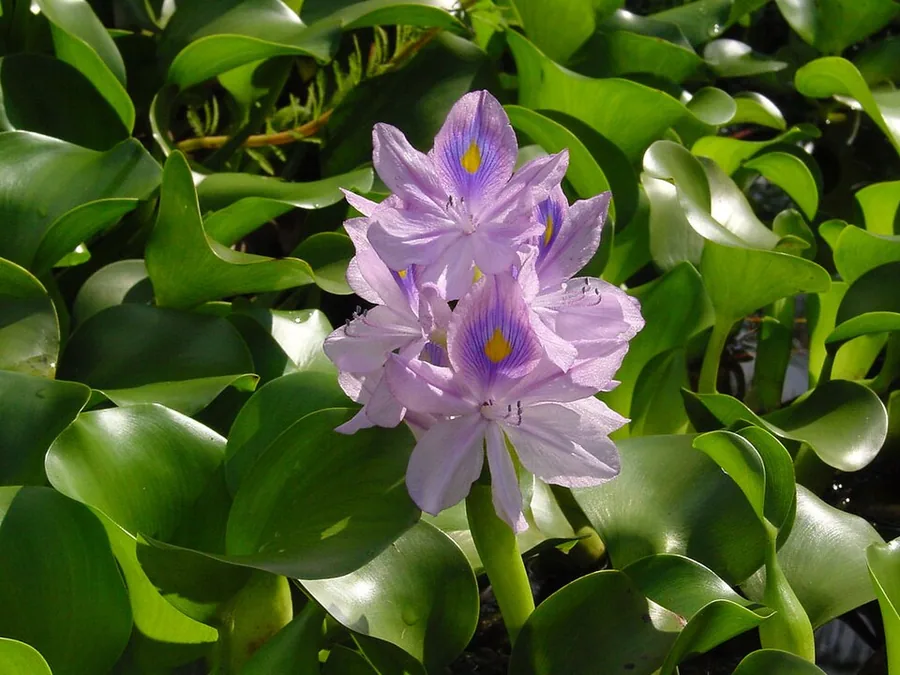
So what exactly is water hyacinth? It's a free-floating aquatic from South America, and it's easy to spot: glossy leaves sit on inflated, spongy petioles that work like tiny life jackets and keep each rosette bobbing on the surface. In summer it puts up spikes of lavender blue flowers with a little yellow eye, and honestly, those good looks are how it ended up all over the world.
Growing it couldn't be much simpler. Just float it on standing fresh water in full sun and it'll take its nutrients right from the water, so there's no soil and no pot to deal with. The tricky part? It's fast. A small clump can double in 6 to 18 days and cover a pond before you've even made a plan.
That speed is also why it's got such a bad reputation. Let it loose in a lake or river and its mats shade out native plants, pull the oxygen from the water, and kill fish, so plenty of states ban or regulate it. Keep it in a fully contained water feature, scoop out the extra often, and don't ever let a fragment slip into natural water.
Care
The short version: float it on standing fresh water in full sun, keep it warm above 50°F (10°C), scoop out the extra often, and never let it get into natural waterways.
Light
Give water hyacinth full sun and it'll grow and flower its best, though partial sun works too. More light just means faster growth, so a bright open pond means a bit more scooping for you.
Water
This is a free-floating aquatic, so it lives right on the water surface and never sits in soil. Float it on standing fresh water in full sun and its dangling roots grab what they need straight from the water. Just don't ever release it into or near a natural waterway.
Soil
There's no soil here at all, which honestly makes life easy. The roots just dangle in the water column while the plant floats free, pulling nutrients from water that sits between a pH of 6.0 and 8.0.
Temperature
It's happiest in a range of 50°F to 86°F (10°C to 30°C) and really wants warmth. Cold water stalls it and frost kills it outright, so it can't make it through winter outdoors where things get cold.
Humidity
Since it's floating on open water, it lives in constant high humidity and never runs short on moisture. There's no number to fuss over here, because its whole world is the water itself.
Feeding
You'll almost never need to feed it. It pulls nutrients from the water so easily that extra fertilizer nearby just fuels its fast growth, so keeping the water lean is the smarter move.
Pruning
Thin and pull the extra plants often so it doesn't take over a contained water garden. Bag and compost whatever you remove on dry land, and never toss a piece back in the water, where even a fragment can take hold.
Repotting
not applicable (free-floating, not potted)
Size & spacing
Each rosette only stands about 6 to 9 inches (15 to 23 cm) tall, but it spreads 6 to 18 inches (15 to 46 cm) across and keeps going sideways. So don't think about spacing so much as the regular scooping that keeps a clump from becoming a mat.
When to plant
This one's all about warm weather and has no patience for cold. Put it out only once the last frost's passed in late spring, count on flowers through summer, and know the first frost will finish it, since it can't hang on below zones 9 to 11.
Northern hemisphere
Southern hemisphere
Typical months for a temperate climate: start earlier in warm zones, later where spring frosts linger.
- Plant: After all danger of frost has passed in late spring, only into a fully contained water garden away from natural water
- Harvest: Summer (roughly June to September)
Hardiness
USDA hardiness zones: 9–11
Temperature: down to -7°C
Troubleshooting
Here's the thing about water hyacinth: almost every problem comes down to it growing too well. So the notes below aren't really about a sick plant, they're about keeping a very eager one in check and out of places it shouldn't be. Give them a read before you float your first one.
The plants seem to double overnight and cover everything
This is that explosive vegetative spread that makes water hyacinth so risky. Give it warm water, full sun, and a few spare nutrients and a population can double in 6 to 18 days as stolons pump out daughter plants, and the rosettes lock together into a mat that seals off open water within days. So skim and rake them out on a steady schedule, ease off the nutrients feeding the water, and compost everything you pull on dry land.
Fix:
- Physically skim and rake out plants repeatedly to keep the surface mostly open
- Reduce nutrient inputs to the water
- Bag and compost all removed plant material on dry land, never return any fragment to water
Thick mats ruin the water for everything else
Once a mat closes over, the ecological damage shows up fast. The shade kills submerged plants and phytoplankton, the dissolved oxygen crashes, and fish get stressed or die, while that same mat clogs irrigation, flood control, and any boat trying to get through. That's why you keep it away from natural or shared water, and why infestations of open waterways belong with your state aquatic invasive species agency.
Fix:
- Never plant or release it where it can reach natural or shared water bodies
- Report infestations of natural waterways to your state aquatic invasive species or extension agency
- Remove and dispose of plants on dry land before mats establish
It might be illegal to own where you live
Because it does so much damage, a lot of states have made it a prohibited or noxious aquatic weed, and the penalties cover owning, selling, and moving it. Florida lists it as a Noxious Weed and Class 1 Prohibited Aquatic Plant, and Texas makes it illegal to possess or transport at all. So check with your state department of agriculture or natural resources before you get one, and where it's banned, just pick a legal aquatic ornamental instead.
Fix:
- Confirm legality in your state before obtaining the plant
- Do not buy, sell, move, or transport it where it is regulated
- Dispose of any existing plants by composting on dry land
The leaves blacken and flop after a frost
Water hyacinth is frost-tender, so it just won't survive winter outside zones 9 to 11. Once the cold hits, the leaves blacken, the plant flops, and it rots down into the water. In cold climates treat it like an annual and lift the dead material out to compost on dry land before it fouls the water.
Fix:
- Treat it as an annual in cold climates
- Remove and compost dead material on dry land before it fouls the water
Toxicity
Good news first: the ASPCA lists water hyacinth as non-toxic, so it's low on the poison scale. That said, it's not something you'd want anyone chewing, because the leaves carry insoluble calcium oxalate crystals that prick and irritate the mouth and gut, leaving most pets, livestock, and people with mild drooling or an upset stomach if they bite in. The real danger here isn't to your pet at all, it's to the environment, where this ranks as a notorious invasive weed that should never reach open water.
Toxic to
Cats · Dogs · Horses · Rabbits · Livestock · Birds · People
Cats Mild
A cat that bites the leaves might drool, paw at its mouth, and throw up as the oxalate crystals sting the soft tissue inside. It usually stays mild, though, and settles down once the chewing stops.
Dogs Mild
Expect some drooling, a sore mouth, and maybe a bout of vomiting or loose stool if a dog chews the foliage. Most dogs spit it out fast anyway, since the raphides make it pretty unpleasant to eat.
Horses Mild
The crystals can irritate a horse's mouth and gut, so a mouthful tends to bring mild drooling and a bit of stomach upset rather than anything serious.
Rabbits Mild
A nibbling rabbit might get some mouth irritation and go off its food for a little while. Just keep this one off the menu and stick to greens you know are safe.
Livestock Mild
Cattle, goats, and sheep that browse the leaves can end up with mild mouth and gut irritation from the oxalate. The bigger worry, though, is that plants pulled from polluted water might carry heavy metals and other contaminants.
Birds Mild
Birds don't really make a meal of it, but a curious one that chews the leaves can get the same mild mouth irritation. There's no safe edible part to offer, either.
People Caution
This isn't a food plant, and biting into the raw leaves or stems leaves a burning, prickling feeling in the mouth from the calcium oxalate. Keep kids from chewing it, and don't treat any part of it as edible.
Chewing the oxalate-containing leaves can irritate the mouth and stomach; the plant can also accumulate heavy metals and other contaminants from polluted water. Keep pets and children from chewing it.
Helpline numbers

United States
ASPCA Animal Poison Control: (888) 426-4435 (fee applies)
Poison Control: (800) 222-1222


Canada
Poison Centres: 1-844-764-7669
Varieties
There's basically just the wild species to grow, since nobody's bred it into garden cultivars. The one thing worth sorting out is the plant people keep confusing it with.
Pontederia crassipes (species)
What you're growing is just the wild species as-is, since there aren't any real ornamental cultivars to choose from, and it's still a banned or regulated noxious invasive in a lot of states.
Water lettuce (Pistia stratiotes) - look-alike, not a variety
People mix this separate floating plant up with water hyacinth all the time, but it gives itself away with velvety, ribbed pale green rosettes and none of the inflated bulbous petioles or lavender blue flowers of the real thing.
How to propagate
You'll never have trouble making more of this plant, only stopping it. It multiplies on its own faster than just about anything else in a water garden, which is exactly why moving it around is restricted.
DivisionEasy
Warm season (late spring through summer) · 1 to 2 weeks
You'll honestly never need to propagate this one, because it takes care of that itself. All through the warm season it throws off stolons and daughter plants and can double its population in 6 to 18 days, with each division settling in within a week or two. That same speed is exactly why moving or spreading it is discouraged and outright illegal in lots of states, so never let a division reach natural water.
SeedModerate
Warm season · Variable
It also sets seed through the warm season, and how long it takes to sprout varies. Seed's really a secondary route next to its runaway vegetative spread, but it still adds to how the plant gets around.
Myths
Water hyacinth is just a harmless, pretty floating pond plant.
Sure, the lavender flowers are gorgeous, but this is one of the world's worst aquatic invasive weeds and it's regulated or banned in a lot of states. Turn it loose in natural water and its mat-forming growth chokes whole waterways and kills the native plants and fish underneath. Never release it into or near open water, and always get rid of plants on dry land.