
Introduction
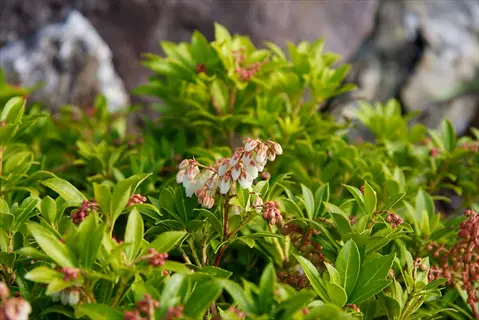
Few shrubs give you something to look at every month of the year, but pieris japonica does just that. Spring brings drooping clusters of small white flowers shaped like tiny urns. Summer settles into glossy dark green leaves. New shoots push out in coppery-red, and by winter the plant carries tight reddish flower buds that wait for the next warm spell. You buy one plant and get four seasons of payoff.
This shrub goes by a few names. You will see it sold as japanese pieris, japanese andromeda, or the lily-of-the-valley shrub, a nod to those dangling spring blooms. It is a slow-growing broadleaf evergreen shrub in the heath family, the same group that holds azaleas and rhododendrons. Its home range covers parts of China, Japan, and Taiwan, and it grows well across USDA zones 5 to 8.
Size is where the guides start to argue. NC State Extension lists it near 8 to 10 feet tall. UConn puts it closer to 6 to 8 feet. The University of Illinois Extension stretches it to 9 to 12 feet. So the real answer is a range. Plan for 6 to 12 feet tall and 6 to 8 feet wide. Your cultivar and your local climate set the final size, and most plants stay small with slow growth.
Now the safety part, which deserves more than one quick line. Every part of this plant is highly toxic to people and pets. All of its tissue holds compounds called grayanotoxins. NC State Extension rates the poison risk as high. Lab work by vets shows how these toxins hit nerve and muscle cells. This guide gives you the real, sourced safety story so you can plant it with your eyes open.
More gardeners now pick this plant in place of azaleas and rhododendrons. It is deer resistant and takes shade well. That makes it a smart fit for woodland borders and the beds along a house. It wants acidic soil and a spot out of harsh sun and wind. Below you will find its growing needs, planting and soil basics, and ongoing care. Then comes the safety section, the best cultivars by use, and how to fix pests and problems.
Growing Japanese Pieris
Eight years ago I tucked two small 'Mountain Fire' shrubs into a damp back border, under a tall oak at the woodland edge of my Zone 6 garden. From the kitchen window I watched them creep up year after year, and only now have they reached chest height. The dappled light off that oak suits them, and the partly shaded ground stays moist without sitting wet.
Japanese pieris is a broadleaf evergreen that loves partial shade. In cooler regions it takes full sun, as long as the afternoon stays mild. It holds glossy leaves all year. New growth comes in coppery-red each spring, and flower buds ride through the cold months. NC State Extension rates it hardy across USDA zones 5 to 8. In zone 4 your plants risk cold injury, so give them a sheltered spot.
This is a slow growing shrub, so plan for patience and give it room from the start. The honest truth about its mature size is that the numbers do not agree. NC State lists 8 to 10 feet tall, UConn says 6 to 8 feet, and both Oregon State and the University of Illinois quote 9 to 12 feet. Those gaps come down to species, cultivar, and climate. Plan your bed for the full 6 to 12 foot range, and pick a dwarf cultivar if your space is tight.
This shrub earns its keep in woodland and foundation plantings. Set it next to your azaleas. It also pairs well with rhododendrons and camellias. All four want the same things, which makes them easy partners. They share a taste for acidic, moist, well-drained soil and the same cool, dappled light. So you can group them and treat the whole bed as one. Give it that company and the right spot, and you get a low-fuss anchor that looks good all year.
Planting And Soil Basics
Learning how to plant pieris the right way decides whether your shrub thrives or sulks for years. Get the soil wrong and the leaves turn yellow within a season. This plant wants acidic soil below pH 6.0 that stays moist but drains fast, so the two demands have to work together from day one.
Plant in spring or early fall, when the soil is warm enough for roots to settle but the heat of summer has passed. Pick a spot in partial shade with shelter from drying wind. Then think about your soil like a sponge cake layer for the roots. You loosen it, fold in compost, and mix in an acidic amendment so the bed holds water yet never turns to mud.
Pieris is a calcifuge, which means it can't pull iron out of alkaline ground. In the wrong soil you get chlorosis, the pale yellow leaves that signal the roots are starving. To fix the pH and feed the roots at once, work in ericaceous compost or pine-needle mulch before you ever dig the hole. Both lower acidity and add the organic matter this shrub craves.
Choose partial shade with shelter from drying wind and harsh winter sun, in acidic, well-drained soil rich in organic matter.
Loosen the bed and mix in compost plus an acidic amendment so the soil stays cool and moist but never waterlogged.
Dig a hole as deep as the root ball and twice as wide, then set the plant level with the surrounding soil, not deeper.
Backfill with the amended soil, firm gently to remove air pockets, and space plants for the mature 6 to 8 foot (1.8 to 2.4 m) width.
Add 2 to 3 inches (5 to 8 cm) of acidic mulch kept off the stem, then water deeply so roots settle into even moisture.
Two numbers matter most as you finish. Planting depth should leave the top of the root ball flush with the bed, because burying the crown smothers the roots. For spacing, give each shrub the full 6 to 8 foot mature width even though it looks like a lot of empty ground at first. Pieris grows slowly, so crowded plants only fight for light and air later.
Many gardeners tuck pieris next to a downspout or in a low corner, thinking it loves wet feet. It doesn't. Constant soggy roots invite phytophthora root rot, a problem that is hard to reverse once it sets in. That's why well-drained soil sits right beside acidity on the list of things this shrub must have. Get the drainage right and you've solved half the battle.
Never plant Pieris japonica in alkaline or constantly soggy soil. Wrong pH causes yellowing, and waterlogged roots invite phytophthora root rot that is hard to reverse.
Care And Maintenance
Good pieris japonica care comes down to four habits you repeat all year. You water with purpose, you feed the right way, you mulch the roots, and you prune at the one moment that protects next spring's flowers. Get those four right and this shrub looks after itself.
I do not chase a long checklist with this plant. My approach to watering pieris is simple. I keep the soil moist, drop a layer of acidic mulch each year, and feed once in early spring. The cards below group those jobs so you can see the exact numbers at a glance instead of hunting through scattered tips.
One dry summer the leaf edges on my 'Mountain Fire' turned brown and crisp, scorched along the rim. It sat in a damp back border under an oak, and I had let a stretch of hot days pass without a deep soak. I went back to about an inch of water a week, and within a few weeks fresh green growth pushed out past the burned tips. Steady moisture brought it back. The occasional heavy soaking never did.
Watering
- Amount: Provide about 1 inch (2.5 cm) of water per week, increasing during heat, drought, or for plants growing in containers.
- Goal: Keep the soil consistently moist but never waterlogged, since soggy roots invite phytophthora root rot that is difficult to reverse.
- Tip: Water deeply at soil level rather than lightly and often, so roots grow down and the plant handles dry spells better.
Feeding
- Type: Use an acid-loving plant fertilizer formulated for azaleas and rhododendrons, which suits the shrub's preference for acidic soil below pH 6.0.
- Timing: Apply in early spring as new growth begins, and avoid heavy late-season feeding that pushes tender growth into cold weather.
- Watch for: Yellowing leaves with green veins often signal alkaline soil rather than a need for more fertilizer, so check pH first.
Mulching
- Material: Spread 2 to 3 inches (5 to 8 cm) of acidic mulch such as pine needles or composted bark over the root zone.
- Placement: Keep mulch a few inches off the stem to prevent rot, and refresh it each year as it breaks down.
- Benefit: Mulch keeps the shallow roots cool and moist, suppresses weeds, and slowly adds the organic matter this shrub favors.
Pruning And Deadheading
- When: Prune only right after spring flowering, because next year's flower buds form on old wood by late summer.
- How: Remove spent flower clusters and any dead or crossing stems, keeping cuts light to preserve the natural rounded habit.
- Avoid: Do not shear in autumn or winter, since that removes the buds already set and erases next spring's display.
The timing on pruning after bloom is the rule that trips up most people. Flower buds for next year form on old wood by late summer, so cut only lightly right after the spring flowers fade. Trim any later and you snip off the buds you were waiting on. While you tidy up, deadheading the spent clusters keeps the shrub neat and steers its energy back into leaves and roots.
People often ask about coffee grounds, and the honest answer is they help a little. Worked in as mulch they add mild acidity and organic matter, which this shrub likes. But they are not a real swap for a proper acid fertilizer or acidic soil. Treat them as a bonus, not a fix. I cover the coffee-grounds question in more depth in the FAQ below.
Toxicity And Safe Handling
This shrub is beautiful, and it is also dangerous. Every part of it is pieris japonica toxic. The leaves, stems, flowers, and even the nectar all carry the poison. NC State Extension rates the poison severity as HIGH. So never taste, chew, or brew any part of it.
The danger comes from a group of compounds called grayanotoxin. You may also see it named andromedotoxin. These toxins lock onto the sodium channels in your nerve and muscle cells. Then they refuse to let go. The cells stay switched on and cannot reset, and that stuck-on signal drives the poisoning symptoms that follow.
In people, NC State Extension lists salivation, nausea, vomiting, and diarrhea. It also lists belly pain, headache, and weakness, with heart effects in the worst cases. The animal numbers show how little it takes. Goats got sick from fresh leaves at about 0.1% of body weight in a 2025 study. The range for this plant family runs near 0.1% to 0.6%. One alpaca ate just 10 leaves and died about 4 hours after signs began.
I caught my own dog mouthing a low branch one spring afternoon, fresh flowers and all. I pulled him back, rinsed his mouth, and had the vet line dialed in under a minute. So who needs to worry? The plant is poisonous to dogs and poisonous to cats. It is rated toxic to horses too, and cattle and goats show up in the research. The chart below breaks down each group and the signs to watch for. If you think a person or pet swallowed any part of it, act fast. Call a vet, a poison control line, or emergency care right away.
People
- Risk: All parts are poisonous, and even the nectar carries grayanotoxins, so flowers, leaves, and sap should never be tasted.
- Symptoms: NC State Extension lists salivation, nausea, vomiting, diarrhea, abdominal pain, headache, weakness, and in severe cases cardiac effects.
- Children: Keep curious children from chewing leaves or flowers, since small bodies are more vulnerable to the toxic compounds.
Dogs And Cats
- Risk: Rated toxic to both dogs and cats by NC State Extension, with all plant parts capable of causing poisoning if chewed or eaten.
- Signs: Watch for drooling, vomiting, weakness, and lethargy after possible contact, and treat any suspected ingestion as urgent.
- Action: Contact a veterinarian or an animal poison control line promptly rather than waiting for symptoms to worsen.
Horses And Livestock
- Risk: Toxic to horses (NC State) and documented in goats, alpacas, and cattle, where small amounts of fresh leaves caused serious illness.
- Dose: Toxicity appeared in goats from fresh leaves at roughly 0.1% of body weight, per Tanaka et al. 2025.
- Severity: A reported alpaca case turned fatal about four hours after signs began following ingestion of only ten leaves.
Why Deer Stay Away
- Reason: The same bitter grayanotoxin chemistry that harms pets makes the foliage unpalatable, so deer reliably avoid browsing it.
- Rating: NC State Extension and UConn both rate Pieris japonica as deer resistant to very deer resistant.
- Benefit: This makes it a dependable choice for woodland and foundation plantings in areas with heavy deer pressure.
Now flip that risk around. The same bitter chemistry that makes this shrub dangerous to chew is why deer leave it alone. They taste the grayanotoxin and move on to your neighbor's hostas. The trait that demands care around kids and pets also hands you a dependable, deer-proof evergreen. That is a real win in yards where browsing wrecks everything else.
Grayanotoxins bind voltage-gated sodium ion channels in nerve cells and myocytes of the heart and skeletal muscle, preventing inactivation and leaving the cells depolarized.
Best Cultivars By Use
The Mountain Fire I planted in my damp back border glowed like a low flame each spring. Its red new leaves burned bright against the dark oak shade behind it. I had set a Valley Valentine a few feet away, and its pink-red blooms picked up the show. That bed held color from the late winter buds straight through the spring flush.
There are dozens of pieris cultivars out there. I like to match a plant to a job instead. So I have grouped my picks by what you want from the shrub. You will find the best red new growth, a dwarf pieris for a tight spot, a pink flowering pieris, and a lace bug resistant pieris for a tougher site.

Mountain Fire (Best Red New Growth)
- New growth: Emerging leaves are a brilliant fiery red that slowly matures to glossy dark green, giving a striking spring show.
- Flowers: Produces the typical drooping clusters of white urn-shaped flowers in early spring above the colorful foliage.
- Size: Reaches a standard 6 to 10 feet (1.8 to 3 m) over many years given its slow growth rate.
- Resistance: Noted as more lace-bug resistant than some cultivars, which helps keep foliage clean in brighter sites.
- Use: A standout focal shrub for woodland borders and foundation plantings where the red flush can be admired up close.
- Care: Needs the same acidic, moist, well-drained soil and partial shade as the species, and is equally toxic in all parts.
Compacta (Best Dwarf For Small Space)
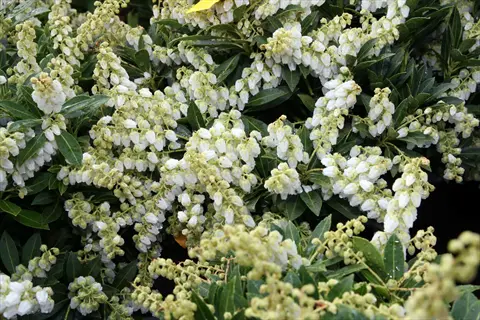
- Size: A compact form reaching roughly 6 feet (1.8 m), making it suited to smaller gardens and tighter spots.
- Flowers: Praised for profuse white spring flowers despite its smaller frame, per University of Illinois Extension.
- Habit: Keeps a dense, rounded shape that needs little pruning beyond a light tidy after bloom.
- Placement: Works well in containers, low foundation beds, and mixed acid-loving borders where space is limited.
- Color: New growth emerges bronze to reddish before maturing to the glossy evergreen green typical of the species.
- Care: Shares the species' need for acidic soil and partial shade, and carries the same grayanotoxin toxicity throughout.
Valley Valentine (Best Pink Flowers)
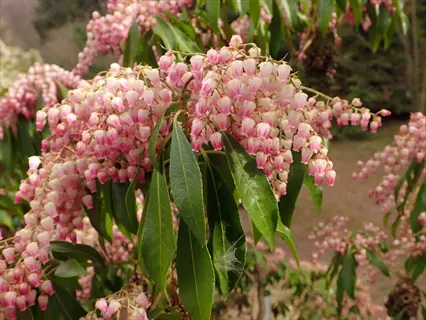
- Flowers: Bears deep rose to pink-red flower clusters that stand out against the more common white-flowered types.
- Buds: Reddish flower buds hold color through fall and winter, adding interest before the spring bloom opens.
- Size: Grows to a typical mid-range height for the species, fitting borders and woodland-edge plantings.
- Pairing: Combines beautifully with red-new-growth cultivars to extend the season of color in one bed.
- Foliage: Carries glossy dark green leathery leaves once new growth matures, staying evergreen year round.
- Care: Requires the same acidic, moist, well-drained soil and partial shade, and is equally toxic in every part.
Brower's Beauty (Most Pest Resistant)
- Resistance: Noted for resistance to lace bug, the shrub's signature pest, helping foliage stay clean in tougher sites.
- Flowers: Produces abundant white flower clusters in spring along with attractive reddish winter buds.
- Habit: Forms a dense, well-branched mound that suits hedging and foundation use with minimal shaping.
- New growth: Emerges bronze-red before maturing to deep evergreen green, adding seasonal contrast.
- Use: A practical pick for gardeners who want reliable performance with less pest trouble over time.
- Care: Needs acidic, moist, well-drained soil and partial shade, and shares the species' full-plant toxicity.
Every one of these cultivars wants the same care and carries the same toxicity as the plain species. So you are not picking a safe-to-handle version. Your choice comes down to four things: how big it gets, the color of its new leaves, its flower color, and how well it shrugs off pests.
Check the plant tag for one more thing. Many of these pieris cultivars hold an Award of Garden Merit. The Royal Horticultural Society gives it out. The award is a strong sign the plant does well in real gardens. It hands you a quick way to spot a pick you can trust.
Pests, Problems, And Fixes
Most pieris problems trace back to one thing: where you put the shrub. Plant it in cool partial shade with shelter from wind and good drainage, and you head off lace bugs, scorch, and root rot before you ever reach for a spray.
The pieris lace bug is the pest you will meet first. These tiny insects feed on the underside of leaves and leave a yellow and brown stippling across the top. The damage gets worse in hot, dry, sunny spots, so a shadier home keeps the foliage cleaner.
Soggy ground brings a quieter threat. Phytophthora root rot sets in when soil stays wet and the plant cannot drain, and it shows up as wilting and dieback even while you keep watering. Wind and harsh winter sun cause leaf scorch, which browns and crisps the edges of leaves on exposed plants.
The table below pairs each symptom with its trigger and a fix, so you can spot the cause fast and act.
Watch for spider mites in the same hot, dry weather that draws lace bugs. They leave fine stippling and faint webbing, and a strong rinse of the foliage knocks back most of them before you need insecticidal soap.
Not every issue is a bug, though. Yellowing leaves with green veins point to soil that is too alkaline rather than a pest. Pieris needs acidic ground to stay green. This kind of chlorosis ties back to the soil pH the shrub depends on. Lower the pH with acidic amendments and the color comes back.
Sort out the site first and most pieris problems never show up. A spray of insecticidal soap or neem oil handles the bugs that do, while better drainage stops root rot at the source.
Lacebug can cause significant stippling on foliage, making it yellow and unsightly, especially in hot dry sites.
5 Common Myths
Pieris japonica is only mildly toxic, so a few leaves or some flower nectar around the garden pose no real danger to pets.
It is rated highly toxic. All parts hold grayanotoxins, and as little as roughly 0.1 percent of body weight in leaves sickened ruminants in studies.
Pieris japonica needs full sun to flower well, so gardeners should plant it in the brightest, most open spot they have available.
It prefers partial shade and flowers reliably there. Full sun in hot sites raises leaf scorch and lace bug damage, harming the plant overall.
You should prune Pieris hard in autumn to tidy it up and encourage a bigger, more impressive flush of flowers the following spring.
Prune lightly right after spring bloom. Flower buds form on old wood by late summer, so autumn pruning removes next year's blooms entirely.
Coffee grounds alone will acidify the soil enough to keep a struggling, yellowing Pieris japonica healthy without any other amendments.
Coffee grounds add only mild acidity and organic matter. Reliable results need proper acidic soil, sulfur or ericaceous mix, and acid plant fertilizer.
Pieris japonica grows quickly and will fill a large bare space within a single season once it is planted in the right spot.
It is a slow grower that takes several years to reach mature size, so spacing and patience matter more than expecting fast coverage.
Conclusion
A well-placed pieris japonica earns its keep all year. You get coppery-red new growth, drooping spring blooms, glossy summer leaves, and tight winter buds. That is real four season interest from one shrub. None of it happens by accident, though. This plant pays you back only when you read its needs and meet them.
I planted my first pieris on the bright south wall of the house, in plain garden dirt, because the tag said evergreen and I wanted instant cover. By the next August the leaves had scorched brown at the edges and the new growth sulked. I dug it out, moved it to the dappled bed under a dogwood, and worked in pine bark to drop the pH. Same plant, two feet over, and it has thrown coppery new shoots every spring since.
Get the site right and the rest gets easy. This shrub wants acidic soil below pH 6.0 and ground that stays moist but drains well. It wants the dappled light of partial shade, not a hot, windy, sun-baked wall. It is hardy in roughly USDA zones 5 to 8. It grows slowly to about 6 to 12 feet (1.8 to 3.7 m) tall, and the range shifts with the source and the cultivar. That slow pace is a feature. You will rarely fight it back, and a shrub in the right spot stays healthy for years.
One fact deserves the last word. Every part of this plant is highly toxic. All of its tissues hold grayanotoxins, and that danger reaches people, dogs, cats, and horses alike. The same bitter chemistry that makes it such a reliable deer resistant shrub is exactly what makes it unsafe to chew. So place it with thought. Set it away from paths where a child grazes, keep curious pets from the leaves and the nectar, and you strip out the only real risk this shrub carries.
Match the cultivar to your space and the site to the plant. Do that and you set up a long, low-effort run with one of the best broadleaf evergreens you can grow. Patience is the whole game with a slow grower like this, so plant it well once and let the years do the work. Still weighing questions about watering, growing it in pots, the right pruning timing, or pet safety? The FAQ entries below dig into each one.
Glossary
- andromedotoxin
- Another name for the grayanotoxin compounds found throughout Pieris japonica.
- calcifuge
- A plant that needs acidic soil and struggles or yellows in chalky, alkaline ground.
- chlorosis
- Yellowing of leaves, often with green veins, usually caused by soil that is too alkaline for the plant.
- ericaceous compost
- An acidic growing mix made for lime-hating plants like Pieris, azaleas, and rhododendrons.
- grayanotoxin
- A natural plant toxin in Pieris japonica that disrupts nerve and muscle cells, making every part of the shrub poisonous.
- lace bug
- A small insect that feeds on leaf undersides, leaving yellow and brown stippling that is worse in hot, dry, sunny spots.
- phytophthora root rot
- A soil-borne disease that rots roots in soggy ground and causes wilting and dieback.
- raceme
- A drooping cluster of small flowers along a single stem, the form Pieris flowers take in spring.
External Sources
Frequently Asked Questions
Does Pieris japonica like sun or shade?
It grows best in partial shade. It tolerates full sun in cooler regions but prefers some shade, especially in warm southern gardens.
How do you care for a Pieris japonica?
Plant in acidic, moist, well-drained soil in partial shade, water about an inch weekly, mulch, feed an acid plant fertilizer, and prune after bloom.
What are the common problems with Pieris japonica?
The main issues are:
- Lace bugs causing yellow stippling
- Phytophthora root rot in soggy soil
- Leaf scorch from wind and winter sun
- Yellowing leaves from alkaline soil
Is Pieris japonica poisonous to dogs and cats?
Yes. All parts contain grayanotoxins and the plant is rated highly toxic to dogs, cats, horses, and people. Contact a vet or poison control if ingested.
What month do Pieris flower?
Most bloom in early spring, roughly March to April, with flower clusters lasting about two to three weeks. Reddish buds show through the prior winter.
Do Pieris grow fast?
No. Pieris japonica is a slow grower, so it takes years to fill in. Mature size ranges from about 6 to 12 feet tall depending on source and cultivar.
Should you cut Pieris back in autumn?
No. Prune right after spring flowering. Cutting in autumn removes the flower buds that already formed on old wood, so you lose next spring's display.
Can you grow Pieris japonica in pots?
Yes. Use a large pot with ericaceous (acidic) compost, ensure drainage holes, water consistently, and feed an acid plant fertilizer through the growing season.
How often should I water Pieris?
Aim for about one inch of water per week, more in heat or in pots. Keep soil consistently moist but never soggy, since wet roots invite rot.
Are coffee grounds good for Pieris?
They can help slightly. As mulch they add organic matter and a little acidity, but they are not a reliable way to acidify soil or replace fertilizer.