Houseplant · Lentibulariaceae
Bladderwort
Utricularia
Pure water, lean soil, and bright light: this tiny carnivore feeds itself.
Bright indirect
Every 1–3 days
50–86°F · 10–30°C
USDA 9–11
Overview
Bladderwort (genus Utricularia, family Lentibulariaceae) is an oddball carnivore that catches its own food underwater. It grows wild on every continent except Antarctica, with some species rooting into soggy ground and others floating free in still water. What ties them all together? They hunt with tiny bladder traps that snap shut on microscopic prey.
Each trap is a hollow sac that pumps itself empty, then springs open in a fraction of a second the moment a passing protozoan or water flea brushes a trigger hair, sucking in water and prey all at once. That's how it grabs the nutrients its nutrient-poor home can't offer, which is exactly why feeding and fertilizing do more harm than good.
Think of caring for it like tending a bog rather than a houseplant. Keep the medium constantly wet with mineral-free water, give it plenty of bright light, and otherwise just leave it alone. Get the water right and the rest pretty much takes care of itself.
Care
The short version: bright light, distilled or rainwater only, and a lean peat-and-sand mix kept constantly wet. Never fertilize, and never let it dry out.
Light
Give it bright, indirect light. It'll handle partial to full sun once it's used to the spot. Light is what drives flowering, so a leafy plant that just won't bloom is usually asking for more of it.
Water
This is the part that makes or breaks the whole thing. Use only distilled, reverse-osmosis, or rainwater, because tap or mineral water will kill it. Keep terrestrial types soggy in a tray of 1 to 3 cm of pure water, grow aquatic types submerged or free-floating, and never let the medium dry out.
Soil
Go with a lean mix of peat and silica sand, roughly half and half, with no nutrients added. A pH of 4.0 to 6.0 keeps things nicely acidic. Aquatic types need no soil at all.
Temperature
It's comfortable anywhere from 50°F to 86°F (10°C to 30°C). That covers normal room temps with plenty of room to spare, so most homes work just fine.
Humidity
It likes the air on the humid side, somewhere around 50% to 80%. A water tray around terrestrial types nudges up the local humidity, and aquatic types live in water anyway, so they're sorted.
Feeding
Just don't feed it. The bladder traps catch all the nutrients the plant needs from microscopic prey, and fertilizer usually ends up killing it.
Pruning
There's barely anything to do here. Snip off spent flower stalks and clear away any dead or decomposing mat to keep the medium clean.
Repotting
Refresh it every 1 to 2 years as the peat breaks down. Repot when the mat spills over the edges, the medium's decomposed, or vigor and flowering start to fade.
Size & spacing
It stays small, 2 to 12 inches (5 to 30 cm) tall, with a mat that spreads 4 to 12 inches (10 to 30 cm) across. A wide, shallow pot suits its creeping habit far better than a deep one.
Troubleshooting
Nearly every issue traces back to water, light, or feeding it. Match your symptom to the cause below, and you'll find the fix is usually as simple as changing the water or moving the pot. Catch trouble early and the mat tends to bounce right back.
Mat Browning And Dying Back
When the mat starts browning and caving in, the culprit is almost always mineral or salt buildup from tap or hard water, or a medium that dried out. Switch over to distilled, RO, or rainwater right away and flush the peat to rinse the salts out. Keep that tray topped up too, since even a single dry spell can knock it back hard.
Fix:
- Switch to distilled, RO, or rainwater immediately
- Flush the medium thoroughly with pure water
- Keep the tray topped up so the medium stays soggy
Soft Mushy Growth Turning To Rot
Mushy, rotting growth normally means fertilizer or nutrient-rich water the plant just can't deal with, or aquatic types sitting in warm, stagnant water. These carnivores are built for lean conditions, so quit feeding it. Repot into fresh nutrient-poor peat and sand, then flush everything with pure water.
Fix:
- Stop all fertilizing
- Repot into fresh nutrient-poor peat/sand mix and flush with pure water
Healthy Mat That Won't Bloom
So the leaves look great but you're not seeing flowers? That usually points to too little light or stray minerals creeping into the water. Move it somewhere brighter or set up a grow light, then flush the medium with distilled or RO water. Once it's getting good light and clean water, the flower stalks tend to follow.
Fix:
- Move to a brighter location or add supplemental light
- Flush the medium with distilled/RO water to remove accumulated minerals
Algae Smothering Aquatic Plants
With aquatic types, algae can take over when there are too many nutrients around or the light is too strong. Do a few partial water changes with pure water and pull out any decaying matter. Easing back on the light keeps that green film from coming right back.
Fix:
- Perform partial water changes with pure water
- Reduce light intensity and remove decaying organic matter
Toxicity
Good news: bladderwort is safe all around. The ASPCA doesn't list it as toxic to cats or dogs, and no extension or botanical source flags it as a danger to people or other animals. After all, the traps catch nothing bigger than a water flea.
Safe for
People · Cats · Dogs · Horses · Rabbits · Livestock · Birds
Cats None
A nibble of the wet mat won't poison a cat, though all that soggy peat could leave them with an upset stomach.
Dogs None
There's no poison to worry about here, so a dog tasting the foliage or sipping from the tray is nothing to stress over.
Horses Safe
Nothing toxic has been reported, and honestly this tiny bog plant is far too small to make much of a mouthful anyway.
Rabbits Safe
Totally harmless to rabbits; there are no toxins in the leaves or stems, and the traps only ever grab microscopic prey.
Livestock Safe
Cattle, goats, and sheep have nothing to fear from it, and it grows in bogs they'd rarely wander into to browse.
Birds Safe
Safe for birds, with nothing harmful in it; the traps are far too small to bother anything bigger than a water flea.
People Safe
Not toxic to people at all; the traps catch only microscopic aquatic prey, so it's no danger to handle or keep around the house.
No special handling precautions; the bladder traps capture only microscopic aquatic prey and pose no risk to pets or people.
Varieties
There are hundreds of species out there, from bog-dwellers to free-floaters. Here are the ones you're most likely to grow or stumble across.
Utricularia sandersonii
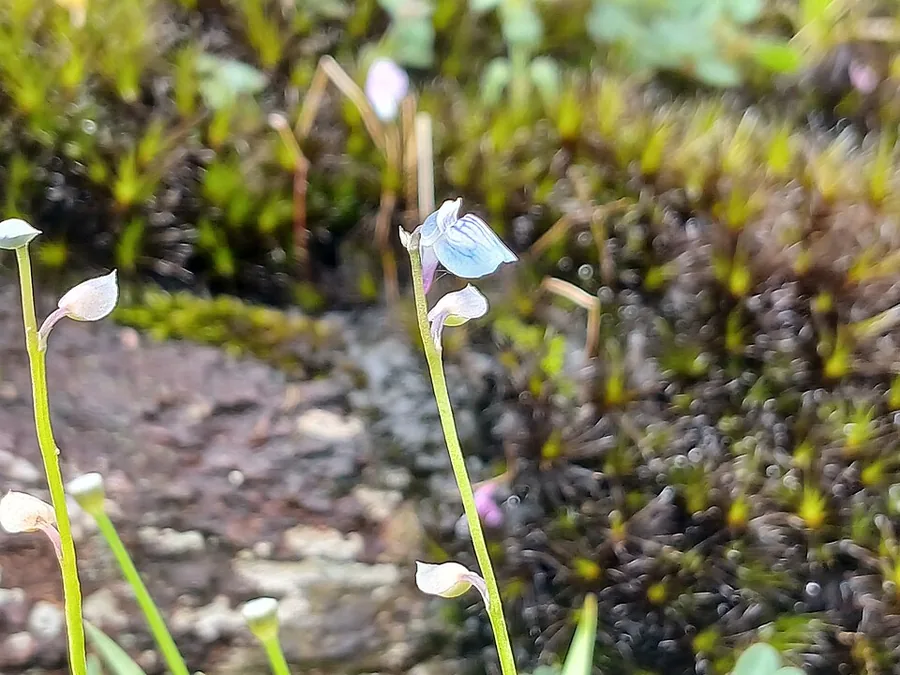
A popular, easy-going terrestrial species with pale blue-white flowers that look a bit like little snapdragons, complete with violet veining.
Utricularia livida
A very forgiving species from Africa and Mexico that forms dense mats dotted with small lilac-and-white flowers.
Utricularia vulgaris
A free-floating aquatic species whose feathery submerged stems are loaded with bladder traps, topped by bright yellow flowers held above the water.
Utricularia graminifolia
A grass-like species that ranges from terrestrial to semi-aquatic; aquarists love using it as a low carpeting plant.
Utricularia subulata
A tiny species found all over with yellow flowers, and it often shows up uninvited in pots of other bog plants.
How to propagate
Once it's settled in, bladderwort multiplies readily, either by splitting the mat or sowing its dust-fine seed if you've got the patience for it.
DivisionEasy
Spring or early summer during active growth · A few weeks to a couple of months
The simplest route is splitting the mat in spring or early summer while it's actively growing. Lift out a section, replant it in fresh nutrient-poor peat and sand, and keep it constantly wet with pure water. It'll settle in over a few weeks to a couple of months.
SeedDemanding
Spring · Several months to over a year
Growing from seed is more of a patient gardener's project. Surface-sow the fine seed on damp peat and sand in spring, then settle in for a wait, since germination is slow and the seedlings come up tiny and delicate. Plan on several months to over a year.
Myths
You have to feed bladderworts meat or insects, just like a Venus flytrap.
The traps are sized for microscopic prey like protozoa and water fleas, not chunks; toss in meat or insects and they'll just rot in the medium. The plant feeds itself from the water and needs no help from you.
Carnivorous plants need fertilizer to really grow well.
They evolved in nutrient-poor bogs and pull what they need straight from the water; fertilizer or mineral-rich water usually kills them, which is the opposite of normal feeding advice.