Tree · Anacardiaceae
Cashew
Anacardium occidentale
A tropical tree that hands you two harvests in one, the cashew apple and the nut, as long as its roots stay warm, sunny, and well drained.
Full sun
Every 7–14 days
USDA 10–13
20–39 ft · 6–12 m
Overview
The cashew is a fast-growing tropical tree, and it's actually a cousin of both poison ivy and mango. It hails from the warm lowlands of Brazil and now grows across the frost-free tropics. It loves heat and can't take cold, so it only hangs around in the warmest zones where frost never shows up. Give it room and it'll spread into a wide tree that can top 40 feet (12 m), with a canopy just as broad.
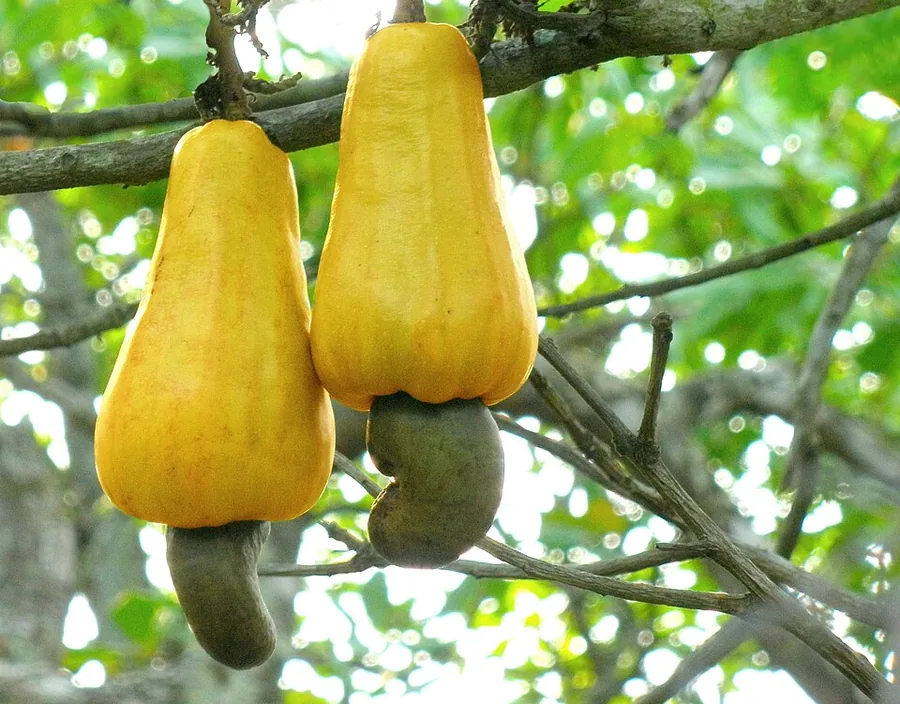
Here's the part that trips people up about cashews. That fleshy red or yellow bit everyone notices? That's the cashew apple, a swollen stalk rather than the real fruit, and the kidney-shaped nut hangs underneath it on the outside. The nut's the prize, but its shell is full of a caustic oil that has to be cooked off before you can eat the kernel inside.
For such a big tree, the cashew doesn't ask for much once it's settled in. It does great in poor, sandy ground where fussier trees would sulk, and it shrugs off drought after the first few years. The one thing it won't tolerate is wet feet, so good drainage matters way more than rich soil right from day one.
Care
The short version: give it full sun and deep, sandy, fast-draining soil. Water steadily only while it's young, keep it warm and frost-free, then ease off once it's mature. And whatever you do, never let the roots sit in soggy ground.
Light
Cashews want full sun and won't crop well in shade, so give yours an open, bright spot with nothing crowding it. All that light is what keeps the flowers and nuts coming.
Water
Water young trees pretty often so they settle in, then back right off, because a grown cashew is highly drought tolerant and hates soggy ground. Let the top half of the soil dry out between drinks, around every 7 to 14 days, and when in doubt go a little dry rather than too wet.
Soil
Plant it in deep, well-drained sandy or sandy-loam soil, even the poor, low-fertility kind other trees can't handle. A pH of 5.0 to 6.5 is what it likes, and honestly fast drainage matters way more than rich earth.
Temperature
This one's a true tropical tree, happiest from 50°F to 104°F (10°C to 40°C), and frost will kill it flat out. Only grow it where the cold never really bites, so tropical or frost-free subtropical spots.
Humidity
Cashews like the air on the humid side, around 50% to 80%, just like the tropics they come from. Still, keep the canopy open so the leaves dry off, because trapped damp is what invites disease.
Feeding
Feed it through the warm growing season with a balanced NPK that's got nitrogen, phosphorus, and potassium, plus a little zinc if your soil runs short on it. One seasonal feeding is plenty for a tree this tough.
Pruning
Train a young tree to a single strong leader, then clear out anything dead, diseased, crossing, or hanging low. Opening up the canopy gets air moving through, and that's your best defense against the fungal diseases cashews can pick up.
Repotting
A cashew in the ground pretty much stays put for good, but a potted one needs a bigger home every 2 to 3 years. Watch for roots circling the pot, water running straight through, or growth that's stalled, since those all mean it's cramped.
Size & spacing
A regular cashew turns into a wide tree, 20 to 40 feet (6 to 12 m) tall and nearly as broad, so it needs real room. Keep it well away from buildings, paths, and power lines, because that canopy can spread as much as 33 feet (10 m) across.
When to plant
Cashew runs on the tropics, not a regular garden calendar. Start the nuts in nursery bags a couple of months ahead, plant the young trees out once the soil's warm and frost is done, and you'll get flowers in the dry season with the nuts and apples turning up a few months later.
Northern hemisphere
Southern hemisphere
Typical months for a temperate climate: start earlier in warm zones, later where spring frosts linger.
- Sow: Seeds sown in nursery bags 2 to 3 months before transplanting in warm climates
- Plant: After all frost danger when soil is warm; tropical and frost-free subtropical regions only
- Harvest: Flowers in dry season; nuts and cashew apples harvested several months later, typically late dry season
Hardiness
USDA hardiness zones: 10–13
Temperature: down to -1°C
Troubleshooting
Most cashew trouble shows up on the new growth, the flowers, or the roots, and damp weather is usually what's behind it. Catch it early and a fungicide or better drainage will usually sort it out. Spot the symptom below and act before it spreads.
Black sunken spots on leaves and shoots with dying twigs
That's anthracnose, a fungus that moves in when warm weather stays wet and the new growth and flower clusters sit damp for hours. Prune off and destroy the infected shoots, open up the canopy so air can move, and reach for a labeled fungicide while the tree's flushing and flowering. Space your trees out and keep water off the leaves, and you'll stop most of it before it even starts.
Fix:
- Prune and destroy infected shoots
- Improve canopy air circulation
- Apply a labeled fungicide during susceptible flushing and flowering
Wilting and scorched leaves in wet, soggy soil
If a cashew's wilting and barely fruiting in heavy, waterlogged ground, that's root rot, not thirst. The roots go discolored and the trouble shows up right after heavy watering or standing water. Fix the drainage, ease off the watering, and on heavy soils pop it on a raised mound. A grown cashew handles dry spells just fine, so wet roots are the real thing to watch.
Fix:
- Improve drainage
- Reduce irrigation
- Plant on mounds in heavy soils
Grayish-white powder on flowers and tender new nuts
A dusty white film on the flower clusters and baby nuts is powdery mildew, and it loves soft new growth during cool, dry flowering spells. Leave it be and it'll drop flowers and little nuts and shrink your crop. Dust with sulfur or a labeled fungicide at bloom, snip off the worst clusters, and keep that canopy open so it has less to work with.
Fix:
- Apply sulfur or a labeled fungicide at flowering
- Remove badly affected panicles
Toxicity
A roasted, shelled cashew is a safe everyday snack, but the raw nut is a whole different story. The shell and the layer wrapped around the kernel hold a caustic oil called CNSL, loaded with the same urushiol that makes poison ivy itch, and it burns skin and mouth on contact. Keep raw shells, husks, sap, and prunings away from kids and pets, and only handle them with gloves on.
Toxic to
Cats · Dogs · Horses · Rabbits · Livestock · Birds
Safe for
People
Cats Caution
The rich, fatty kernel can bring on drooling, vomiting, and loose stools, and if a cat licks or bites a raw shell it can burn its mouth on that caustic oil. Keep both well out of paw's reach.
Dogs Caution
A few swiped nuts usually mean vomiting and diarrhea, and a bigger helping of that fatty kernel can set off painful pancreatitis. Chew a raw shell on top of that and you've got urushiol burns on the mouth and skin too.
Horses Caution
Horses really shouldn't be anywhere near raw shells, sap, or prunings, since the same urushiol that scars people's skin can blister their lips and mouth. Keep fallen shells and trimmings cleared out of any paddock.
Rabbits Caution
That caustic shell oil and the heavy, fatty nut are both bad news for a rabbit's gut. Don't offer either one, and watch for soft stools or a stalled appetite if one gets into dropped shells.
Livestock Caution
Cattle, goats, and sheep can scorch their mouths on the raw shell liquid and upset their stomachs on the oily kernels. Fence the stock away from the tree and rake up the shell waste once harvest's done.
Birds Caution
Backyard birds should never get raw shells or husks, because that irritant oil burns soft tissue. A crumb of plain roasted kernel here and there won't hurt, but the fat doesn't really do them any favors.
People Roasted nuts safe
Properly roasted and shelled cashews are a wholesome snack and totally safe to eat. The raw nut and its shell are another matter, since the urushiol in them is the same irritant as poison ivy and burns skin and mouth, which is exactly why nobody should handle or eat them unprocessed.
Wear gloves when handling raw shells, husks or sap; never let people or pets contact or chew unprocessed nuts. Roasting in the open can release irritant fumes.
Helpline numbers

United States
ASPCA Animal Poison Control: (888) 426-4435 (fee applies)

United Kingdom
Animal PoisonLine: 01202 509000 (fee applies)

Australia
Animal Poisons Helpline: 1300 869 738
Varieties
Growers mostly sort cashews by how big they get and how soon they fruit, and these two broad types cover most of what you'll run into.
Common (medium/tall) cashew
The common medium to tall cashew is the old-school plantation tree, a big spreading thing that climbs to 12 m or more and takes its sweet time before it starts bearing.
Dwarf precocious cashew (e.g. anao precoce types)
Dwarf precocious cashews like the anao precoce types are compact picks that flower and fruit within a few years and stay small enough to plant close together and harvest without a fuss.
How to propagate
You can start a cashew from a fresh nut or clone a tree you already like, and the route you pick decides how fast it fruits and how closely it takes after its parent.
SeedEasy
Sow fresh viable nuts in the warm season · Germinates in 2 to 3 weeks; bears in about 3 years
Seed. Sow fresh, viable nuts in the warm season and keep the ones that sink in water, and the seedlings will pop up in 2 to 3 weeks. Put them straight in the ground or into bags, because that long taproot really doesn't like being moved once it forms. Seedlings vary a fair bit, and a tree grown this way takes about 3 years to start bearing.
GraftingModerate
Onto vigorous seedling rootstock in warm conditions · Bears in roughly 2 to 3 years
Grafting. Graft a clone you like onto a vigorous seedling rootstock in warm weather and you'll get trees that are uniform and crop sooner. A softwood, cleft, or veneer graft is the usual way to go, and the tree bears in roughly 2 to 3 years.
Air layeringModerate
Warm humid growing season · Several weeks to root before severing
Air-layering. Air-layering during the warm, humid growing season gives you a clone of the parent tree. The wrapped stem needs several weeks to root before you cut it free, and honestly it's used a lot less than grafting on a commercial scale.
Myths
The cashews labeled raw in stores really are raw, and any nut off the tree is fine to eat.
Those so-called raw cashews have already been steamed or heat-treated and shelled before they hit the shelf. A nut straight off the tree still carries that caustic shell oil, the urushiol and anacardic acid that burn skin and mouth. No cashew is safe to eat or even handle until it's been roasted and processed.
The fleshy red or yellow cashew apple is the fruit, with the nut tucked inside it.
That juicy cashew apple isn't really the fruit at all, it's a swollen stalk, an accessory fruit the tree puffs up below the flower. The real fruit is the kidney-shaped nut hanging outside and below the apple, not inside it.