Ornamental · Convolvulaceae
Dichondra
Dichondra
A low carpet of coin-shaped leaves that doubles as a lawn you hardly mow or a silver waterfall spilling over a pot.
Full sun
Every 3–7 days
60–120 days
USDA 8–12
Overview
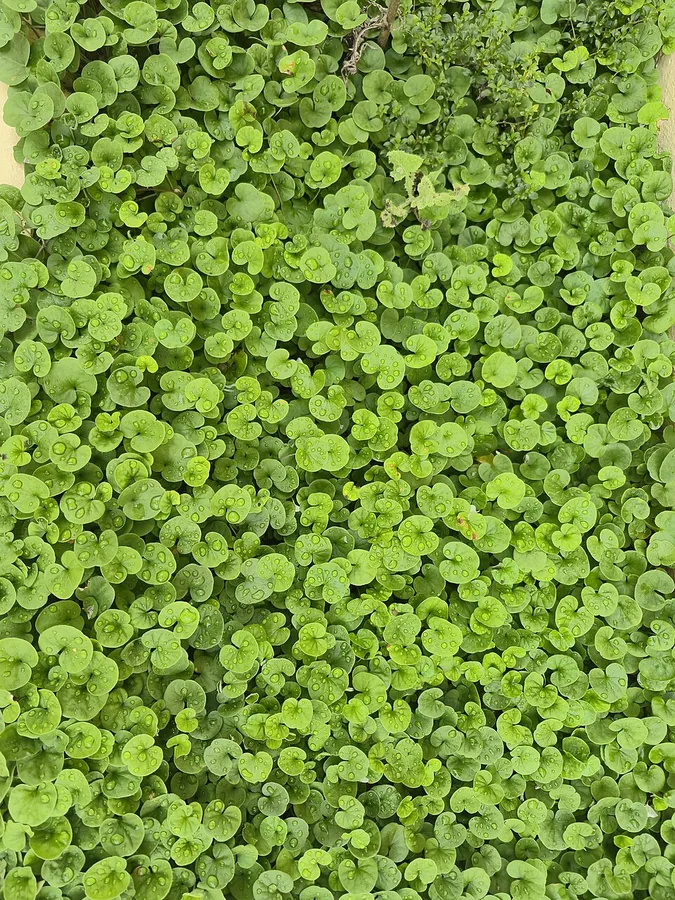
Think of dichondra as a low, mat-forming groundcover in the morning glory family, and it gets its name from those little kidney-shaped leaves behind nicknames like ponysfoot and kidney-weed. It hugs the ground at just an inch or two and creeps sideways on stems that root as they travel, so a handful of plants can grow together into a broad carpet. In warm regions, folks pick it when they'd rather have a soft green mat than a thirsty lawn that needs constant mowing.
One name, two pretty different plants. The green lawn kinds, D. repens and D. micrantha, give you a nice low-mow turf substitute that wants steady moisture. The silver-leaved 'Silver Falls' is a drought-tolerant trailer people grow for the way its felted stems spill over the lip of a container or basket. And then there's a wild cousin, D. carolinensis, that shows up where you didn't plant it in weak turf.
None of it is fussy beyond wanting sun and good drainage. It's happy in full sun to partial shade and copes with a big temperature range, though it'll rot in wet ground and gets unhappy where people keep walking on it. Hand it a well-drained spot and a bit of patience while it spreads, and it mostly looks after itself.
Care
The short version: full sun to partial shade in well-drained soil, with steady moisture for the green lawn kinds and a much drier touch for silver 'Silver Falls', and good drainage no matter which one you've got.
Light
Dichondra is happiest in full sun, but it'll take partial sun and partial shade without putting up much fuss. The green lawn kinds hold a denser look in bright light, and 'Silver Falls' keeps its crisp silver color best where the sun can reach it.
Water
This is where the two types go their separate ways. Green lawn dichondra wants steady moisture and drinks a lot, while silver 'Silver Falls' is very drought tolerant once established and likes dry to medium soil. Both need good drainage either way, so plan on watering roughly every 3 to 7 day and never let the soil sit soggy.
Soil
Go with well-drained sandy loam or a decent garden loam, because for groundcover use drainage is what counts most. It's content with a pH anywhere from 6.0 to 7.5, which means most regular garden soil already fits the bill.
Temperature
Dichondra copes with a wide range, somewhere around 30°F to 100°F (-1°C to 38°C), and that's exactly why it does so well in warm-climate gardens. Cold is its soft spot, though, and 'Silver Falls' especially is frost tender and won't survive a freeze.
Humidity
Ordinary outdoor humidity is all it wants, so there's no target to fuss over. The one thing to watch is damp, crowded foliage, since leaves that stay wet too long open the door to leaf spot.
Feeding
Feed it monthly right through the spring and summer growing season. The green lawn kinds appreciate a higher-nitrogen feed to drive thick, even growth, while 'Silver Falls' does better on a much lighter diet so it trails instead of bulking up.
Pruning
Snip the trailing stems to shape things up and keep the spread under control, which counts because it roots at the nodes as it goes. The green lawn type is easygoing about it, so you can mow it or leave it unmown, whatever you'd rather.
Repotting
Potted plants like to be repotted seasonally, and that's doubly true for the fast-growing 'Silver Falls'. Bump them up to a bigger pot when roots start circling, the rootball dries out fast after watering, or the stems hang well past the rim with hardly any new growth.
Size & spacing
Each plant keeps low, just 1 to 3 inches (2 to 8 cm) high, but it sprawls wide, stretching 2 to 4 feet (60 to 120 cm) across. Space your plants out enough that the rooting stems can bridge the gaps and weave into one continuous mat.
When to plant
Dichondra is a warm-season plant that doesn't put up with hard cold. Get seed going indoors in early spring, roughly 6 to 8 weeks before your last frost, then sow or plant out from April to May once the soil has warmed. You can look for small, easy-to-miss greenish-yellow to white flowers in May and June.
Northern hemisphere
Southern hemisphere
Typical months for a temperate climate: start earlier in warm zones, later where spring frosts linger.
- Sow: early spring, about 6-8 weeks before last frost
- Plant: after last frost when soil has warmed, April to May
- Harvest: inconspicuous greenish-yellow to white flowers May to June
Hardiness
USDA hardiness zones: 8–12
Temperature: down to -12°C
Troubleshooting
Most of what goes wrong with dichondra is about the spot, not the plant itself. Thin patches, rot, and pest trouble usually tag along with heavy foot traffic, poor drainage, or a stand that never really filled in. Find what matches your situation below, and start by fixing the conditions.
Yellowing and dieback when the ground is cold or waterlogged
Wet, badly drained soil is what triggers root and stem rot, and cold weather does in 'Silver Falls' since it can't take frost. So what do you do? Get the drainage sorted, dial back the watering, and tuck any container 'Silver Falls' somewhere sheltered before that first frost arrives. Anything growing in well-drained sandy loam can simply go back in come spring once things warm up.
Fix:
- Improve drainage and reduce irrigation frequency
- Move container 'Silver Falls' under cover or indoors before frost
- Plant in well-drained sandy loam
- Replant in spring once soil warms
Thin, bare spots showing up along paths and play zones
Here's the thing: dichondra is slow to settle in and really doesn't like being trampled, so the spots that get the most footsteps stay patchy while the quiet corners fill in nicely. Want it to look good? Keep it in small, calm areas and stay off it until it's knit together. For the thin bits, overseed them, keep them evenly moist, and give them some nitrogen to push dense growth.
Fix:
- Limit dichondra lawns to small, low-traffic areas
- Keep foot traffic off until the mat is fully established
- Overseed or plug thin areas and keep evenly moist
- Fertilize with nitrogen to encourage dense growth
Nibbled leaves and dark spotting across the foliage
A couple of culprits here: flea beetles and cutworms munch the leaves and snip off young seedlings, while leaf-spot diseases like Alternaria leave marks when the weather turns damp. The good news? A thick, healthy stand usually brushes off most of it. Try watering in the morning so leaves dry quickly, clear away any heavily spotted growth, and check with your local extension office if it keeps spreading.
Fix:
- Maintain vigorous, dense growth to outgrow minor damage
- Reduce leaf wetness by watering early in the day
- Remove and dispose of severely spotted foliage
- Consult local extension for control options
Toxicity
Good news if you've got pets or kids: dichondra is not toxic. It's nowhere on the ASPCA's poison lists, so cats, dogs, and the rest of the garden crowd can hang out near it safely. A pet that scarfs down a big pile of foliage might get a quick, mild stomach upset, but honestly that goes for nearly any plant.
Safe for
People · Cats · Dogs · Horses · Rabbits · Livestock · Birds
Cats None
This one's fine for cats. If yours grazes on a big helping of foliage, the worst you'd see is a quick, mild tummy upset, just like with any other leafy plant, and that's it.
Dogs None
Dogs can sniff and poke around it with zero concern. Gulping down a mouthful of leaves might cause a short spell of loose stool, but there's nothing actually toxic going on.
Horses Safe
No worries for horses at all. Those trailing stems and little kidney-shaped leaves hold nothing harmful, even if a horse helps itself to the mat.
Rabbits Safe
Rabbits are welcome to nibble the soft foliage as much as they like, and plenty of them treat a patch just like any other leafy snack without any fuss.
Livestock Safe
Cattle, goats, and sheep can graze it without any trouble. There's nothing in the plant that would hurt a browsing animal.
Birds Safe
Both backyard and pet birds do just fine around dichondra. A peck at the leaves won't do them any harm.
People Safe
Perfectly fine to keep around kids. It isn't a crop you'd eat, but if a curious child puts a leaf in their mouth, there's no real danger.
Not poisonous, but pets that nibble foliage may experience at most mild, self-limiting GI upset, as with any plant.
Varieties
Dichondra isn't a single plant so much as a little family, and which one suits you depends on whether you're after a lawn, a trailer for a pot, or just want to recognize the weed. Here are the three worth keeping straight.
Dichondra repens / Dichondra micrantha
Its green, coin-like kidney leaves creep along on rooting stems, knitting into a tidy low-mow stand-in for a lawn and a handy groundcover in warm areas.
Dichondra argentea 'Silver Falls'
Felted silvery leaves tumble down quick-growing cascading stems, giving you a tender, drought-tolerant trailing accent for pots and hanging baskets that gets treated as an annual wherever winters get cold.
Dichondra carolinensis
This is the wild Carolina ponysfoot, the creeping lawn weed you'll spot popping up in thin, weak turf all over the South.
How to propagate
Dichondra is a breeze to multiply since its stems root wherever they touch down. Depending on the type you're dealing with, you can begin a new stand from seed, dig up rooted pieces, or take cuttings.
SeedModerate
Spring, April to May after soil warms · Several weeks to months to form a dense mat
Want a green lawn of dichondra? Seed is how most people get there. Put it down in spring, somewhere from April to May once the soil has warmed up, and keep the ground evenly damp while it sprouts. Just don't rush it, because filling into a dense mat takes several weeks to months.
DivisionEasy
Spring to early summer · A few weeks
Since the stems put down roots as they creep along the ground, you can scoop up rooted chunks and relocate them in spring or early summer. They move over without complaint and get going again within a few weeks.
Stem cuttingsEasy
Spring to summer · 2 to 4 weeks
Those trailing stems root effortlessly at the nodes, so cuttings are the easiest route to more 'Silver Falls'. Snip them anytime from spring through summer and they'll send out roots in 2 to 4 weeks.
Myths
Dichondra is nothing but a lawn weed, or else it's always a lawn you'd want.
Truth is, it's both, and it all comes down to which plant you're talking about. The cultivated lawn kinds (D. repens/micrantha) and the trailing 'Silver Falls' are sought-after ornamentals, but wild dichondra such as D. carolinensis is a creeper that moves into thin, weak turf down South. On its own the plant is neither good nor bad; the species and where it's growing make the call.