Shrub · Vitaceae
Grape
Vitis vinifera
Give a grapevine full sun, something strong to climb, and one hard prune a year, and it'll hand you fruit for decades.
Full sun
Every 7–14 days
730–1095 days
USDA 6–10
Overview
A grapevine is a long-lived woody climber, and people have grown it for its fruit for thousands of years, so you're in good company. The European wine grape is at the center of most vineyards, but American species and hybrids step in for the colder spots where it struggles. Plant one well and it can keep cropping for decades.
What does a grape actually want? Full sun, deep well-drained soil, and something strong to climb. Left alone the vine sprawls and can reach up to 40 to 60 feet (12 to 18 m), and that's exactly why the yearly prune is such a big job. It grows fast, and all that energy only turns into fruit if you keep it in line.
Just know this isn't a plant for the impatient. A new vine spends its first couple of years building roots and a framework before it really earns its keep, and the fruit takes 2 to 3 years to show up. But once it settles in, you've got a vine that gives you grapes for fresh eating, juice, raisins, or wine year after year.
Care
The short version: full sun, deep well-drained soil, and a sturdy trellis or arbor to climb on. Water young vines well to get them started, take it easy on the nitrogen, and prune hard every winter so the vine keeps producing.
Light
Grapes want full sun, all day if they can get it. They'll put up with a little partial sun, but shade just gives you a leafy vine, so-so fruit, and way more disease in that damp, dim canopy.
Water
Give young vines a deep drink every 7 to 14 days while they're settling in. Once the roots run deep, a grown vine shrugs off dry spells, so you can ease off. Just steer clear of soggy soil and overhead wetting, since both of those invite fungus.
Soil
Plant in deep, loamy, humus-rich soil that drains well. The vine's pretty easygoing about a range of soils and a pH from 5.5 to 7.0, but it really won't put up with ground that stays wet.
Temperature
Grapes take a wide swing, roughly 5°F to 95°F (-15°C to 35°C) depending on the type. American grapes and hybrids handle cold way better than the European wine grapes, so pick a variety that suits your winters.
Humidity
Grapes like it on the dry side, around 30% to 60%. Damp, still air is what powdery mildew and black rot thrive on, so an open canopy and good airflow matter a lot more than the number on a gauge.
Feeding
Feed just once in early spring as growth kicks off, using a balanced fertilizer like 10-10-10. Go easy on the nitrogen though, because too much pushes leafy growth and eats into your fruit.
Pruning
Prune hard every winter while the vine's dormant, taking off roughly 80% to 90% of last year's wood. Train it onto a strong trellis or arbor, and use cane or spur pruning depending on the variety. Honestly, this is the most important job on the whole grape calendar.
Repotting
Grapes are made for the ground or a big permanent container, not regular repotting. If you're growing one in a pot, size it up before the roots start circling, or the vine will stunt and dry out fast.
Size & spacing
Pruned and trained, a vine sits at around 5 to 20 feet (1.5 to 6 m) with a spread of 4 to 10 feet (1.2 to 3 m). Leave it unpruned and it can reach 40 to 60 feet, so give it a sturdy support and room to keep it in hand.
When to plant
Grapes work on a slow clock, so don't rush them. Set dormant bare-root or potted vines out in early spring once hard frost's passed, then cut them back hard each winter while they're asleep. The vine blooms in late spring and ripens its fruit from late summer into fall, though that first real harvest is still a couple of years away.
Northern hemisphere
Southern hemisphere
Typical months for a temperate climate: start earlier in warm zones, later where spring frosts linger.
- Plant: Early spring after danger of hard frost has passed, as dormant bare-root or potted vines
- Harvest: Blooms late spring; fruit harvested late summer to fall (roughly Aug-Oct depending on variety and climate)
Hardiness
USDA hardiness zones: 6–10
Temperature: down to -23°C
Troubleshooting
Most grape trouble comes down to fungal disease in damp, crowded growth, pests in the soil, or wildlife after the ripe fruit. Catch it early and you can usually save the crop. Find what matches below, then get on it before it spreads through the vine.
Spotted leaves and berries drying into hard black balls
This is black rot, and it turns up in warm, wet weather. You'll see tan spots ringed with dark edges on the leaves first, then the berries shrivel into hard black mummies stuck on the cluster. It can take out a whole crop, so don't wait around. Pull off the mummies and any infected canes, prune so air can move, and spray from bud break right through fruit set.
Fix:
- Remove and destroy mummified berries and infected canes
- Apply fungicide from bud break through fruit set
- Prune and thin for better airflow
A vine running out of steam with lumpy roots
If an own-rooted European vine keeps fading and you dig up galls on its roots, the trouble is grape phylloxera, a tiny insect munching away underground. Here's the catch: no spray can reach it down there. The real fix is to start over on resistant American rootstock, which the pest just can't hurt.
Fix:
- Replant on phylloxera-resistant American rootstock
- Remove severely affected own-rooted vinifera vines
That white dusty film on leaves, shoots, and berries
See a pale, dusty film? That's powdery mildew, a fungus that loves warm, muggy weather and any vine that's grown too crowded and shaded. It wipes right off, but don't let that fool you, because it curls the leaves and leaves the berries rough and split. Open things up with a good prune, keep the vine in full sun, and stay ahead of it with a preventive sulfur or fungicide spray.
Fix:
- Open the canopy with proper pruning and shoot thinning to improve airflow
- Apply sulfur or a recommended fungicide on a regular preventive schedule
- Site in full sun with good air circulation
Ripening clusters getting pecked and picked clean
Birds and other wildlife always seem to know when grapes are ready, usually before you do, and they'll clean out a cluster in a hurry. The trick is to drape netting over the vines as the fruit starts to color, well before it's fully ripe. After that, just pick your grapes soon after they're ready instead of letting them hang.
Fix:
- Drape bird netting over vines as fruit begins to color
- Harvest promptly once fruit is ripe
Toxicity
Ripe grapes are just an everyday fruit for you, but they're seriously dangerous to dogs and cats. Grapes and raisins can cause acute kidney failure, and even a small amount might be enough. Keep fruit, fallen grapes, and prunings well away from your pets, and treat any amount they eat as an emergency.
Toxic to
Cats · Dogs · Horses · Rabbits · Livestock · Birds
Safe for
People
Cats Toxic
Grapes and raisins aren't safe for cats either. It's the same kidney damage that worries dog owners, so keep fruit and fallen grapes well out of reach, and if a cat gets into any, call a vet right away.
Dogs Severe
Even a little can set off acute kidney failure, so this one's serious. Keep an eye out for vomiting, diarrhea, low energy, no appetite, belly pain, lots of thirst, and less pee than usual. Don't wait for signs to show up though, just call a vet straight away.
Horses Caution
Nobody's really studied the risk to horses, so why chance it? Keep grapes, raisins, and vine prunings away from them, and don't hand over the fruit as a treat.
Rabbits Caution
There's no clear answer for rabbits one way or the other, so it's not worth the gamble. Skip grapes and raisins altogether and stick with the greens and hay you know are fine.
Livestock Caution
It's not clear how grapes affect cattle, goats, and sheep. Since pets can suffer kidney trouble, it's smart to fence off dropped fruit and keep prunings out of grazing spots.
Birds Caution
The risk to birds hasn't been nailed down, so play it safe. Don't feed grapes or raisins to pet birds, and keep an eye on any poultry that wander near the vines.
People Safe
For you, ripe grapes are just an everyday fruit, whether you're eating them fresh, drying them into raisins, or pressing them for juice and wine. The danger's all on the pet side, not yours.
Keep fruit, prunings, and fallen grapes out of reach of dogs, and never feed grapes or raisins to pets. Grapes and raisins are also advised against for cats as a precaution.
Helpline numbers

United States
ASPCA Animal Poison Control: (888) 426-4435 (fee applies)

United Kingdom
Animal PoisonLine: 01202 509000 (fee applies)

Australia
Animal Poisons Helpline: 1300 869 738
Varieties
Grapes sort out into three rough camps: the European wine grapes, the cold-hardy American types, and the hybrids that bridge the gap. These are the ones a home grower is most likely to run into.
'Cabernet Sauvignon' (V. vinifera)
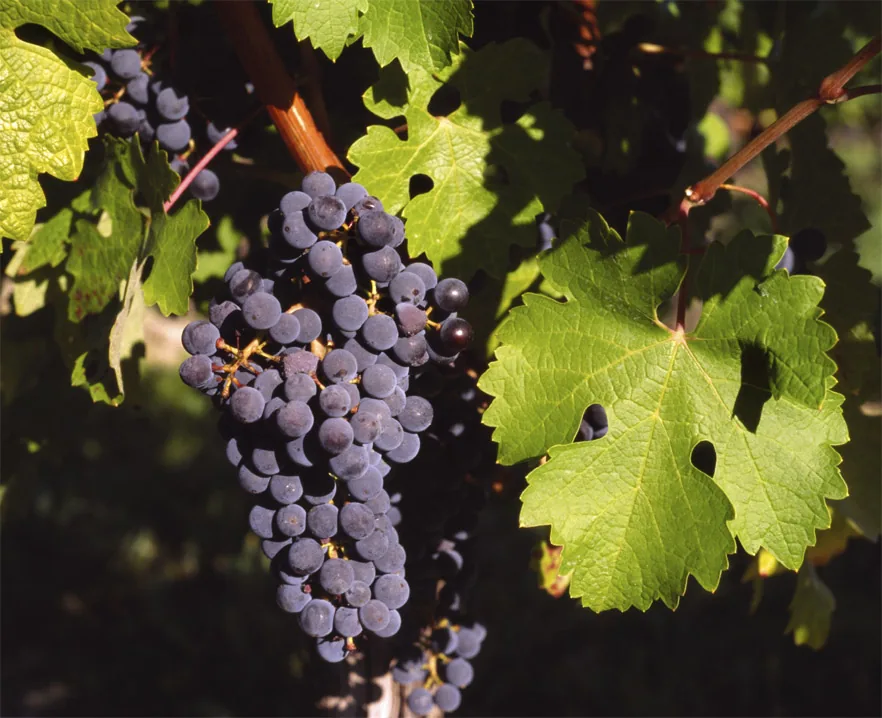
It's a classic European wine grape with small dark berries, and it wants a long, warm season, doing its best in zones 6 to 9.
'Thompson Seedless' (V. vinifera)
It's a seedless green table grape, and it's also the one that most often gets dried into raisins.
'Concord' (American Vitis labrusca)
It's a cold-hardy, slip-skin blue-black grape grown for juice and jelly, and it takes colder zones than vinifera can.
'Niagara' (American Vitis labrusca)
It's a cold-hardy white labrusca with a bold foxy flavor, and it works for both juice and white wine.
'Reliance' (interspecific hybrid)
It's a seedless red table grape bred for cold hardiness and better resistance to disease.
Companions
Grapes do best with low plantings that improve the soil or warn of disease early, and worst near big trees that steal their light and water.
Plant near
Roses: Traditionally planted at vineyard row ends as an early-warning indicator, since powdery mildew often appears on roses before the vines.
Clover or legume cover crops: Living mulch between rows improves soil and reduces erosion without heavily competing once vines are established.
Keep apart
Large shade trees: Compete for light, water, and nutrients and cast shade that reduces fruiting and worsens disease.
How to propagate
Grapes are easy to multiply right off the vine, so most new plants are clones rather than seedlings. Cuttings and layering couldn't be simpler, and grafting takes a bit more skill but it's what solves the phylloxera problem.
Stem cuttingsEasy
Late winter while the vine is dormant · Roots in one growing season; fruiting in about 2-3 years
In late winter, while the vine's still asleep, snip pencil-thick dormant hardwood cuttings that each have 3 to 4 buds. It's the go-to way to start own-rooted American types and rootstocks, and the cuttings root over one growing season before they start fruiting in about 2 to 3 years.
LayeringEasy
Spring to early summer · Roots within one growing season
Here's an easy one: bend a low cane down in spring or early summer and bury part of it so it roots where the buried nodes sit. Give it a growing season and it'll have its own roots, and then you can cut it free from the parent vine.
GraftingDemanding
Late winter as a bench graft, or in spring · 1-2 years to a productive vine
Want European vinifera on tough roots? Graft the scions onto phylloxera-resistant American rootstock, either as a bench graft in late winter or out in the field in spring. It's the standard move where phylloxera lives in the soil, and the graft turns into a productive vine in 1 to 2 years.
Myths
Only dried raisins are dangerous to dogs, not fresh grapes.
Nope, fresh grapes are just as dangerous as raisins, and so are sultanas and currants. Any of them can cause acute kidney failure in dogs, and it doesn't matter whether the fruit's fresh or dried.
Seedless or peeled grapes are safe for dogs.
The seeds and skin have nothing to do with it, so taking them off doesn't help. Seedless and peeled grapes are still just as toxic, and since there's no way to know the dangerous dose, no amount is worth the risk.