Shrub · Vitaceae
Virginia Creeper
Parthenocissus quinquefolia
A tough native vine that hands you knockout fall color as long as you keep it trimmed back.
Full sun
Every 7–14 days
USDA 3–9
30–50 ft · 9.1–15.2 m
Overview
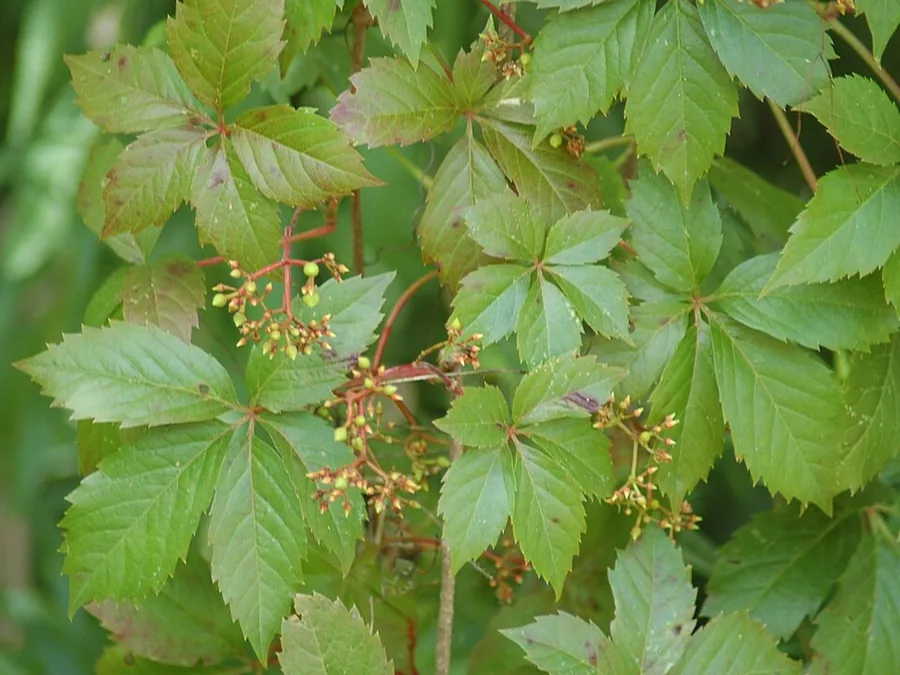
Virginia creeper is a fast, woody climber that grows wild all over eastern North America, and people plant it for the blazing scarlet color it puts on every fall. The leaves come in fives, spread out like fingers on a hand, and that's your easy tell that it isn't the three-leaflet poison ivy. Give it a fence, an arbor, or a bare bank and it'll cover the ground in a season or two, no problem.
The very thing that lets it climb is also what makes it a bit of a handful. It hangs on with disk-tipped holdfasts that stick to just about anything, so it'll shoot up trees, walls, and trellises way past head height. Only catch is that same grip works at paint and mortar, so it's happiest with a spot of its own, set back a little from the house.
Once it's settled in, though, it barely asks for a thing. Full sun or deep shade, sandy soil or heavy clay, a dry spell or cold down to -40°F (-40°C), it just shrugs and keeps going. The one thing to watch comes later in the year, when it hangs out clusters of dark blue-black berries that look like little grapes but are poisonous to both people and animals.
Care
The short version: pop it into almost any well-drained soil, go full sun if you want the best fall color or settle for shade if that's what you've got, keep it watered until it's settled in, and after that you're mostly just trimming it to keep it where you want it.
Light
Here's a nice surprise for a climber: Virginia creeper is happy in anything from full sun to full shade. Sun gives you the deepest red come fall, while shade still grows a perfectly healthy vine, just with softer, more muted color.
Water
While a young plant's getting rooted, give it a good soak every 7 to 14 days and let the top half of the soil dry out in between. Once it's established, it gets really drought tolerant and hardly needs anything past what the sky gives it.
Soil
It'll take clay, loam, or sand and never complain, as long as it gets decent drainage and a bit of organic matter to work with. The pH range is nice and wide, 5.0 to 8.0, so whatever soil you've got will probably do just fine.
Temperature
Not many vines are this tough. It shrugs off winters as cold as -40°F (-40°C) and summer heat up to 100°F (38°C), and that's exactly why it grows happily across such a huge chunk of the country.
Humidity
Regular outdoor air is plenty, so this is one thing you can just forget about. Airflow matters way more than any humidity number, since it's that close, stuffy air that brings on the odd leaf spot or bit of mildew.
Feeding
You can pretty much skip feeding, since this vigorous native hardly ever wants it. If the growth ever looks tired, a light balanced feed in spring is all it takes, and piling on more just fuels the runaway growth you'll be cutting back anyway.
Pruning
Pruning's really the main gig with this one. Cut it hard in late winter or early spring, then keep trimming through the season to hold it off masonry, gutters, shutters, and wiring, because left alone it climbs fast and far.
Repotting
In the ground it never needs repotting, and even in a pot it barely asks. Only bump it up a size if you see roots circling the base or water running straight through without soaking in.
Size & spacing
Turn it loose and this vine can climb a wild 30 to 50 feet (9 to 15 m) with a spread of 5 to 10 feet (1.5 to 3 m). Give it that kind of room on a sturdy support and keep it well back from the house.
When to plant
This is a hardy perennial vine, not some crop racing the calendar, so timing is really just about helping it settle in rather than beating a frost. Plant it out in spring or fall, keep an eye out for the little greenish flowers from May into July, and enjoy the dark berries and that famous red glow from late summer through fall.
Northern hemisphere
Southern hemisphere
Typical months for a temperate climate: start earlier in warm zones, later where spring frosts linger.
- Plant: spring or fall
- Harvest: Greenish-white insignificant flowers May to July, followed by blue-black berries in late summer to fall
Hardiness
USDA hardiness zones: 3–9
Temperature: down to -40°C
Troubleshooting
Virginia creeper is almost too healthy for its own good, so most of its trouble is about size rather than anything actually being wrong. The big one to watch is the vine climbing where it shouldn't and grabbing onto walls. Catch its handful of cosmetic leaf issues early and it's easy to keep looking great.
Vine grabbing the wall and leaving sticky spots you cannot rub off
Ever wonder what those little clinging pads are? They're adhesive holdfasts, the disk-tipped tendrils the vine uses to haul itself up whatever it can grab. Trouble is, once they're on a house they tug at paint, dig into mortar, and gum up the gutters, and the sticky residue hangs around even after you've pulled the stems off. So cut it back hard, ease the stems away before those disks lock on, and send the new growth onto a trellis you've set a good way from the walls.
Fix:
- Cut vines back hard and pull stems off surfaces before disks set
- Trim regularly through the growing season to keep growth in bounds
- Redirect onto a sturdy trellis, fence, or arbor away from buildings
Spotty leaves or a dusty white film showing up on the foliage
Seeing dark spots or a chalky white haze? The spots are fungal leaf spot and the haze is powdery mildew, and both like shade and damp, stuffy air. Good news is they barely bother a vine this tough, so you're really just tidying up the look. Open up any crowded stems, pull off the sorriest leaves, and water down at the roots so the leaves can stay dry.
Fix:
- Improve air circulation by thinning crowded growth
- Remove and dispose of badly affected foliage
- Avoid wetting foliage when watering
Nibbled or freckled leaves with bugs hanging around
Nine times out of ten it's Japanese beetles, and they'll eat a leaf right down to its skeleton, while leafhoppers leave a fine speckling and scale sit like little bumps on the stems. Here's the thing, though: a grown vine takes it all in stride. Flick the beetles into some soapy water, hose or snip off any small patch that gets going, and only break out the horticultural oil if scale really digs in.
Fix:
- Hand-pick beetles into soapy water
- Hose off or prune out localized infestations
- Treat scale with horticultural oil if severe
Toxicity
Just treat the whole plant as something you never eat. Every bit of it carries sharp calcium oxalate crystals, and the dark berries pile oxalic acid on top, which is why they've poisoned cats, dogs, horses, livestock, and people. The fruit is the real worry here, since it looks so much like wild grapes that curious kids and pets want to try it.
Toxic to
Cats · Dogs · Horses · Rabbits · Livestock · Birds · People
Cats Toxic
The whole plant is loaded with sharp calcium oxalate crystals that sting the second a cat bites in, so you'll see a lot of drooling, pawing at the mouth, and maybe some vomiting. Sometimes the lips and throat puff up a bit too.
Dogs Toxic
If a dog chews the leaves or those grape-lookalike berries, its mouth burns, the drool really flows, and its stomach gets upset with vomiting or diarrhea. The berries pack the most oxalic acid, so they're the ones that hit hardest.
Horses Toxic
A horse that grazes the vine ends up with a sore mouth and a churned-up gut, so expect drooling, mouth pain, and that colicky kind of discomfort. Keep any creeper that's crept into the paddock fence trimmed away.
Rabbits Toxic
Those same crystals mean this is a hard no for rabbits, and even a little nibble can leave the mouth sore and the tummy unhappy. Keep the cuttings and any stray fruit well out of the hutch.
Livestock Toxic
Cattle, goats, and sheep that browse the leaves or berries get a sore mouth, plenty of drooling, and an upset stomach. Best to pull the vine off the pasture edges before the animals stumble onto it.
Birds Toxic
Wild birds happily eat the ripe berries and spread the seed around, but that acid-heavy fruit is no good for a pet bird. If a companion bird gets a taste, look for a sore mouth and some digestive trouble.
People Caution
None of this plant is food, plain and simple. The dark berries look so much like wild grapes that they've poisoned people, kids most of all, bringing a burning mouth and throat, drooling, and vomiting, and the sap can leave a rash on your skin too.
Sap and oxalate crystals can cause skin irritation or contact dermatitis in sensitive people; wear gloves when pruning or removing the vine.
Helpline numbers

United States
ASPCA Animal Poison Control: (888) 426-4435 (fee applies)
Poison Control: (800) 222-1222



Canada
Poison Centres: 1-844-764-7669
Varieties
Most folks just grow the plain species, but a few named picks swap a little of that vigor for nicer color or patterned leaves. These are the ones you're most likely to run into.
var. engelmannii (Engelmannii)
It's a calmer grower than the wild species, with smaller leaflets and a bronze-red fall show that give it a tighter, finer-textured look.
'Monham' (Star Showers)
This variegated one is splashed with white, paint-like markings on green leaves, and they even pick up a pink blush once things cool off.
'Troki' (Red Wall)
It starts bronze in spring, goes green all summer, then flips to a fire-engine red when fall rolls around.
How to propagate
This vine is so keen to spread that making more of it is almost too easy. You can root a few cuttings, peg a stem down to layer, or start from seed if you don't mind waiting out a cold spell first.
Stem cuttingsEasy
Late spring to summer from softwood or semi-hardwood · 4 to 8 weeks to root
Cuttings are about as easy as it gets. Snip some softwood or semi-hardwood pieces from late spring into summer, and they'll usually root in 4 to 8 weeks without much help from you. Honestly, stray stems will even root themselves anywhere they flop onto damp ground.
LayeringEasy
Spring through summer · One growing season
Want the no-fuss option? That's layering. Anytime from spring through summer, a trailing stem roots right at the nodes where it touches down, so once you pin a shoot to the soil it's usually good to cut loose after one growing season.
SeedModerate
Sow outdoors in fall or cold-stratify before spring sowing · Germination after cold stratification
Seed takes a bit more patience, mostly because it needs a cold spell to wake up. Sow it outside in fall, or give it a chilled stretch before you sow in spring, and the sprouts show up after that cold treatment. And out in the wild? The birds do all the sowing for you, eating the berries and dropping the seed everywhere.
Myths
Virginia creeper is just poison ivy, so any vine with five leaflets is poison ivy.
Just count the leaflets and you'll never mix them up. This one has five, which is where the old saying 'leaves of five, let it thrive' comes from, while poison ivy has three, 'leaves of three, let it be.' There's no urushiol in it, the oil that makes poison ivy itch so bad, though the oxalate crystals in its sap can still leave a mild rash if your skin reacts easily.