Tree · Betulaceae
American Hornbeam
Carpinus caroliniana
Give it moist soil and a bit of shade, and this tough, slow-growing native will hold its shape for decades.
Partial shade
Every 5–10 days
USDA 3–9
20–30 ft · 6.1–9.1 m
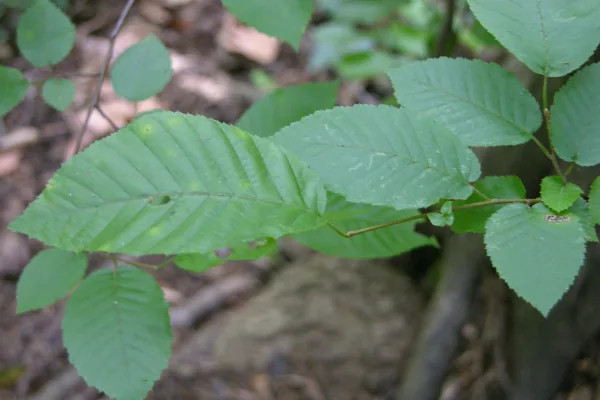
Overview
American hornbeam is a small, slow-growing native from eastern woodlands, and it's happiest in the dappled light under bigger trees. What really catches your eye is the bark, which is smooth, blue-gray, and rippled with muscle-like flutes that gave it the nicknames musclewood and ironwood. And the wood underneath? It's some of the hardest you'll find on any North American tree.
It pulls its weight all year long. Spring brings dangling catkins, summer fills in a dense rounded crown, and fall turns the leaves yellow, orange, and red before clusters of winged nutlets ripen and feed the birds. It stays pretty modest in size too, so it slots easily into a shaded yard or a naturalized planting.
This is a tree for folks who don't mind waiting, since it takes its time. It grows slow and asks for hardly anything once it's settled, but it won't put up with drought, heat, or packed soil. Give it the moist, rich ground it likes, though, and it brushes off pests, takes a hard pruning, and even grows where black walnut roots would kill off most other trees.
Care
The short version: part to full shade suits it best, though it'll take full sun if the ground stays moist. Keep the soil moist and rich, keep it out of drought and heat, and otherwise just let this low-maintenance native grow at its own slow pace.
Light
Hornbeam grows best in part to full shade, which makes sense since it lives as an understory tree in the wild. It'll take full sun too, but only if the soil stays reliably moist, because sun plus dry ground stresses it out fast.
Water
Keep the soil consistently moist and rich, watering it about every 5 to 10 days, and more often until a young tree gets established. It even shrugs off the occasional flood, but it's especially sensitive to drought, so don't let those roots dry out and bake.
Soil
Plant it in moist, organically rich, well-drained loam, whether that's sandy or a bit clay-heavy, and it's fine with ground that floods now and then. It's not picky about pH either, growing happily across a wide range from 5.0 to 7.5.
Temperature
This is one tough, cold-hardy native that handles anything from -40°F to 100°F (-40°C to 38°C). Its real weak spot? Heat paired with drought, not the cold.
Humidity
Regular outdoor humidity suits it just fine, so there's no number you need to hit. What matters way more is good airflow, since still, damp air is exactly what the leaf-spot fungi are waiting for.
Feeding
It doesn't need much feeding in decent soil. A balanced slow-release fertilizer in spring, or honestly just a layer of compost or leaf mulch, gives it everything it's after.
Pruning
As a tree it barely needs pruning, but it takes shearing well and bounces right back from hard cuts when you grow it as a hedge or screen. Do the work from late summer through mid-winter so the cuts don't bleed sap.
Repotting
Hornbeam is a landscape tree, not a container plant, so it's rarely repotted. If you've got a young one in a pot, bump it up when the roots start circling, water runs straight through, or new growth stalls.
Size & spacing
Expect a tree around 20 to 30 feet (6 to 9 m) tall with a spread of 20 to 35 feet (6 to 10.5 m), so give it open ground to fill out that rounded crown. Grow it as a sheared hedge, though, and you can keep it a whole lot tighter.
When to plant
Hornbeam does its own thing at its own slow speed, and it doesn't love being disturbed. Get it planted in spring so the roots have a whole season to settle before the summer heat kicks in, then keep an eye out for catkins in spring and clusters of winged nutlets ripening from late summer into fall.
Northern hemisphere
Southern hemisphere
Typical months for a temperate climate: start earlier in warm zones, later where spring frosts linger.
- Plant: spring
- Harvest: Spring (catkins); winged nutlet clusters mature in late summer to fall
Hardiness
USDA hardiness zones: 3–9
Temperature: down to -40°C
Troubleshooting
Hornbeam is famously easy, and most of the time a problem just means the tree's stressed and thirsty, not seriously sick. Keep an eye on the leaves and twigs for the early signs below, and step in before a little issue turns into a big one. Honestly, just keeping the roots cool and moist heads off nearly all of it.
Wilting and crispy leaf edges when it's hot and dry
Hornbeam really can't stand drought, heat, and packed-down soil, and a tree you just planted feels all three the most. When the ground dries out you'll see the leaf edges go brown and the whole tree kind of droop. So water it deeply through the dry spells, pile some mulch over the roots, and only put new trees in the ground in spring on loose, moist soil.
Fix:
- Water deeply during dry periods
- Apply organic mulch over the root zone
- Transplant only in spring and avoid compacted sites
Sunken bark patches with twigs dying off above
When you see sunken, cracked bark with dead twigs sitting above it, that usually points to canker fungi or twig blight. Here's the thing: it tends to pick on a tree that's already run down by drought or heat. Prune the bad wood well below the sunken spot and wipe your tools between cuts so you're not carrying it along, and honestly, the best defense is just keeping the tree healthy in the first place.
Fix:
- Prune out dead and cankered wood well below the lesion
- Disinfect tools between cuts
- Reduce stress by watering during drought and mulching
Dark, angular spots showing up on the leaves
Those defined blotches with darker edges? That's just fungal leaf spot, and it loves the wet stretches when leaves stay damp and the air barely stirs. It looks a lot scarier than it actually is, and it rarely does the tree any real harm. Rake up the leaves that drop, let the canopy breathe so it dries out, and you can shrug off whatever's left.
Fix:
- Rake and dispose of fallen infected leaves
- Improve air circulation and avoid overhead wetting
- Tolerate minor infections as they rarely harm tree health
Toxicity
Got pets? Good news, because American hornbeam isn't toxic. It doesn't show up on the ASPCA's poison lists, and cats, dogs, horses, and livestock can all hang around it safely. There's nothing sneaky hiding in the leaves, bark, or seeds to worry about.
Safe for
People · Cats · Dogs · Horses · Rabbits · Livestock · Birds
Cats None
If a cat sneaks a bite of a leaf, there's nothing to stress about, because hornbeam is safe for them. It just doesn't hold any toxin that could hurt them.
Dogs None
A dog can chew on the leaves or bark and won't get poisoned, plain and simple. Sure, a big mouthful of rough plant stuff might give a mild tummy ache, but that's it, and there's no toxic effect at all.
Horses Safe
Horses can graze and browse hornbeam all they like, since none of its parts are poisonous to them.
Rabbits Safe
Rabbits are totally fine nibbling the leaves and young twigs. There's just nothing in the plant that would harm them.
Livestock Safe
Cattle, goats, and sheep can browse the foliage no problem, because hornbeam isn't a toxic species.
Birds Safe
Birds actually go for the winged nutlets as food, and the seeds and leaves don't pose any toxic risk.
People Safe
Hornbeam isn't poisonous to people either. There's no crop to eat here, but handling it or an accidental taste won't cause any toxic trouble.
No special handling required; as a large landscape tree it is not an indoor or houseplant.
Varieties
Most named hornbeams get picked for their shape or their fall color, and a few European cousins pop up wherever someone wants a tight, formal screen. These are the ones you'll run into most.
'Native Flame'
This American hornbeam is a go-to for reliable bright red fall color on a tidy, upright-oval shape.
'Firespire'
A skinny, upright American hornbeam that goes orange-red in fall and squeezes into tight spots.
Carpinus betulus (European hornbeam)
The bigger European cousin gets up to 40 to 60 feet, works great as a sheared hedge or screen, and is the parent of loads of columnar cultivars.
Carpinus betulus 'Fastigiata'
A columnar to pyramidal European hornbeam that's been a favorite formal street and screening tree for ages.
Carpinus betulus 'Frans Fontaine'
A tightly columnar European hornbeam that keeps its narrow upright shape as it gets older, which makes it perfect for streets.
Companions
Hornbeam thrives in the shade where many trees struggle, and it tolerates juglone, so it pairs well with woodland plantings and even the difficult ground beneath a black walnut.
Plant near
black walnut (Juglans nigra): American hornbeam tolerates juglone, so it can be planted near black walnut where many trees fail.
woodland shade perennials and ferns: As a shade-tolerant understory tree it pairs well with shade groundcovers for naturalized plantings.
How to propagate
Hornbeam is slow and stubborn when it comes to propagating, so nurseries lean on seed and grafting instead of the quick rooting you get from cuttings. Every method takes a little time and a little know-how.
SeedDemanding
Sow fresh nutlets in fall, or stratify for spring sowing · Germinates the spring after maturity; slow to establish
Growing hornbeam from seed takes some patience, because the nutlets have double dormancy. They want a warm spell and then around 18 weeks of cold, moist stratification near 40°F (4°C), so you either sow fresh seed in fall or chill it for a spring sowing. And even then? The seedlings won't pop up until April through June the next year, and they're slow to get going.
GraftingDemanding
Late winter to early spring · One to two seasons
Named cultivars get grafted onto seedling rootstock so they keep their shape and fall color, and it works best from late winter to early spring. Just give it a season or two for the union to take and the young tree to start growing on its own.
Stem cuttingsDemanding
Early summer (softwood) · Slow and unreliable
Softwood cuttings taken in early summer root badly, and the results are slow and pretty hit-or-miss. That's why most growers skip them and go with seed or grafting instead.
LayeringModerate
Spring · One or more growing seasons
Layering is the easier way to go. Just pin a low branch down into the soil in spring and let it root there over one or more growing seasons before you cut it loose as a new plant.
Myths
Hornbeam is called ironwood because the wood holds iron or is poisonous.
Those names, ironwood and musclewood, are really just about the wood itself, which is famously hard and dense, plus the smooth, sinewy fluted bark that looks like a flexed muscle. There's no iron in there, and nothing toxic to your pets either.
American hornbeam needs full sun to grow well.
It's actually one of the most shade-tolerant trees you can plant, and out in the wild it grows as an understory tree under a taller forest canopy. It's happy in part to full shade, and it'll still take full sun as long as you keep the soil moist.