Tree · Meliaceae
Neem Tree
Azadirachta indica
Give it heat, sun, and free-draining soil, and the neem tree will happily shrug off drought and poor ground for decades.
Full sun
Every 7–21 days
USDA 10–12
50–75 ft · 15.2–22.9 m
Overview
Neem is a fast-growing evergreen in the mahogany family, and it hails from south Asia, though these days it grows all over the warm parts of Asia and Africa. Leave it alone and it shoots up into a big, shady tree pretty quickly. People have relied on it for generations too, whether that's chewing the twigs or pressing the seeds for oil.
So what makes neem stand out in a garden? Its seed oil. The seeds are loaded with azadirachtin, which puts insects off their food and throws their growth and breeding out of whack, and that's exactly why gardeners turn neem into a natural pesticide. The leaves have their own long medicinal tradition, and they're a lot gentler than the concentrated oil.
Once it's settled in, neem barely asks for anything. It takes heat up to 113°F (45°C), doesn't mind drought, and grows in poor, rocky, even slightly salty ground. Its one real weak spot is cold, because frost cuts it back and a hard freeze can finish it off, so it only lives outdoors in the warmest zones.
Care
The short version: give it full sun and warmth, deep well-drained soil, and a good deep soak for young trees during dry spells while you let the surface dry between waterings. Once it's established it deals with drought and poor ground on its own, but it just can't handle frost.
Light
Neem loves full sun and grows fastest out in the open, but it'll put up with partial sun or light shade if it has to. The more direct light it gets, the denser and stronger that crown turns out.
Water
Give young trees a deep drink during dry spells, then let the top half of the soil dry out before you water again, which works out to roughly every 7 to 21 days. Once a neem's established it handles real drought just fine, and the one thing it won't put up with is waterlogged ground.
Soil
Go for deep, well-drained sandy or loamy soil. Neem isn't picky and does fine in poor, rocky, even slightly salty ground, working across a wide pH range of 6.0 to 8.0. Drainage is what really counts, since the roots will rot in soil that stays wet.
Temperature
This is a tropical to subtropical tree, so it's totally happy in heat right up to 113°F (45°C). The catch is the cold end, around 41°F (5°C), below which frost scorches the leaves and a freeze can take out a young tree.
Humidity
Average humidity is fine, somewhere in the 40% to 70% range, and it handles the dry air of semiarid regions without a fuss. There's no need to mist it or worry about moisture in the air.
Feeding
Feed it through spring and summer with a balanced slow-release fertilizer or compost, and once a season is plenty. Neem does well in lean soil, so piling on the feed actually helps pests more than the tree by pushing out soft, sappy growth.
Pruning
Prune in late winter to early spring to shape the crown and take out any dead, damaged, or crossing branches. Neem shrugs off hard pruning and even pollarding, which is what makes it such a good pick for a clipped hedge.
Repotting
A container-grown neem wants repotting every 2 to 3 years while it's young, before the roots start circling and choking the pot. If your climate stays frost-free, though, the smarter long-term move is to just plant it in the ground.
Size & spacing
A grown neem is a seriously big tree, hitting 50 to 75 feet (15 to 23 m) tall with a broad canopy that can spread 40 to 60 feet (12 to 18 m) across. So give it plenty of open room and keep it well clear of buildings, paving, and smaller plantings.
When to plant
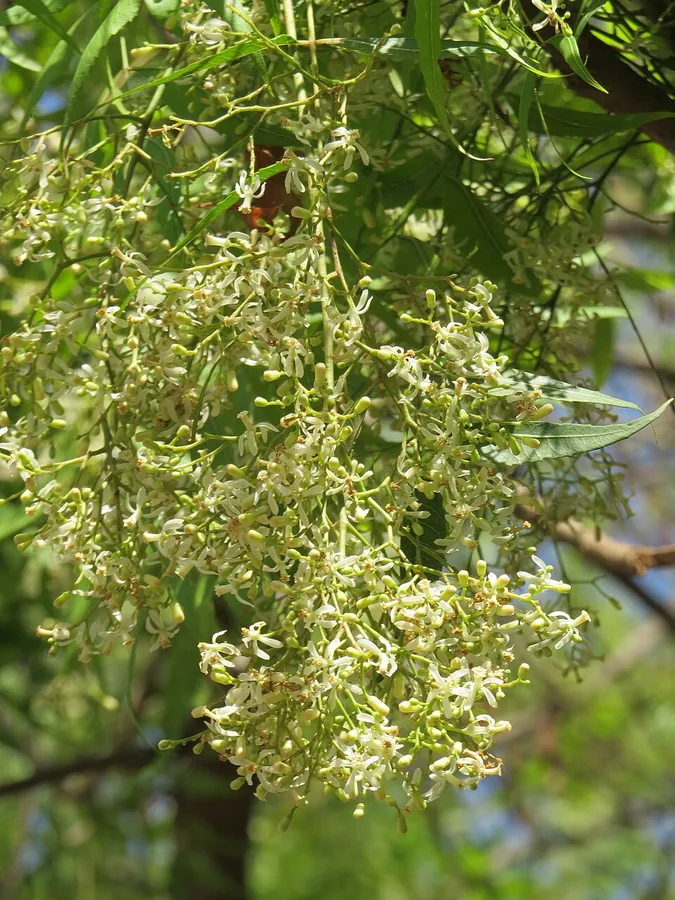
Neem runs on warmth and won't make it through frost, so timing matters. Sow fresh seed under cover in late winter or early spring, get young trees out in spring once the soil's warmed up and the cold has passed, and keep an eye out for fragrant white flowers in spring, followed by olive-like drupes from summer into early fall.
Northern hemisphere
Southern hemisphere
Typical months for a temperate climate: start earlier in warm zones, later where spring frosts linger.
- Sow: Late winter to early spring in frost-free warmth; sow fresh seed because viability is short
- Plant: Spring after all danger of frost, once soil is warm
- Harvest: White fragrant flowers in spring; olive-like drupes ripen summer to early fall
Hardiness
USDA hardiness zones: 10–12
Temperature: down to -1°C
Troubleshooting
Give a neem the right climate and it barely causes trouble, so most problems come down to cold, soggy soil, or sap-sucking pests. Learn to spot the early signs on the leaves and roots and you can jump in before anything spreads. Find what matches below, then act while it still does some good.
Droopy, yellow growth and roots gone soft and dark
If a neem in soggy ground starts wilting and going yellow, root rot is the usual suspect. Scrape back the soil and you'll probably find brown, mushy roots where firm pale ones should be. Here's the tough part: once it's set in, there's no real fix, so the move is to stop overwatering, sort out the drainage, and replant in deep, sandy soil that dries out at the surface between waterings.
Fix:
- Improve drainage and stop overwatering
- Remove affected plant material
- Replant in deep, sandy, well-drained soil
Burnt-looking leaves and dead tips after the cold moved in
Neem's a tropical tree, and it just can't take frost, so a cold spell scorches the exposed outer leaves the moment things dip below about 41°F (5°C). That's also why it only really works in zones 10 to 12. Once the frost danger's behind you, cut out the dead wood, and if a tree's still young, tuck it under cover or keep it in a pot you can bring inside when the cold shows up.
Fix:
- Prune out dead wood after the danger of frost has passed
- Protect young trees with frost cloth or grow in containers that can be moved indoors
- Site in a warm, sheltered location
Sticky leaves wearing a blackish, sooty coating
See a black film with something sticky underneath? That's sooty mold, and it's just growing on the sugary honeydew that scale, whitefly, or aphids drip while they feed up above. The mold itself does no harm and wipes right off, so the real job is finding those bugs on the shoot tips and leaf undersides. Give the leaves a rinse, treat the pests with horticultural soap or oil, and let the natural predators mop up whatever's left.
Fix:
- Rinse foliage and wipe off mold
- Control the sap-sucking insects with horticultural soap or oil
- Encourage natural predators
Toxicity
The leaves are low in toxicity and have been used medicinally forever, so a curious nibble usually isn't worth worrying about. What you do want to watch is the concentrated neem oil and the seeds, which are full of azadirachtin and can make pets and people sick if they swallow much of it. Cats feel it the most, so just keep the oil and seed products stored well out of reach.
Toxic to
Cats · Dogs · People
Safe for
Horses · Rabbits · Livestock · Birds
Cats Mild
The leaves are pretty low in toxicity, but cats are the ones that react most to concentrated neem oil. If a cat swallows the undiluted oil or gets treated with it, you might see drooling, vomiting, and a listless cat, and some reported cases went as far as tremors, twitching, and convulsions. So keep the seed oil and extracts somewhere a cat just can't get to.
Dogs Mild
A nibbled leaf? That's rarely a big deal. It's the concentrated oil that's the worry, since swallowing it or slathering it on too thick can bring on vomiting, drooling, and a dull, sluggish dog. Dogs do handle diluted topical neem better than cats do, though.
People Caution
Neem leaves have been used medicinally for ages and they're low in toxicity, but the concentrated oil and the seeds are a whole different story. Swallow those in any quantity and you can end up with vomiting and worse, and it's small children who are most at risk, so keep neem oil and seed products stored safely.
Horses Safe
A grazing horse isn't in much danger from the foliage. Just keep the concentrated neem oil and seed products stored where a horse can't get into them.
Rabbits Safe
For rabbits, browsed leaves are low-toxicity, so no worries there. The only real trouble would be the concentrated oil or a bunch of crushed seed, and honestly, a rabbit shouldn't be able to reach either one.
Livestock Safe
Cattle, goats, and sheep can browse neem foliage with little risk, and the leaves even get used as fodder in parts of its range. The thing to hold back is the seed oil, which shouldn't be fed to them.
Birds Safe
Birds don't have much to fear from the leaves or the fruit. Just keep them away from any concentrated oil or extract and they'll be fine.
Keep concentrated neem oil and neem seed products away from pets; never apply undiluted neem oil to a cat or dog or allow them to ingest it.
Helpline numbers

United States
ASPCA Animal Poison Control: (888) 426-4435 (fee applies)
Poison Control: (800) 222-1222



Canada
Poison Centres: 1-844-764-7669
Varieties
Neem comes in two main forms: one that's grown for the kitchen and one for its potent seed oil. These are the two worth telling apart.
Azadirachta indica var. siamensis (Thai neem)
This Southeast Asian one grows young leaves and flowers that are mild enough to eat as a vegetable, which is handy since the common type's way too bitter for that.
Common neem (typical var. indica)
The widely grown South Asian type is the one gardeners want for its azadirachtin-rich seed oil, which they press into a natural botanical biopesticide.
Companions
Neem earns its keep near vegetable and fruit crops, where its leaf and seed extracts deter many garden pests, but its dense shade, hungry roots, and allelopathic leaves make poor company for small plants growing right beneath it.
Plant near
Vegetable and fruit crops: Neem leaf and seed extracts are used as a botanical biopesticide that deters many garden pests.
Keep apart
Shallow-rooted understory plants: Its dense shade, vigorous roots and allelopathic leaf compounds suppress small plants growing directly beneath it.
How to propagate
Neem's easy to multiply, and it's nearly always done from seed, with cuttings kept as a backup for when there's no fresh seed around or you want an exact copy of a particular tree.
SeedEasy
Sow fresh seed in spring in warm conditions · Germinates in 1 to 3 weeks; transplant after a few months
Most neem trees start out from seed, and the one thing that trips people up is timing. The seed goes off fast, so sow it soon after the fruit ripens, while spring's still warm. It'll come up in 1 to 3 weeks, and after a few months it's ready to transplant.
Stem cuttingsModerate
Warm season from semi-hardwood cuttings · Roots in several weeks under warmth and humidity
No fresh seed around, or want an exact copy of a tree you like? Take semi-hardwood cuttings in the warm season instead. Keep them warm and humid and they'll root over several weeks.
Myths
Neem oil's all-natural, so it's got to be fine for every animal at home.
Natural doesn't automatically mean safe, and here's why: the active compound azadirachtin can bring on drooling, vomiting, and tremors, and the concentrated oil has made cats seriously sick and, in some reported cases, killed them. Stick to heavily diluted oil and keep the concentrate away from your animals.
Neem zaps whatever bug it touches, instantly.
Not quite. Neem mostly puts insects off feeding and messes with how they grow and breed, so it works over days rather than seconds. Think of it as slowly thinning out a pest population, not wiping everything out the moment it lands.