Tree · Caricaceae
Papaya
Carica papaya
Give it full sun, steady moisture, and frost-free warmth, and papaya fruits within a year.
Full sun
Every 1–4 days
50–95°F · 10–35°C
210–330 days
Overview
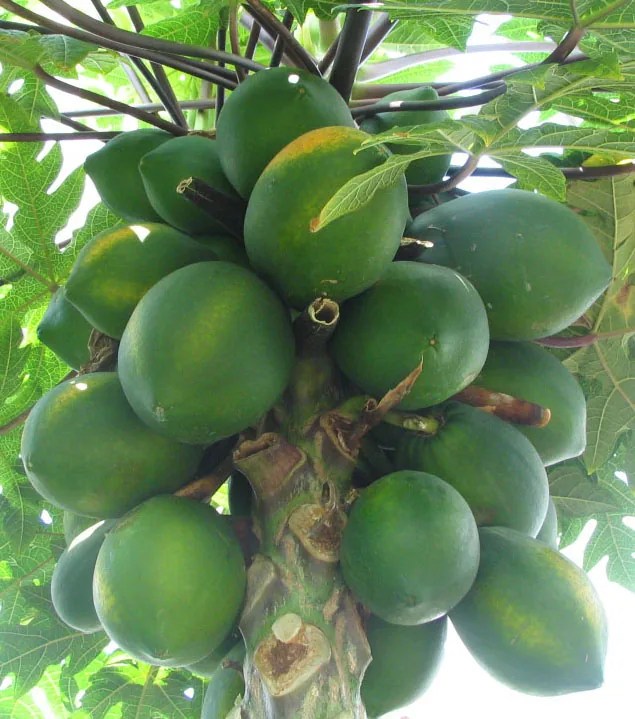
Papaya's a fast-growing tropical tree that gets from seed to fruiting plant in well under a year. It's part of the Caricaceae family, and it holds its melon-like fruit way up on a tall, single, soft trunk topped with a crown of broad, lobed leaves. Give it a frost-free spot and it'll climb anywhere from 6 to 20 feet (2 to 6 m) as it goes.
So what's the catch? Papaya is short-lived and tender. There's no real wood in that trunk, the plant fades within a few years, and one cold night below freezing can finish it off. That's why most growers treat it like a quick crop and swap plants out every 18 to 24 months to stay ahead of ringspot virus.
Pollination takes a bit of planning. Seedlings come up male, female, or bisexual, and you won't know which until they bloom, so gardeners grow a few plants together or pick a bisexual cultivar. Sort out the warmth, the water, and a fruiting plant, and the harvest keeps coming nearly year-round in a tropical climate.
Care
The short version: full sun, warmth that never dips to frost, and soil kept evenly moist but never soggy. Feed it regularly through the growing season, give that tall trunk room to spread, and plan on swapping the plant out every couple of years.
Light
Papaya wants full sun, and honestly, the more the better. It'll put up with a bit of partial sun, but bright, all-day light is what drives that fast growth and heavy fruiting.
Water
Keep the soil evenly moist with frequent watering, daily in sandy or rocky ground during hot, dry spells and every 3 to 4 days in loam. Just don't let it sit waterlogged, because wet roots rot fast. And if it dries out or the moisture's all over the place? The plant'll drop its leaves, flowers, and fruit.
Soil
Plant it in well-drained, organically rich sandy loam, though papaya's happy enough in sandy, loamy, and rocky ground too. It handles a wide pH range from 4.5 to 8.0, so drainage matters way more than acidity.
Temperature
Papaya loves warmth, from about 50°F to 95°F (10°C to 35°C), and it's got no tolerance for cold at all. Anything left exposed below roughly 31°F (-1°C) gets killed, so a single frost can end the plant.
Humidity
The plant likes it humid, around 60% to 80%, which fits its tropical roots. Just pair that warmth and moisture with good airflow, or the damp'll invite fungal trouble on the fruit.
Feeding
Papaya's a hungry, fast grower that needs a complete NPK feed with micronutrients through the warm season. Give young plants small amounts about every 14 days, then move older trees to bigger feeds every other month.
Pruning
Mostly, just leave it be, since its single growing point at the top must never be cut. Take off only dead, damaged, or diseased leaves, and stake a trunk if it starts leaning.
Repotting
A container papaya wants moving up into a large tub as it grows. Even at its best it's short-lived, so figure on replacing it every 4 to 5 years, or every 18 to 24 months where ringspot virus is around.
Size & spacing
Don't let the slim trunk fool you, this tree shoots up 6 to 20 feet (2 to 6 m) and holds a crown of leaves that stretches 3 to 10 feet (90 cm to 3 m) across. Leave it plenty of elbow room in a sunny spot so the breeze can slip through all that foliage.
When to plant
Papaya runs on heat and dies in frost, so timing really comes down to staying warm. Start seeds in containers in late winter or early spring, move the young plants outside in spring once the soil's warmed up and all danger of frost has passed, and look for fruit to ripen year-round in a frost-free climate.
Northern hemisphere
Southern hemisphere
Typical months for a temperate climate: start earlier in warm zones, later where spring frosts linger.
- Sow: Late winter to early spring, started in containers in a warm, frost-free spot
- Plant: Spring after all danger of frost, when the soil is warm
- Harvest: Flowers about 4 months after planting; fruit ripens roughly 7 to 11 months after transplanting and is harvested year-round in frost-free climates
Hardiness
USDA hardiness zones: 9–11
Temperature: down to -7°C
Troubleshooting
Most papaya trouble comes back to one of three things: a virus that aphids carry, wet soil, or cold. Learn to read the early signs on the leaves, roots, and fruit, and you can jump in before a problem takes the whole plant. Find what matches below, then move quick.
New leaves gone patchy yellow and rings showing up on the fruit
What you're looking at is papaya ringspot virus, and it's the thing that cuts most papaya plantings short. Aphids ferry it from plant to plant, and here's the hard part: there's no cure once a tree's got it. So pull and destroy anything infected, keep the aphids down, and just start over with virus-free or tolerant stock every 18 to 24 months.
Fix:
- Remove and destroy infected plants to reduce the virus source
- Control aphid vectors
- Replant with virus-free or tolerant stock every 18 to 24 months
Leaves turning yellow while the trunk gives way in soaked ground
This one's all about wet feet. Phytophthora root and stem rot moves in when the soil just won't drain, and it softens the roots and the base of the trunk until the whole thing tips over. Want to turn it around? Fix the drainage, back off the watering, and put new plants up on raised beds or mounds so the extra water can drain away.
Fix:
- Improve drainage
- Reduce watering
- Plant on raised beds or mounds
Leaves gone black overnight and shoots dying back once the cold hits
Here's the thing: papaya just can't handle cold. A frost kills off any tissue left out below about 31°F (-1°C), and you'll see the damage the moment the cold passes. So cover the plant or bring containers inside when a cold snap's on the way, and don't cut off the dead growth until all danger of frost is behind you.
Fix:
- Protect with covers or move container plants indoors during cold
- Prune out dead tissue only after danger of frost has passed
Little dark dents that keep growing on fruit that's ripening
That's anthracnose, a fungus that wakes up in warm, humid, wet weather and shows itself right as the fruit ripens. Cut off and toss anything affected, open up the canopy so air can move through, and grab each fruit as soon as it colors up. Keep overhead watering light and clear away any fallen fruit, and the spores won't have anywhere to gather.
Fix:
- Remove and discard affected fruit
- Improve air circulation
- Harvest fruit promptly as it ripens
Toxicity
Good news first: ripe papaya is safe for people and pets alike, so a slice of the sweet flesh is nothing to sweat. The unripe green fruit and the leaves are a different story, though. They ooze a milky latex full of papain that can irritate skin, eyes, and a curious animal's mouth, so pull on gloves when you cut green fruit and keep pets away from the green parts.
Safe for
People · Cats · Dogs · Horses · Rabbits · Livestock · Birds
Cats Caution
A little ripe flesh is totally fine for a cat. It's the milky latex in the unripe fruit and leaves that can upset the mouth and stomach, so keep them off the green stuff and stick to small pieces of the soft ripe fruit.
Dogs Caution
Most dogs do just fine with a bit of ripe papaya. The latex from green fruit and stems? That's another story, and it can cause drooling or a queasy stomach, so keep them away from the unripe parts.
Horses Caution
Ripe fruit won't bother a horse at all. It's the papain-rich latex in the unripe fruit and leaves that can irritate the gut, so treat the green parts as off-limits.
Rabbits Caution
A small bite of ripe papaya makes a nice once-in-a-while treat. Skip the leaves and unripe fruit, though, since the latex is rough on a rabbit's delicate digestion.
Livestock Caution
Cattle, goats, and sheep are fine with the ripe fruit. The irritating latex in the green fruit and leaves is the part to keep them away from.
Birds Caution
Lots of birds love ripe papaya and its seeds, and both are safe in moderation. The green latex can sting the mouth, so only hand over fruit that's softened and colored up.
People Ripe fruit safe
Ripe papaya is great raw or cooked, and the seeds are fine too if you don't mind them peppery. Just watch the latex from unripe fruit and stems, since it can irritate skin and eyes, so pull on some gloves when you cut green fruit.
The unripe green fruit and the stems exude a milky latex containing papain, a proteolytic enzyme that can irritate skin and eyes; wear gloves when harvesting or cutting unripe fruit. The seeds are edible but peppery.
Varieties
Most home growers reach for a handful of proven cultivars, picked for reliable fruit, good flavor, and dependable pollination. These are the names worth knowing.
Red Lady
It's a dependable, disease-tolerant hybrid whose bisexual plants set fruit reliably and ripen to reddish-orange flesh.
Maradol
It's a Mexican type that's known for big fruit with sweet, salmon-red flesh.
Tainung No. 1
It's a vigorous Taiwanese hybrid that carries medium-sized fruit with red flesh.
Solo
It's a small, pear-sized Hawaiian type with yellow-orange flesh, and it's often hermaphroditic, so a single plant can fruit on its own.
How to propagate
Papaya's grown from seed, and it's one of the easier tropical fruits to raise that way. The only tricky bit is making sure you end up with a plant that actually fruits.
SeedEasy
Spring or warm season, started in containers · Seedlings transplant in about 6 to 8 weeks; plants fruit roughly 7 to 11 months after transplanting
Papaya's easy to grow from seed, and here's a tip: fresh seed scooped straight out of a ripe fruit sprouts best. Sow 2 to 4 seeds in a 1-gallon container and thin down to the strongest, then keep 2 to 3 plants going together so you're sure to land a fruiting female or bisexual plant, because you can't call a seedling's sex until it flowers. They'll be ready to transplant in about 6 to 8 weeks, and the plants come into fruit roughly 7 to 11 months after they go in the ground.
Myths
The papaya and the North American pawpaw are just two names for one tree.
They sound alike, but that's about where it ends. Papaya is a tropical species in the Caricaceae family, while the pawpaw is a temperate tree from a totally different family. One wants frost-free heat, and the other's happy in cold-winter woodlands.
You only need one papaya in the yard to get a harvest.
Not so fast. Seedlings turn out male, female, or bisexual, and you can't tell which until they flower. Plant 2 to 3 seedlings together, or go with a bisexual cultivar, so you wind up with a plant that actually sets fruit.
Papaya is a long-lived tree.
It's fast, but it doesn't stick around. That soft-stemmed trunk fades within a few years, so most gardeners replace their plants every 18 to 24 months, partly just to keep ahead of ringspot virus.