Shrub · Aquifoliaceae
Winterberry Holly
Ilex verticillata
Set a male near your females and winterberry gives you bare stems lit up with red berries all winter.
Full sun
Every 3–7 days
USDA 3–9
3–15 ft · 0.9–4.6 m
Overview
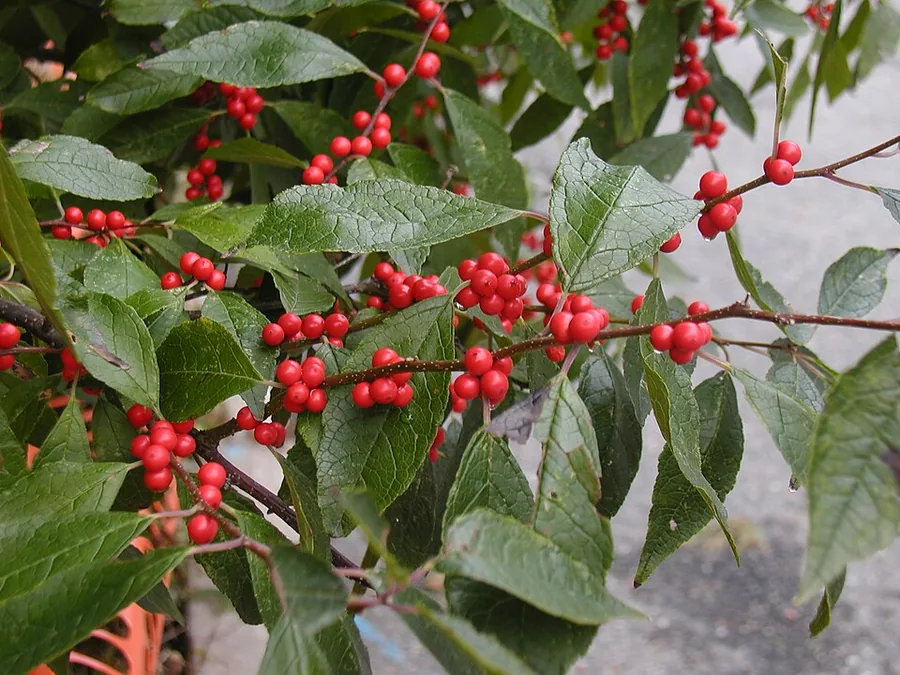
Winterberry holly is the shrub that finally steps up once everything else in the garden has called it a year. It's part of the holly family, but it doesn't play by the family rules, dropping every leaf in fall so that bare stems loaded with scarlet berries can carry the winter. Those berries feed the songbirds and clip nicely into a wreath, so there's plenty to like.
It comes from the wet ground of eastern North America, the edges of swamps, ponds, and low woods, which is why it wants the kind of moist, acidic soil that leaves other shrubs sulking. That easygoing streak makes it perfect for a rain garden or the soggy corner you've never quite figured out, and it takes cold in stride right down to the chilly edge of zone 3.
So what's the one thing to plan for? Sex. Winterberry plants are either male or female, and only a female fruits, and only if a male grows nearby to pollinate her. Nail that pairing and the berries show up like clockwork; skip it and you've still got a healthy green shrub, just one that never colors up.
Care
The short version: give it full sun to part shade and steadily moist, acidic soil that never dries out, and keep at least one male shrub near your females so they'll set berries.
Light
Winterberry takes anything from full sun to full shade, so most spots will do. The berries come thickest in sun though, so give it at least a half day of direct light for the best fruit; a shadier corner still grows a healthy shrub, just with a lighter show.
Water
This one grew up with wet feet, so the trick is to keep the soil steadily moist and never bone dry. It'll even handle boggy, poorly drained spots that would rot most shrubs, which takes the pressure off. Water it through the first season and during any dry stretch while it's settling in.
Soil
Plant it in moist to wet, acidic soil, ideally a pH of 4.5 to 6.0 and rich in organic matter. It's fine in clay or sand too, as long as the ground stays damp, and that acidity is what keeps the leaves nice and green.
Temperature
Not many shrubs are this tough, shrugging off anything from -40°F to 100°F (-40°C to 38°C). That range covers zones 3 through 9, so winter cold is rarely the headache here that it can be with other hollies.
Humidity
Outdoors, humidity is just whatever the weather hands you, and winterberry doesn't fuss about it. Airflow matters more than moisture in the air, since it's the crowded, stagnant plantings where the minor leaf fungi like to move in.
Feeding
One spring feeding with an acidic, slow-release fertilizer made for acid-loving plants is all it wants. A single seasonal meal is plenty for a shrub this laid-back, and it helps keep the soil on the acid side where winterberry's happiest.
Pruning
Good news: winterberry barely needs pruning. Shape it in early spring before the new growth starts, since the flowers form on new wood, and pull out any dead or crossing stems while you're in there.
Repotting
Since it's a ground shrub, repotting hardly ever comes up. If you're growing one in a pot, size up only when the roots start to circle, water runs straight through, or growth stalls even though you're doing everything right.
Size & spacing
Winterberry swings a lot by cultivar, running anywhere from 3 to 15 feet (91 cm to 4.5 m) tall with a spread to match. Give each plant room to fill out its full width, and don't forget to keep a male within about 50 feet of your females.
When to plant
Winterberry is a hardy shrub, not a fussy seasonal crop, so the calendar stays pretty relaxed. Put young plants out in spring or fall while the weather's mild, watch for the small greenish-white flowers from spring into early summer, and then wait on the bright red berries that ripen in late summer and hang on all winter.
Northern hemisphere
Southern hemisphere
Typical months for a temperate climate: start earlier in warm zones, later where spring frosts linger.
- Plant: Spring or fall
- Harvest: Inconspicuous greenish-white flowers April to July; bright red berries August to December persisting through winter
Hardiness
USDA hardiness zones: 3–9
Temperature: down to -40°C
Troubleshooting
Winterberry is an easy shrub, and the few problems it does run into are simple to read once you know them. Almost all of them come back to soil that isn't acidic enough or a female that's missing a male nearby. Find your symptom below, then go after the cause instead of the symptom.
Pale new leaves that still show green veins
Don't stress, this is chlorosis, and it almost always means the soil has crept too high on the pH scale for an acid lover like winterberry. Once the ground goes neutral or alkaline, the roots just can't pull up the iron and manganese the leaves need, so the newest growth fades first while the veins stay green. You can turn it around by lowering the pH with elemental sulfur or an acidifying fertilizer, mulching with pine bark, and reaching for chelated iron when you want a fast fix.
Fix:
- Lower soil pH using elemental sulfur or an acidifying fertilizer
- Apply chelated iron as a temporary correction
- Mulch with acidic organic matter such as pine bark
A female shrub with barely any berries
This is the classic winterberry head-scratcher, and the fix is basically company. The shrubs are either male or female, and a female only fruits when a compatible male blooms nearby at the same time. Plant one male like 'Jim Dandy' or 'Southern Gentleman' for every 6 to 20 females within about 50 feet, line its bloom time up with your female cultivars, and give the pollinators an easy path to the flowers, and the berries will follow.
Fix:
- Plant one male cultivar such as 'Jim Dandy' or 'Southern Gentleman' per 6 to 20 females within 50 feet
- Match the male's bloom time to the female cultivars
- Ensure pollinators have access during bloom
Dark spots or a white powdery film on the leaves
These are fungal leaf spot and powdery mildew, and they show up most in humid, crowded plantings, but there's no need to worry since neither really hurts a healthy shrub. Thin the branches so the air can move, rake up the marked leaves, and try to keep water off the foliage, and the plant will roll right along.
Fix:
- Improve air circulation by thinning and proper spacing
- Remove and dispose of affected foliage
- Avoid overhead watering
Toxicity
Winterberry holly is only mildly toxic, but it isn't something to shrug off. The leaves and especially those bright berries hold saponins and caffeine-like compounds that upset the stomach, so eating them can bring on vomiting, diarrhea, and drooling. The berries really catch the eye, so keep cut branches and any fallen fruit out of reach and you're in good shape.
Toxic to
Cats · Dogs · Horses · Rabbits · Livestock · Birds · People
Cats Mild
A curious cat that nibbles a leaf or, more likely, one of the bright berries usually drools and brings its food back up, with loose stools and a quiet, flat mood after. The saponins and caffeine-like compounds are what irritate, and the good part is that most cases stay mild.
Dogs Mild
Dogs are the ones most likely to wolf down a mouthful of fallen berries, and that tends to mean vomiting, diarrhea, and a lot of drooling. The spiny leaves can scratch the mouth on the way down too. Things usually settle on their own, though a big helping is worth a quick vet call.
Horses Mild
A horse can't vomit, so the same berries and leaves tend to bring on diarrhea, dullness, and a bit of colicky discomfort instead. Grazing animals hardly ever go looking for the plant, and a small taste rarely adds up to more than a passing upset.
Rabbits Mild
The saponins in the leaves and berries can irritate a rabbit's touchy gut, so it's best to keep both well out of reach. Even a little can leave a rabbit off its food with soft droppings.
Livestock Mild
Cattle, goats, and sheep can take a digestive knock from the foliage and berries, usually showing up as drooling and loose manure. Luckily, the plant's unpalatable enough that serious cases stay rare.
Birds Caution
Wild songbirds eat the ripe berries all winter without any trouble, and the fruit is an important cold-season meal for them. Pet birds are a different story, so it's best not to hand holly to a parrot or finch.
People Caution
The berries aren't food, and a kid who eats a handful can wind up with vomiting, diarrhea, and stomach cramps. A stray berry or two rarely does much, but it's still smart to keep cut branches and fallen fruit away from small children.
Keep cut berried branches and fallen berries away from pets and small children; berries are the most likely part to be ingested.
Helpline numbers

United States
ASPCA Animal Poison Control: (888) 426-4435 (fee applies)
Poison Control: (800) 222-1222



Canada
Poison Centres: 1-844-764-7669
Varieties
Most named winterberries are either heavy-fruiting females or the males that pollinate them, and getting that match right is honestly half the game. Here are the ones you'll bump into most.
Winter Red
A generous female that piles its branches with glossy red berries, and they hold their color long into winter.
Red Sprite
A compact female dwarf that only reaches about 3 to 5 feet, yet still carries big red berries, so it slots nicely into a small garden.
Jim Dandy
An early-blooming male that pollinates the early female cultivars, though it never sets fruit of its own.
Southern Gentleman
A late-blooming male whose flowers line up with the mid- to late-season females.
Winter Gold
A female that swaps the usual red for soft pinkish-gold to orange berries.
Companions
Winterberry pairs best with the male shrub that fruits it and with other plants that love the same wet, acidic ground.
Plant near
Jim Dandy winterberry (male): Provides early-season pollen needed for female winterberry shrubs to set fruit.
Red osier dogwood: Shares moist, acidic site preferences and pairs well in rain gardens and native plantings.
Cinnamon fern: Thrives in the same wet, acidic shade conditions for a layered native moist-soil planting.
How to propagate
You can grow more winterberry from cuttings or from seed, but the two aren't really in the same league. Cuttings hand you a known, fruiting plant, while seed is a long wait with a coin flip on which sex you get.
Stem cuttingsModerate
Late spring to summer · 6 to 12 weeks to root, then transplant the following season
Cuttings are the reliable route, and the one to try first. Take softwood to semi-hardwood pieces of the current season's growth from late spring into summer, dip them in rooting hormone, and most will root in 6 to 12 weeks, ready to move on the next season. A cutting off a female stays female, so all it'll ever need to fruit is a male growing somewhere nearby.
SeedDemanding
Fall sowing of cleaned seed · Slow; seeds require warm then cold stratification and may take more than a year to germinate
Seed is the slow, iffy path, and it takes real patience. Sow cleaned seed in fall and settle in for the wait, since it needs a warm spell followed by a cold one and can sit more than a year before it sprouts. You also won't know a seedling's sex until it flowers, which is exactly why cuttings win when you want guaranteed fruiting females or a specific named cultivar.
Myths
Every winterberry shrub grows its own red berries.
Winterberry plants come in separate sexes, and only the females ever fruit. A female sets her berries only when a compatible male with an overlapping bloom time grows close by, so a lone shrub or a male will never color up, no matter how well you look after it.
Winterberry holly keeps its leaves through winter like other hollies.
Nope, this holly is a deciduous one, not an evergreen, so it does its own thing. It drops every leaf in fall and then shows off bare stems studded with red berries right through the cold months, which is really the whole reason to grow it.