Houseplant · Araceae
ZZ Plant
Zamioculcas zamiifolia
Shiny, tough as nails, and content tucked in a corner you forgot about, the ZZ plant wants next to nothing and keeps paying you back for years.
Bright indirect
Every 14–30 days
59–84°F · 15–29°C
USDA 9–11
Overview
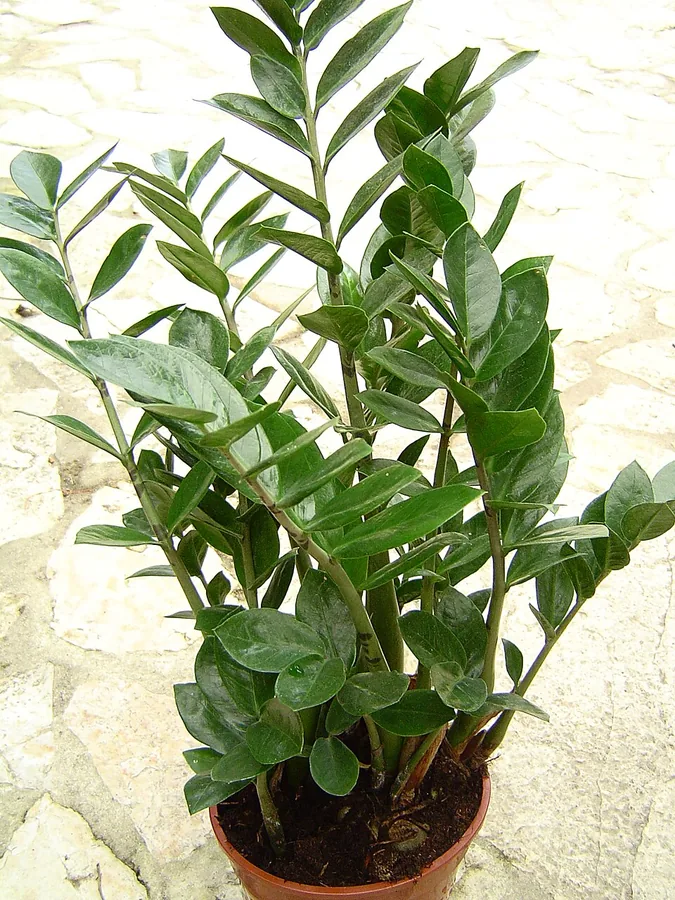
If you've heard there's a houseplant that's nearly impossible to kill, this is the one people mean. It hails from eastern Africa and keeps water locked away in fat underground rhizomes, which is exactly why a skipped watering or a spot far from any window barely fazes it. Glossy deep-green leaflets line up in tidy rows along stems that arch outward, looking for all the world like someone buffed them by hand.
So why is it such a low-key companion? Because it asks for so little. It puts on growth slowly but steadily, keeps its tidy shape on its own, and tends to stay a manageable 2 to 4 feet (61 to 122 cm) tall. Wander off for a couple of weeks and it'll still look great when you get back, which is why you'll find it in offices and dim hallways pretty much everywhere.
The thing to watch is that the whole plant is loaded with calcium oxalate crystals, so it really doesn't belong somewhere a curious pet or toddler can get a chew in. Just handle it, park it somewhere safely out of the way, and it'll thank you with years of calm, shiny growth.
Care
The short version: park it in bright indirect light, only reach for the watering can once the soil has gone fully dry, pot it up in something that drains fast, and keep it cozy and away from direct sun.
Light
A ZZ is happiest in bright indirect light, even though it shrugs off low and medium light better than nearly any other houseplant. Steer it away from direct sun, since that's what burns the leaves. Tuck it in a dark corner and you'll just get slower, lankier growth in return.
Water
Only water once the mix has gone completely dry, which tends to land somewhere around every 2 to 4 weeks. Since the rhizomes are sitting on their own water stash, a forgotten watering bothers it far less than a waterlogged pot does. Honestly, overwatering is the quickest way to do it in.
Soil
Set it up in a well-drained potting mix based on peat or bark, with a good handful of perlite or sand stirred through. You're after something that drains in a hurry and never stays soggy, because sitting moisture is what rots those rhizomes.
Temperature
Aim for a cozy 59°F to 84°F (15°C to 29°C), basically the kind of warmth you'd want around the house anyway. It can't handle cold at all, and once things drop below 60°F (15°C) the leaves start yellowing or falling.
Humidity
Regular household air suits it just fine, so there's no humidity figure to fuss over. It settles right into the dry air of most homes with zero misting required.
Feeding
Through the spring and summer growing season, give it a light meal of balanced, diluted fertilizer, only once or twice across the whole year. It's a slow grower, so it barely needs feeding, and piling on more food actually backfires.
Pruning
There's hardly anything to prune. Just snip off yellowing or beat-up leaflets whenever they crop up so the plant stays looking neat.
Repotting
Plan on repotting every 2 to 3 years, or sooner if it's busting out of its pot. The giveaways are rhizomes pressing hard against the sides, roots poking through the drainage holes, or growth grinding to a halt. Bump it up a single pot size into fresh, quick-draining mix.
Size & spacing
Inside, a ZZ tops out at roughly 2 to 4 feet (61 to 122 cm) tall and gets about as wide as it is high. Leave the arching stems some elbow room to spread out so they aren't bumping into the neighbors.
Troubleshooting
A ZZ plant hardly ever kicks up a fuss, so if it does, the reason is usually pretty straightforward. Almost every problem comes down to water or light, and you'll read it right in the leaves and stems. Find the description that fits what you're seeing and you can sort it out before things get worse.
Yellow leaves plus mushy bits down in the pot
If the leaves yellow and the rhizomes feel soft underground, you're looking at root and rhizome rot, and nine times out of ten it's from watering too much, not too little. Remember, those chunky rhizomes carry their own water supply, so a wet pot just drowns them until they go mushy and start to smell. Hold off on water, tip the plant out, trim anything squishy, and settle it back into a dry mix that drains quickly.
Fix:
- Stop watering
- Unpot and cut away rotted rhizomes
- Repot in dry well-draining mix
Leaflets shriveling and dropping off
Leave the soil bone-dry for ages and a ZZ will start ditching leaflets to protect itself. You'll notice the petioles wrinkling up and the foliage looking thin. The fix is easy: soak it well, then wait until the mix has dried back out before you water again.
Fix:
- Water thoroughly
- Resume regular watering once soil dries
Small brown bumps stuck to the stems
Spot some waxy brown lumps clinging to the stems and petioles? That's armored scale, pretty much the only bug that goes after a ZZ. They tend to leave a sticky residue too. Scrape them off, follow up with horticultural oil or insecticidal soap, and always give a new plant a once-over before it sits near the rest.
Fix:
- Wipe off scale
- Treat with horticultural oil or insecticidal soap
Leaves going yellow or slumping after a chilly snap
Cold really isn't this plant's friend, and a dip below 60°F (15°C) will leave the leaves yellow or flopping over. Get it into a warmer room as soon as you can. Through winter, keep it off drafty windowsills, and if it spent summer outside, carry it back in before the chilly nights arrive.
Fix:
- Move to a warmer spot above 60°F (15°C)
Browned or washed-out spots right where the sun hits
Seeing pale or brown blotches on the side that faces the window? That's leaf scorch, and it means the sun hitting the plant is simply too harsh. Pull it back a bit from the glass into bright indirect light, and the fresh leaves that follow will look perfectly healthy.
Fix:
- Move to bright indirect light
Long, stretchy stems and barely anything new coming in
Sure, a ZZ will hang on in a gloomy corner, but the price is stretched-out petioles and hardly any fresh leaves. The culprit here is not enough light. Give it a brighter home that's still shielded from direct sun, and you'll see it start growing properly again.
Fix:
- Move to brighter indirect light
Toxicity
Keep this one well away from any pet that likes to nibble. Top to bottom it's packed with sharp calcium oxalate crystals that sting the mouth and throat and set off drooling and vomiting if something chews on it. The sap can bother your own skin and eyes too, and no piece of it is meant to be eaten, so tuck it somewhere out of reach and rinse your hands once you're done with it.
Toxic to
Cats · Dogs · Horses · Rabbits · Livestock · Birds · People
Cats Toxic
Bite into a leaf and a cat ends up with a mouthful of tiny sharp crystals, which means drooling, pawing at the face, and throwing up. The sting is usually enough to put them off finishing the snack.
Dogs Toxic
A chewing dog gets lots of drooling, a sore mouth, and a queasy belly. Swallow a bigger bite and it might gag or turn its nose up at dinner for a bit.
Horses Toxic
Those crystals are just as rough on a horse, upsetting its mouth and gut and leaving it drooling and uninterested in food. It's best to keep this plant nowhere near stalls or paddocks.
Rabbits Toxic
Don't ever hand a rabbit a leaf. The oxalate crystals scald its mouth and stomach, so you'll see drooling and a rabbit that stops wanting to eat.
Livestock Toxic
Goats, sheep, and cattle all get sore mouths, drooling, and tummy trouble from the crystals, so it's smart to keep grazing animals fenced away from it.
Birds Toxic
A bird that pecks at it catches those same stinging crystals in its mouth and throat. Pet birds should stay clear of the leaves completely.
People Caution
Nobody should be eating this one, and the sap can leave skin or eyes red and irritated. Give your hands a wash once you've handled it, and don't let little ones gnaw on the leaves.
Wash hands after handling; crystals can irritate skin
Helpline numbers

United States
ASPCA Animal Poison Control: (888) 426-4435 (fee applies)
Poison Control: (800) 222-1222



Canada
Poison Centres: 1-844-764-7669
Varieties
There's more to this plant than the classic glossy green version, since breeders have rolled out a few distinct ZZ cultivars that are well worth a look.
'Raven' (Dowon)
Fresh leaves arrive a bright lime-green and gradually deepen into a glossy purple so dark it reads almost black.
'Zenzi'
This neat little dwarf stays around 10 to 12 inches, with stubby stems and dark leaves bunched close together.
'Dark Zamicro'
Also a small dwarf that keeps below 2 feet, and its leaflets run smaller than the ones on a regular ZZ.
Variegated
Rather than plain green, its leaves come streaked through with cream and white.
'Chameleon'
New shoots come up a sunny golden-yellow, then mellow into dark green as they grow up.
'Lucky'
You'll spot it by the broader green leaves and the gently rounded tip on each leaflet.
How to propagate
Got a ZZ you'd like to clone? There are two ways to do it, one fast and easygoing and one that asks you to wait around for ages.
DivisionEasy
Spring, at repotting · Weeks to months
Want more ZZ plants? Splitting one is the simplest route. Come spring, while the plant is already out of its pot for repotting, gently break the rhizome clumps into pieces, making sure each chunk has its own roots and a shoot or two. Pot those pieces up and they'll find their feet over the next few weeks to months.
Leaf cuttingsDemanding
Anytime; very slow · Several months to form a rhizome
Rooting a single leaflet is possible too, but boy does it test your patience. Push a healthy leaflet into damp mix whenever you like, then sit tight, because it can take several months just to grow a little rhizome and even longer before any shoot shows up.
Myths
A ZZ plant thrives in no light at all.
It copes with a shadowy corner better than just about any other houseplant, and that's where the rumor got going. Still, it needs some light to actually grow, and a genuinely dark spot just leaves it stuck. Bright indirect light is where it really shines.
Watering a ZZ plant just once per season is plenty.
Thanks to those water-hoarding rhizomes it really is drought-tough, but once a season stretches things way too thin. Wait until the mix is fully dry, then water roughly once or twice a month. Go too long without a drink and it'll start shedding leaflets.
A ZZ plant scrubs the air clean inside the house.
This one comes from old sealed-chamber experiments that look nothing like an actual living room. A peer-reviewed review concluded that potted plants don't measurably improve indoor air, and just opening a window beats anything a houseplant can manage.
Brushing against a ZZ plant leads to cancer or serious poisoning.
The calcium oxalate tucked in the leaves and sap is an irritant, plain and simple, not some lethal toxin, and it has nothing to do with cancer. Handle it and your skin or eyes might sting, so wash your hands afterward. Eating it is a bad idea, but what you'd get is irritation, not real danger.
The ZZ plant is safe around pets.
Afraid not. The ASPCA lists it as toxic to cats and dogs, all because of the insoluble calcium oxalate crystals inside it, which sting an animal's mouth and trigger drooling and vomiting once chewed.
Sources
- ASPCA Animal Poison Control
- NC State Extension Gardener Plant Toolbox
- Missouri Botanical Garden Plant Finder
- Missouri Botanical Garden Plant Finder
- Clemson Cooperative Extension HGIC
- UF/IFAS Extension Santa Rosa County
- UF/IFAS Extension (ENH1375/EP639)
- Journal of Exposure Science & Environmental Epidemiology (Cummings & Waring 2020)