Ornamental · Acanthaceae
Black-eyed Susan Vine
Thunbergia alata
Hand it full sun, steady water, and something to climb, and this twining annual keeps flowering from summer right through to frost.
Full sun
Every 2–4 days
50–86°F · 10–30°C
70–100 days
Overview
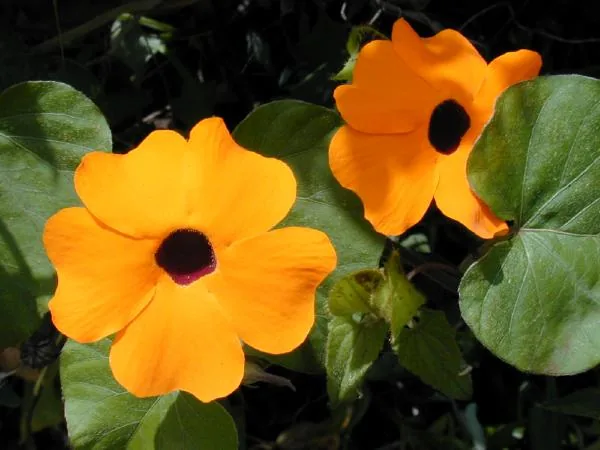
The black-eyed Susan vine is a quick-growing, twining climber that people love for its nonstop run of cheerful flowers. Technically it's a tender perennial out of East Africa, but in most gardens you'll treat it as a warm season annual, letting it scramble up a trellis, fence, or hanging basket over a single summer. Those bright blooms in orange, yellow, and white, most of them marked with a dark eye, are exactly where the plant gets its name.
What makes it worth growing? It climbs in a hurry and keeps the flowers coming for months. Hand it something to twine around and it'll blanket an arbor or tumble out of a container, stretching 3 to 8 feet (91 to 244 cm) over the season. Flowering kicks off in early summer and carries on all the way to frost, and it usually hits its stride in late summer and fall once that brutal heat has eased off.
Here's an easy plant that doesn't ask for much past sun, water, and something to climb. Keep the soil from baking dry during a heat wave, pinch back the young stems so the vine fills out, and you'll get months of color in return.
Care
The short version: full sun to part shade, plus some afternoon shade if your summers get fierce. Keep the soil evenly moist so it never dries out, plant it in rich, well-drained ground with a support to climb, and feed it right through the growing season.
Light
The black-eyed Susan vine blooms best in full sun, but it'll handle part shade without complaint. If your summers get nasty, a little afternoon shade takes the edge off the heat. Too little light, though, and you'll end up with a leggy plant that's all leaves and barely any flowers.
Water
Keep the soil evenly moist and water often enough that it never fully dries, somewhere around every 2 to 4 days when it's warm out. Let it go dry during a hot, dry spell and you'll watch the buds and flowers drop, so be sure it doesn't run short over summer.
Soil
Set it in rich, fertile, well-drained ground that stays steadily moist, with plenty of organic matter mixed in. You want soil that holds onto water without turning soggy, which works nicely for both garden beds and containers.
Temperature
It's happiest somewhere between 50°F and 86°F (10°C to 30°C), and it can't take any frost at all. Blooming eases off during the worst of the summer heat, then bounces right back as things cool down into late summer and fall.
Humidity
Everyday outdoor humidity does the job here, so there's no specific number to chase. What counts more is good airflow, because stagnant, crowded growth rolls out the welcome mat for spider mites and whiteflies, especially on plants you keep indoors.
Feeding
Give it a feeding once a month all through the spring and summer growing season using a balanced, general-purpose fertilizer. A regular feed keeps a fast grower like this one full of leaves and flowers, with no single nutrient ever running low.
Pruning
Pinch the young stems early on to spark side branching and a fuller, bushier vine. As the season goes, snip back anything leggy or overgrown to keep it neat and nudge it toward more flowers.
Repotting
For container plants, refresh or pot up each spring so the roots get more space and the mix gets renewed. Keep an eye out for roots circling the pot or poking through the drainage holes, water that drains straight through, and growth that stalls, all hints it's outgrown its pot.
Size & spacing
On a support, this vine climbs 3 to 8 feet (91 to 244 cm) tall and fans out 3 to 6 feet (91 to 183 cm) wide across a single season. Leave it some room and a trellis or fence to twine onto so it's got a place to head.
When to plant
This vine loves warmth and has zero patience for frost. Get the seeds started indoors in early spring, move the plants outside only after the cold's truly gone and the soil has warmed up, and then you're set for flowers from early summer until frost calls it a season.
Northern hemisphere
Southern hemisphere
Typical months for a temperate climate: start earlier in warm zones, later where spring frosts linger.
- Sow: 6-8 weeks before last spring frost
- Plant: after last spring frost when soil and air have warmed
- Harvest: early summer to frost; best bloom in late summer and fall after peak heat moderates
Hardiness
USDA hardiness zones: 10–11
Temperature: down to -1°C
Troubleshooting
Almost every problem with this vine comes down to heat, light, or pests, and it tends to surface first in the flowers or the leaves. Catch those early clues and you can jump in before the blooms taper off. Find what matches your plant below, then act while it can still make a difference.
Buds and flowers falling off when it's hot and dry
What you're seeing is heat and drought stress, not some disease, and it tends to crop up when the soil dries out in the middle of a hot stretch. To protect itself, the vine simply pauses on flowers, then it gets going again once things cool off in late summer and fall. So water on a regular schedule for even moisture, lay down mulch to keep the roots cool, and offer some afternoon shade if your summers really sizzle.
Fix:
- Water regularly to keep soil evenly moist during heat
- Provide afternoon shade in hot climates
- Mulch to conserve soil moisture and keep roots cool
Speckled, sticky leaves with webbing or tiny bugs
Stressed plants and indoor ones tend to attract spider mites, whiteflies, aphids, or scale, which leave the foliage speckled, tacky, or covered in fine webbing. Flip a leaf over to spot who's behind it, then blast them off with a firm jet of water and come back with insecticidal soap or horticultural oil worked into the undersides. Do the treatment again a little later, and loosen up the airflow, which really helps with plants you keep inside.
Fix:
- Rinse foliage with a strong spray of water to dislodge mites and aphids
- Apply insecticidal soap or horticultural oil, covering leaf undersides
- Repeat treatments and improve airflow for indoor plants
Lots of foliage but hardly any blooms
When a vine stretches out long and leafy but skips the flowers, the culprit is usually too much shade. Want better blooms? Full sun is what this plant craves, so shift a container somewhere brighter and try to land it at least several hours of direct light each day. Hand it the sunshine, and the flowers tend to show up.
Fix:
- Move container plants to a sunnier spot
- Site in full sun to part shade with at least several hours of direct sun
Toxicity
If your home is full of animals, here's some welcome news: the black-eyed Susan vine isn't flagged as toxic to pets or people. You can grow it freely in a garden shared by cats, dogs, and curious kids. That said, like with any plant, a big mouthful of foliage could spark a bit of passing stomach upset, so it's still smart to keep pets from chewing on it.
Safe for
People · Cats · Dogs · Horses · Rabbits · Livestock · Birds
Cats Safe
If a nosy cat nibbles the leaves, there's no harm done, because this vine doesn't appear on the ASPCA toxic list. A really big mouthful of any greenery could leave it drooling a bit or coughing up a hairball, and that's about as far as it goes.
Dogs Safe
Dogs do just fine around this one. About the worst a quick nibble brings on is a brief touch of mild stomach upset, no different from what you'd get with most ornamental foliage.
Horses Safe
Nothing in the records points to this plant being toxic to horses. If one happens to graze on a stray vine, it won't cause any real harm.
Rabbits Safe
It's safe for rabbits to browse the foliage. Like with any fresh green though, ease it in slowly so a quick switch in diet doesn't upset their gut.
Livestock Safe
There's no documented danger to cattle, goats, or sheep from this vine, so a mouthful out in the pasture isn't anything to fret over.
Birds Safe
Birds have nothing to fear from this plant. Backyard hens can happily peck at the leaves and seeds without any trouble.
People Safe
Nobody's been recorded getting poisoned by it, and you grow this vine for the flowers, not the dinner plate. Just keep watch over little kids, who really shouldn't be tasting garden plants either way.
As with any plant, ingestion of plant material may cause mild, transient stomach upset in pets.
Varieties
Most black-eyed Susan vines turn up as seed series bred for a spread of warm flower colors. Here are the ones you're most likely to come across.
Susie series
A favorite among seed series, showing up in orange, yellow, and white, sometimes carrying the signature dark eye and sometimes not.
Arizona series
A strong-growing pick in warm tones of orange, apricot, and gold, with every flower framed by a dark center.
Spanish Eyes
Mixes mellow terracotta and apricot shades around a dark eye, giving you a warmer, softer feel.
Blushing Susie
Brings together soft apricot, rose, and ivory tones, and the eyes here often fade out instead of popping.
Alba
A crisp white-flowered version that holds onto that classic dark purple-black eye.
How to propagate
Multiplying this vine is a breeze, whether you're sowing a fresh seed packet each spring or taking cuttings to carry a favorite plant through the winter.
SeedEasy
Start indoors 6-8 weeks before last frost, or sow directly outdoors after the last frost. · Germinates in about 1-3 weeks; weeks to a few months to a flowering vine
Most folks grow this annual vine from seed, and honestly it couldn't be much simpler. Get it going indoors 6 to 8 weeks before your last frost, or just drop the seeds into warm ground once frost is behind you, and they'll come up in roughly one to three weeks. After that, give it a few weeks to a couple of months to climb up and start putting on flowers.
Stem cuttingsModerate
Take cuttings in late summer for overwintering indoors. · A few weeks to root
Want to hold onto a favorite plant through the cold months? Cuttings are the way. Snip them in late summer, let them root over the next few weeks, and park the young plants in a warm, sunny window until spring rolls around. It does ask a little more effort than seed, but it lets you keep a variety worth growing again.
Myths
Black-eyed Susan vine is the same plant as the Black-eyed Susan wildflower.
Sure, they share a name and a dark center, but the similarities stop right there. The black-eyed Susan vine (Thunbergia alata) is a tender twining annual climber that belongs to the family Acanthaceae and hails from East Africa. Meanwhile the wildflower black-eyed Susan (Rudbeckia hirta or fulgida) stands upright like a daisy and grows as a perennial or biennial in the aster family. They are completely different plants that just happen to resemble each other at the bloom's eye.