Shrub · Gelsemiaceae
Carolina Jessamine
Gelsemium sempervirens
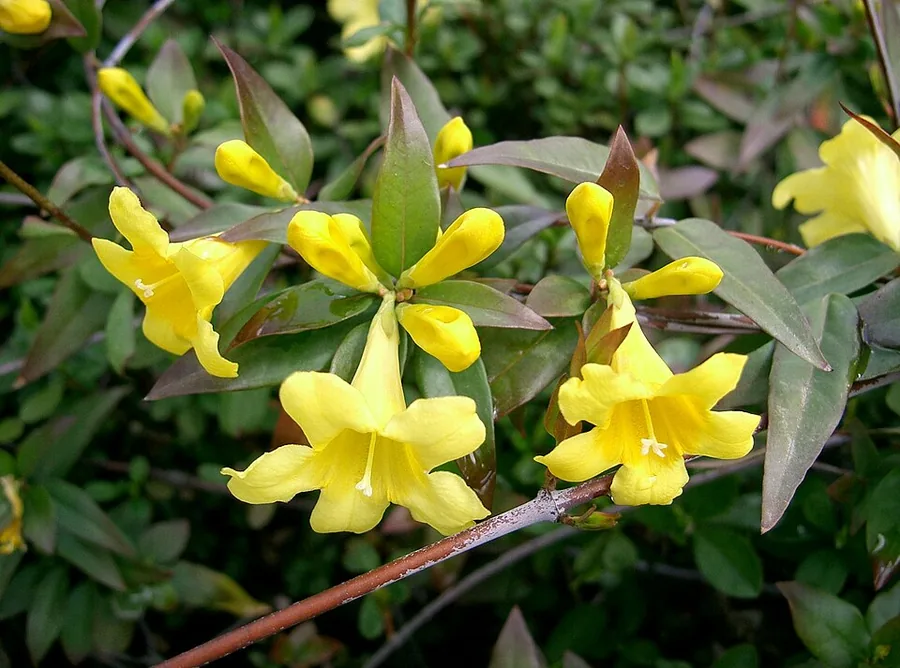
Give it full sun and something sturdy to climb, and this evergreen vine spills out fragrant yellow trumpets in late winter.
Full sun
Every 7–14 days
USDA 7–10
10–20 ft · 3–6.1 m
Overview
Carolina jessamine is the evergreen vine that wakes up the South with fragrant yellow trumpets while most of the garden's still dozing. It twines right up fences, arbors, and mailboxes, and in one fast season it can run stems 12 to 20 feet long. South Carolina liked it enough to make it the state flower, and once you've seen it bloom, that's no surprise.
The best part? It barely asks for anything. Hardy through zones 7 to 10, it brushes off heat, takes drought once it's settled, and rarely deals with pests or disease. The one real must-have is full sun, because a vine stuck in the shade just grows leaves and skips the flowers.
There is a catch you'll want to know first, though. Even with jasmine in the name, this isn't a true jasmine, and every part of it is dangerously poisonous. The leaves, stems, roots, and even that sweet nectar carry strychnine-related alkaloids, so it needs to go well away from kids, pets, and grazing animals.
Care
The short version: full sun for the best bloom, rich well-drained soil, a steady drink while it's young, and then prune hard right after it flowers and hand it a sturdy support to climb.
Light
Put it in full sun and you'll get the heaviest bloom. It'll take partial shade and stay green there, sure, but a shaded vine trades flowers for foliage and ends up looking thin on color. So sunnier is better.
Water
Keep the soil moist while the plant's young, watering every 7 to 14 days as it gets going. Once the roots are down it handles drought just fine, but let it go bone-dry and it'll drop leaves and bloom less, so don't forget it in a dry spell.
Soil
It's an easy one to please, growing in rich, well-drained ground across a wide pH range of 5.0 to 8.0. What really matters is drainage, way more than the exact type of soil.
Temperature
It's hardy from about 10°F to 100°F (-12°C to 38°C), so it takes Southern heat and a decent cold snap in stride. That range is exactly why it's so dependable across zones 7 to 10.
Humidity
Plain outdoor air does the job, so there's no humidity number to worry about. It's right at home in the humid Southeast and just as happy in a drier garden.
Feeding
A balanced slow-release feed in spring is honestly all it wants, applied seasonally. It's not a hungry plant, and piling on fertilizer just pushes leaves instead of flowers.
Pruning
Prune it right after flowering, while there's still time for new growth to set next year's buds. Cut to keep its size in line and head off a top-heavy tangle, and on an old leggy vine you can take the whole thing back to a few feet above the ground to wake up fresh growth from the base.
Repotting
rarely
Size & spacing
Expect a fast climber that runs 10 to 20 feet (3 to 6 m) and spreads 3 to 6 feet (91 to 183 cm) wide. Give it a sturdy support and some room, because it twines and piles on growth in a hurry.
When to plant
Carolina jessamine flowers early, often opening in February while everything else is still waiting around. Set new plants out in spring or fall, prune the moment the bloom fades, and you might even catch a lighter second flush of flowers in the fall.
Northern hemisphere
Southern hemisphere
Typical months for a temperate climate: start earlier in warm zones, later where spring frosts linger.
- Plant: spring or fall
- Harvest: late winter to early spring (February-April), with sporadic fall rebloom
Hardiness
USDA hardiness zones: 7–10
Temperature: down to -18°C
Troubleshooting
Good news here: this vine is about as trouble-free as they come, with no serious pests or diseases to chase down. The handful of issues that pop up usually come down to pruning and how much sun it's getting. Match what you're seeing below and the fix is normally easy.
Heavy on top, bare and woody down below
Let a few years go by without pruning and the vine just keeps stacking new growth on the old, so the top mats up while the bottom turns leggy and bare. What's behind it? Honestly, just missed pruning and stems that never got trained onto a support. Cut that heavy top growth back to a few feet above the ground right after it flowers, then tie the stems that are left onto the support so it fills back in evenly.
Fix:
- Prune hard right after flowering, cutting older top-heavy vines back to a few feet above ground level
- Train remaining stems onto the support to spread growth evenly
Green and leafy, but where are the flowers?
When a jessamine grows lush and green but barely flowers, the culprit is nearly always too much shade. It really does need full sun to bloom well. So move it or train it toward a brighter spot, and while you're at it, open up any overhead branches that are casting shade on it.
Fix:
- Relocate or train the vine into a position receiving full sun
- Thin overhead shade where possible
Toxicity
This is a gorgeous plant, but make no mistake, it's a genuinely dangerous one. Every part holds strychnine-related alkaloids, including that sweet nectar that's poisoned kids who thought the flowers were honeysuckle. No part of it is safe to eat, suck, or chew, and that same toxin is bad news for dogs, cats, horses, livestock, birds, and even the honeybees that drop by the blooms.
Toxic to
Cats · Dogs · Horses · Rabbits · Livestock · Birds · People
Cats Severe
If a cat chews any part of it, things can go wrong within hours: weakness, a wobbly walk, droopy muscles, and trouble swallowing, with breathing that slows and turns shallow. The pupils might change, the body cools off, and seizures can follow. There's really no safe nibble here at all.
Dogs Severe
A dog that mouths the leaves, stems, or flowers can suddenly go weak and staggery and struggle to swallow. As the alkaloids kick in, breathing slows, the body cools, and seizures, paralysis, or worse can follow. Get to a vet right away.
Horses Severe
A horse grazing on this can start with muscle tremors and weakness that build into convulsions and failing breath. Every part of the vine is dangerous, and it doesn't take much to be a deadly dose, so keep it well clear of pastures and paddocks.
Rabbits Severe
That same nerve poison that takes down big animals? Way too much for a little rabbit, and it brings on weakness, tremors, and collapse. None of it is safe to offer a rabbit or to leave where one can reach.
Livestock Severe
Cattle, goats, and sheep that nibble the foliage can end up with muscle weakness, convulsions, and respiratory failure, and even a small amount can kill. The safest move is to fence it out of anywhere stock graze.
Birds Severe
The alkaloids are rough on birds, and even honeybees get poisoned by the nectar and pollen. So pet birds should never get near the leaves, stems, or blooms.
People Caution
None of this plant is food, full stop. Kids have been poisoned sucking the sweet nectar after thinking the yellow flowers were honeysuckle, and even small amounts can cause weakness, dizziness, slowed breathing, and seizures. Keep it away from children and wash your hands after pruning.
Treat as a deadly poisonous plant: keep all parts away from children, pets, and livestock; do not let anyone suck or eat the flowers, and wash hands after handling since the sap can irritate sensitive skin.
Helpline numbers

United States
ASPCA Animal Poison Control: (888) 426-4435 (fee applies)
Poison Control: (800) 222-1222



Canada
Poison Centres: 1-844-764-7669
Varieties
A few named picks tweak the wild vine in handy ways, and there's one close relative worth knowing about if your ground tends to stay wet.
Margarita
It's an extra cold-hardy pick, and its flowers run a little larger than the regular species.
Pride of Augusta (Plena)
This one's double-flowered, and it keeps the show going across a longer stretch of the season.
Gelsemium rankinii (swamp / Rankin's jessamine)
It's a related native with scentless flowers that rebloom hard in both spring and fall, and it doesn't mind wetter soil.
How to propagate
There are three easy ways to make more Carolina jessamine, and because the sap is toxic, every one of them just means washing your hands when you're done.
Stem cuttingsEasy
Late spring to summer · Several weeks to a few months
Want a copy of a named cultivar that's true to type? Semi-hardwood cuttings are your most reliable bet. Take them in late spring or summer, and over several weeks to a few months they'll root into a plant that's just like the parent.
SeedModerate
Fall or spring · One or more seasons
You can start it from seed in fall or spring, sure, but a named cultivar won't come true that way, and the plant takes one or more seasons to really settle in. And since every seed and seedling is toxic, handle them carefully.
LayeringEasy
Spring to summer · A few months
This one's almost effortless. Wherever a low twining stem is resting on the soil in spring or summer, it'll root itself within a few months, and then you just snip the rooted bit free and move it.
Myths
Carolina jasmine is a true jasmine, so its fragrant flowers are safe to touch or taste.
Here's the thing: it isn't a jasmine at all, which is exactly why people call it false jasmine, and it's one of the most poisonous vines you'll find in a garden. Every part, even the sweet nectar, holds strychnine-related alkaloids, and kids who sucked the flowers have been badly poisoned, right along with pets and livestock. Never treat those yellow blooms as honeysuckle or any other edible plant.