Shrub · Hydrangeaceae
Climbing Hydrangea
Hydrangea anomala subsp. petiolaris
It's slow to start, then a wall of fragrant white lacecaps that sticks around for decades.
Partial shade
Every 5–10 days
USDA 4–8
30–60 ft · 9.1–18.3 m
Overview
Want a vine that does its own climbing? Climbing hydrangea is a deciduous woody vine that grabs onto brick, stone, and tree bark with little aerial rootlets, so you're not stuck tying it up. It comes from the woodlands of Japan and Korea, which is why shade doesn't faze it at all, whether that's part shade or full shade. Once it's rolling it can hit 30 to 60 feet (9 to 18 m) and drape its support in broad green leaves.
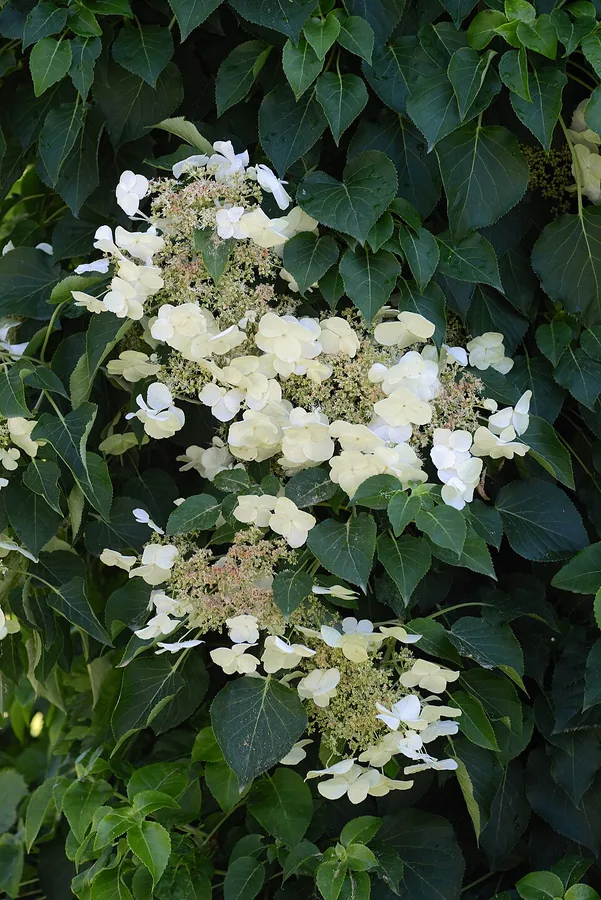
The flowers are what you're really after. In late spring to early summer it opens flat, fragrant white lacecap clusters, with a ring of showy blooms around the little fertile ones in the middle. And after the leaves drop in fall? You still get the peeling cinnamon bark to look at all winter.
Here's the catch, and it's a big one: this vine is in no hurry. A young plant can just sit there for a few years, quietly working on roots before it bothers to climb or bloom. So plant it for the long haul, give it good soil and steady water, and it'll make the wait worth it.
Care
The short version: give it part shade and rich, evenly moist soil, a strong masonry or freestanding thing to climb, and a few patient years to settle in before it flowers.
Light
Part shade is the sweet spot here. It'll take full shade and it'll grow in full sun, but sun only works where the soil stays reliably moist, and too much deep shade means fewer flowers. An east- or north-facing wall with a little light? That's about perfect.
Water
Keep the soil consistently moist but never soggy, because standing water is the one thing it really can't stand. Water deeply when things dry out, somewhere around every 5 to 10 days depending on the weather, and keep at it while the vine's settling in. If yours is in sun, it'll want that moisture even more.
Soil
Give it rich, humus-heavy loam that drains well, basically the woodland soil it grew up in. It's pretty relaxed about acidity and handles a pH from 5.5 to 7.5, so honestly the texture and moisture matter way more than the exact number.
Temperature
This one's tough in the cold, happy through USDA zones 4 to 8 and shrugging off winters down to -29°F (-34°C). On the warm side it holds up to about 86°F (30°C), and past that it just leans harder on moist soil and a bit of shade.
Humidity
Regular outdoor humidity is all it needs, so there's no number to chase. Airflow's the thing that matters, since still, humid air around crowded leaves is exactly what brings on powdery mildew and leaf spot.
Feeding
Good news, it's not a hungry plant. Work a balanced or slow-release granular fertilizer into the soil around the base in spring and call it done, because loading it up with nitrogen just feeds soft growth and aphids instead of flowers.
Pruning
Go light on the pruning. It blooms on old wood, so only cut in late winter or right after flowering, and only to keep size in check or take out dead, damaged, or stray stems. Cut too hard and you're snipping off next year's flower buds.
Repotting
It's barely ever grown in a pot and almost never needs repotting. But if a potted one shows roots circling the base, water blowing straight through, or growth that's stalled out, just move it up a size or stick it in the ground where it'd really rather be.
Size & spacing
Plan for something big. It climbs 30 to 60 feet (9 to 18 m) tall and spreads 5 to 6 feet (152 to 183 cm) wide, so give it a sturdy support and plenty of room to fill in over the years.
When to plant
There's no rush, but a bit of timing helps it settle. Pop it in the ground in spring or early fall so the roots get cool, moist soil to dig into, and then you can look forward to that first round of bloom from late spring into early summer once it's good and established.
Northern hemisphere
Southern hemisphere
Typical months for a temperate climate: start earlier in warm zones, later where spring frosts linger.
- Plant: Spring or early fall
- Harvest: Late spring to early summer (May to July)
Hardiness
USDA hardiness zones: 4–8
Temperature: down to -34°C
Troubleshooting
Most of the time, trouble with climbing hydrangea is about patience or placement, not bugs. Slow early growth? That's just normal. The real headaches come from where and what it's allowed to climb, so check what you're seeing below before you grab a spray.
Clinging rootlets messing up siding, paint, or mortar
The vine hangs on with self-clinging aerial rootlets that work into cracks, loose joints, and the gaps behind trim. On wood or stucco those holdfasts pull material off and wreck the paint, and a grown vine gets heavy on whatever it's holding. So grow it on brick, stone, or a freestanding arbor instead, and if you use a trellis, set it 4 to 6 inches off the wall so air moves and you can pull it back later.
Fix:
- Keep the vine off wood-sided houses; grow it on brick, stone, or sturdy masonry, or on a freestanding arbor, trellis, fence, or large tree
- Mount a trellis 4-6 inches off the wall to allow air circulation and easier removal
- Prune regularly to limit weight and keep growth away from gutters, windows, and trim
Barely growing and not flowering early on
Don't panic, this is normal establishment, not a sick plant. Climbing hydrangea sleeps, then creeps, then leaps, building a deep root system before it puts on any length or bloom. Give it 2 to 5 years, keep the soil moist and mulched, and ease up on heavy pruning that'd strip the old-wood flower buds.
Fix:
- Be patient; allow 2-5 years to establish before expecting vigorous growth and bloom
- Keep soil consistently moist and mulched while establishing
- Site in part shade with at least some light to encourage flowering
- Avoid heavy pruning that removes old-wood flower buds
Spotty leaves or a white powdery film
Two fungi tend to turn up here. Cercospora leaf spot leaves tan centers ringed in purple, while powdery mildew dusts the surface white when the air's humid and still. Pull off the affected and fallen leaves, water at the base early in the day, and open the plant up so the foliage dries quick.
Fix:
- Remove and dispose of affected and fallen leaves
- Improve air circulation and avoid wetting foliage; use drip irrigation or water early in the day
- Apply a labeled fungicide (such as horticultural oil for powdery mildew) per directions if needed
Sticky leaves, clustered bugs, or fixed stem bumps
Soft new growth pulls in aphids, which gang up on the tips and leave that sticky honeydew behind. Those firm bumps on stems and leaf undersides that won't budge? Those are scale insects like cottony camellia scale. Blast the aphids off with a strong spray of water or hit them with insecticidal soap, treat scale with horticultural oil, and go easy on nitrogen feed that pushes the tender growth they love.
Fix:
- Knock aphids off with a strong water spray or treat with insecticidal soap or horticultural oil
- Treat scale with horticultural oil, following label directions
- Encourage natural predators and avoid over-fertilizing with nitrogen
Toxicity
Keep the whole plant away from mouths, simple as that. The leaves, buds, and flowers carry cyanogenic glycosides, which can let off cyanide when they're chewed and upset the stomach in pets and people alike. Serious poisoning's rare since it takes a lot to get there, but none of this plant is food, so keep pets, grazing animals, and little kids from nibbling.
Toxic to
Cats · Dogs · Horses · Rabbits · Livestock · Birds · People
Cats Mild
A cat that chews the leaves or flowers usually ends up with vomiting, diarrhea, and a dull, draggy mood. Serious cyanide poisoning's rare since it takes a lot of plant to cause it, but that upset stomach's reason enough to keep them off it.
Dogs Mild
Dogs go pretty much the same way, with vomiting, loose stools, and low energy after a mouthful of foliage or blooms. The risk climbs with how much they eat, so a single nibble's a lot less worrying than a whole chewed-up branch.
Horses Mild
The ASPCA lists vomiting, depression, and diarrhea in horses that browse it. Most cases stay mild, though a horse stripping a big vine is a whole different story.
Rabbits Caution
Those same cyanogenic glycosides sit in every leaf, bud, and flower, so this isn't safe browse for a rabbit. Keep it out of reach and out of the hutch.
Livestock Caution
Grazing animals can take in the cyanide-releasing compounds if they eat the foliage, which is most likely when better forage runs short. Fence it off from cattle, goats, and sheep just to be safe.
Birds Caution
There's no record of birds eating it, but the toxin's all through the plant, so treat it as unsafe and keep pet birds away from the leaves and flowers.
People Caution
None of this plant is food. The leaves, buds, and flowers all carry cyanogenic glycosides, so keep little kids from chewing on them, even though a serious dose would take a big mouthful.
Keep pets and small children from chewing leaves and flowers; no special skin-handling precautions are typically needed.
Helpline numbers

United States
ASPCA Animal Poison Control: (888) 426-4435 (fee applies)
Poison Control: (800) 222-1222



Canada
Poison Centres: 1-844-764-7669
Varieties
The plain species handles most gardens just fine, but if you're after variegated leaves or bigger flowers, a few named picks are worth a look.
Firefly
Firefly's a variegated pick, with leaves carrying bright yellow margins that give you color long before the flowers even show up.
Miranda
Miranda's another variegated one, its leaves edged in soft lime-green that brightens up a shady corner.
Skylands Giant
Skylands Giant is grown for the noticeably larger flower clusters it puts out once the vine settles in.
Japanese hydrangea vine (Schizophragma hydrangeoides)
Japanese hydrangea vine (Schizophragma hydrangeoides) isn't a true hydrangea but a close clinging relative, just as slow to establish, sometimes taking up to 7 years to bloom, and topped with showy lacecap-style flowers.
How to propagate
There's more than one way to make more climbing hydrangea, and they all ask for the same patience this plant always does. Layering's the safest bet, and seed is far and away the slowest.
Stem cuttingsModerate
Early to mid summer (softwood or semi-hardwood) · Several weeks to root; multiple years to establish and bloom
Take softwood or semi-hardwood cuttings from this season's growth in early to mid summer, then keep them moist and humid until they root over several weeks. The catch? Same patience the plant always wants, since a rooted cutting still needs years to settle in and flower.
LayeringEasy
Spring or summer · One or more seasons to root before separating
The easiest way is layering in spring or summer. Pin a low, bendy stem down onto moist soil and it roots happily where it touches the ground, though you'll wait a season or more before that rooted bit's ready to cut free.
SeedModerate
Fall or spring · Slow; seedlings take years to reach flowering size
You can sow seed in fall or spring, but it's the slow road. Seedlings creep along and take years to reach flowering size, so most folks reach for cuttings or layering instead.
Myths
Climbing hydrangea covers a wall or fence fast.
Not even close, since it's one of the slowest vines to get going, often adding almost nothing for the first 2 to 3 years while it roots in. Gardeners put it as sleep, creep, then leap, and it only really climbs after that last stage. Put it somewhere you can wait a few seasons, not somewhere you need cover right now.