Shrub · Hydrangeaceae
Mock Orange
Philadelphus coronarius
Give it sun and a prune at the right moment, and mock orange fills early summer with orange-blossom scent.
Full sun
Every 7–14 days
USDA 4–8
10–12 ft · 3–3.7 m
Overview
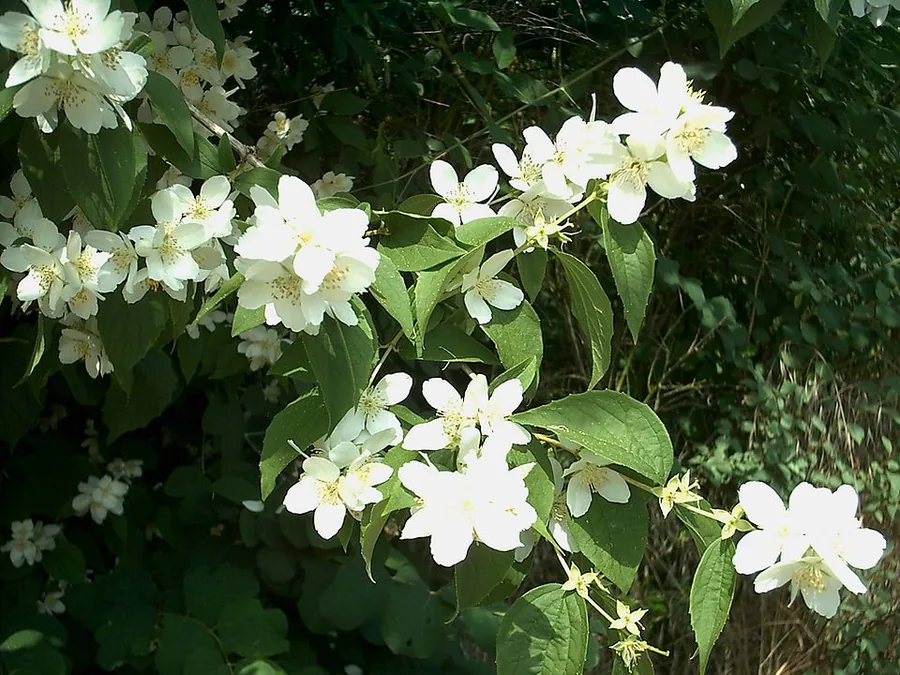
There's really one reason this shrub earns its keep, and it's the white, four-petaled flowers that open in late spring and throw an orange-blossom scent you can catch clear across the garden. It's a deciduous shrub in the hydrangea family, native to southeastern Europe and Asia Minor, and it grows into a big, multi-stemmed mound of arching canes.
It's a pretty forgiving plant, honestly. It shrugs off cold down to zone 4, takes drought and wind once it's settled in, and doesn't fuss over sandy, loamy, or clay soil, even where the pH runs alkaline. The one thing it really wants is sun, since shade thins out the bloom and invites mildew.
So what's the catch? Age. Leave it be and the shrub goes leggy and twiggy, with the flowers stranded way up at the tops of long bare canes. A yearly cut of the oldest stems keeps it full and flowering, and that's honestly about all the work it'll ever ask for.
Care
The short version: full sun gives you the most bloom, keep the soil moist and well-drained while it settles, and prune just once right after flowering to keep an older shrub full and fragrant.
Light
Pop it in full sun and you'll get the heaviest, most fragrant bloom. It'll take partial shade and still grow, sure, but shade quietly swaps flowers for leaf and lets powdery mildew sneak onto the crowded inner branches.
Water
Keep the soil moist while the shrub's getting established, then ease right off, because once it's settled it handles drought and wind on its own and barely wants extra water. A drink every 7 to 14 days does the trick in dry spells. The one thing it won't put up with? Wet, poorly drained ground.
Soil
It's not picky about soil at all, and it'll grow in sand, loam, or clay as long as the water drains away. Any pH from 4.0 to 7.0 works, and it even handles the alkaline end that trips up a lot of other shrubs.
Temperature
This one's tough and cold-hardy, happy from about -29°F to 100°F (-34°C to 38°C). It rides out hard winters in zone 4 and takes summer heat without so much as a complaint.
Humidity
Regular outdoor humidity is fine, so there's really nothing to manage there. What matters more is air movement, because still, crowded conditions are exactly what bring on powdery mildew.
Feeding
A vigorous shrub like this barely needs feeding, so don't go overboard. A balanced fertilizer or just a light layer of compost in spring covers it, and piling on more only pushes soft growth that aphids love.
Pruning
Timing's the whole game here, because mock orange blooms on old wood, so prune right after the flowers fade in early summer and never in fall or winter. As it ages and gets leggy, cut about a third of the oldest stems to the ground each year to bring it back.
Repotting
It's a landscape shrub, not a container plant, so repotting hardly ever comes up. If you do need to move it, just dig and transplant young suckers in early spring or fall while it's dormant or barely waking up.
Size & spacing
Give it some space, because a grown plant hits 10 to 12 feet (3 to 3.7 m) tall and spreads 8 to 10 feet (2.4 to 3 m) wide. Put it somewhere that arching mound can fill out without bumping up against a wall or path.
When to plant
Spring or fall is the sweet spot for planting, back when the soil's still cool and damp and roots settle in easily. Then the fragrant white flowers turn up in late spring to early summer, roughly May into June. It's a short show, sure, but it's the kind you'll wait all year for.
Northern hemisphere
Southern hemisphere
Typical months for a temperate climate: start earlier in warm zones, later where spring frosts linger.
- Plant: Spring or fall
- Harvest: White fragrant flowers in late spring to early summer (May to June)
Hardiness
USDA hardiness zones: 4–8
Temperature: down to -34°C
Troubleshooting
Here's the good news: mock orange hardly ever causes real trouble, and most of what pops up is just cosmetic. The one thing that actually stings is a shrub that won't flower, and that almost always comes back to pruning at the wrong time. Find your symptom below and deal with it early.
Barely any flowers on long, bare canes
This almost always comes down to timing, because mock orange flowers on old wood, so a cut in fall or winter strips off next spring's buds and leaves you short. Too much shade and years of neglect do the same. Prune only right after the flowers fade, take out a third of the oldest canes each year, and move it into fuller sun.
Fix:
- Prune only immediately after flowering, not in fall or winter
- Renewal prune by removing about one third of the oldest canes to the ground
- Move or site in fuller sun for best bloom
A white dusty film showing up on the leaves
That's powdery mildew, a fungus that moves in wherever the air sits still and the shrub's stuck in too much shade. Open up the canopy with a few good cuts and pull off the worst leaves. A spot in full sun, where the foliage dries fast, keeps it from coming back.
Fix:
- Prune to open up the canopy and improve air circulation
- Remove and dispose of badly affected foliage
- Site in full sun where foliage dries quickly
Dark spots and blotches all over the leaves
These are fungal leaf spots, and honestly they look way worse than they are on this shrub. Just rake up the fallen leaves where the spores wait out winter, thin a couple of stems so air can move, and keep water off the foliage. The plant shrugs it off most years anyway.
Fix:
- Rake and remove fallen, infected leaves
- Thin stems to improve airflow
- Avoid wetting foliage when watering
Curled new shoots crawling with tiny bugs
Nine times out of ten that's aphids, soft little insects that pile onto tender tips and leave a sticky film behind. Knock them off with a hard jet of water, and only reach for insecticidal soap if they keep coming back. Now, pale winding trails inside the leaves? That's leaf miners instead, so just pick and destroy those leaves.
Fix:
- Dislodge aphids with a strong spray of water
- Use insecticidal soap if populations are heavy
- Remove and destroy mined leaves
Toxicity
Got pets or little kids? You can breathe easy, because mock orange is non-toxic all around. Nothing in the leaves, stems, or flowers will poison a cat, dog, horse, rabbit, bird, or child. Worst case, a stray mouthful means a bit of mild stomach upset, the same as chewing on any plant.
Safe for
People · Cats · Dogs · Horses · Rabbits · Livestock · Birds
Cats None
Cats are totally fine around mock orange. A curious nibble of leaf or flower won't poison them, though chewing on any plant can bring a bit of drool or a quick upset stomach.
Dogs None
Dogs are in the clear with this shrub too. Nothing in the foliage or blooms is toxic, so a stolen mouthful is no big deal beyond the odd bout of mild tummy trouble.
Horses Safe
Horses can graze right near mock orange without any risk. It's got no toxins that affect them, which makes it a solid pick for a paddock edge or pasture border.
Rabbits Safe
Rabbits have nothing to fear from mock orange. The leaves and stems are non-toxic, so a wandering rabbit that samples a low branch comes away just fine.
Livestock Safe
Cattle, goats, and sheep can browse this shrub safely. There's nothing in it that troubles ruminants, so it's no threat where stock roam.
Birds Safe
Birds are perfectly safe around mock orange, and they'll often shelter in its dense, twiggy growth. Neither the foliage nor the flowers carry anything that'd harm them.
People Safe
Mock orange is harmless to people, kids included. It's not grown to be eaten, but a stray taste of leaf or petal won't cause any real trouble.
No special handling required; as with any plant, discourage pets and children from chewing foliage to avoid mild stomach upset.
Varieties
Most of what's sold is just the plain species, and that's lovely, but a few named picks are worth hunting down if you're after some color or cold-hardy bloom.
'Aureus'
New growth on 'Aureus' comes in a bright golden-yellow, then fades toward green once summer heat kicks in.
'Variegatus'
Every green leaf on 'Variegatus' gets a clean, creamy-white edge that really lights up a shady corner.
'Nanus'
'Nanus' is a compact dwarf that stays well below the towering size of the species.
'Minnesota Snowflake'
'Minnesota Snowflake' is a cold-hardy pick that covers itself in heavily fragrant double white blooms.
How to propagate
Want more of it? Mock orange is one of the easier shrubs to multiply, and there are three simple ways to go about it depending on the season and how much fuss you feel like.
Stem cuttingsEasy
Softwood cuttings in late spring to early summer; hardwood cuttings from dormant stems in late fall to winter · 4 to 8 weeks for softwood cuttings to root
Cuttings are the easiest way to make more of this shrub, hands down. Take softwood cuttings in late spring to early summer or hardwood cuttings from dormant stems through late fall and winter, and the softwood pieces root in 4 to 8 weeks.
DivisionEasy
Early spring or fall · One growing season
Mock orange throws up suckers from its base, so you can just dig and split off the rooted ones in early spring or fall. Each division settles in over a single growing season, no drama.
LayeringEasy
Spring to summer · One growing season or more
Layering barely takes any effort at all. Pin a low branch down against the soil any time from spring through summer, and it roots right where it touches the ground over a season or more.
Myths
Every shrub called mock orange is the exact same plant.
Turns out a bunch of unrelated plants share the name, which trips people up. The true mock orange, Philadelphus coronarius, is a deciduous shrub in the hydrangea family with four-petaled white flowers, while Pittosporum tobira is an evergreen carrying five-petaled blooms in clusters and Murraya paniculata is a tropical evergreen that sets red fruit. They're in completely different genera and only really share that orange-blossom scent.