Tree · Lythraceae
Crepe Myrtle
Lagerstroemia indica
Give it full sun and an easy touch with the pruners, and you'll get summer-long blooms and great peeling bark in winter.
Full sun
Every 7–14 days
USDA 6–9
15–25 ft · 4.6–7.6 m
Overview
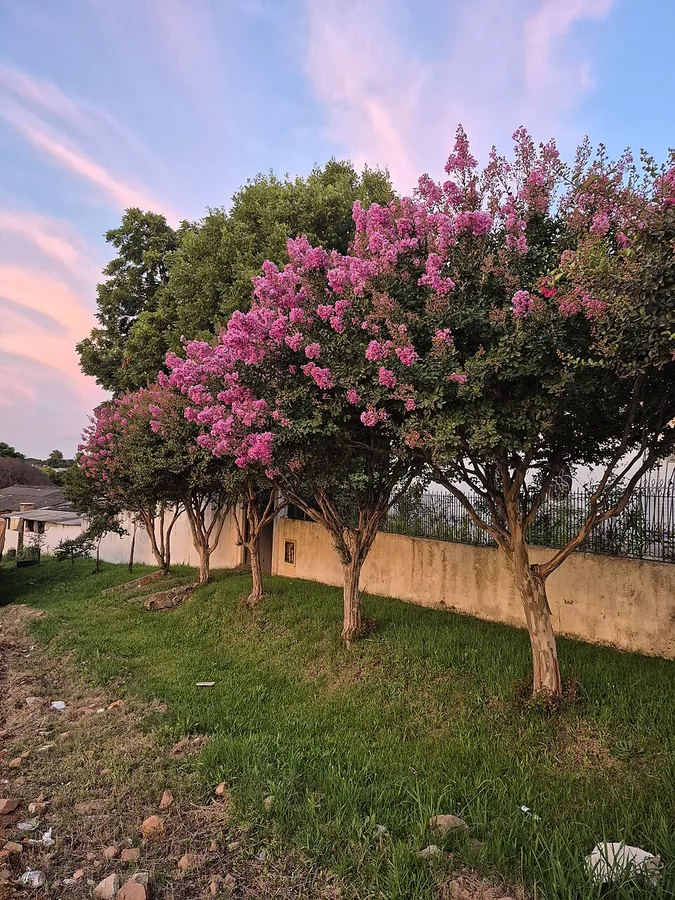
Want a tree that flowers right through the dog days? That's the crepe myrtle. It puts out crinkled, crepe-paper blooms from July into September in white, pink, lavender, and deep red, and once winter rolls around it sheds its bark to show off smooth, mottled wood underneath. It's quick to grow and pretty tough, taking heat, dry spells, and all sorts of soil in stride once it's settled in.
Just know it wants sun and a bit of room. A grown one can hit 15 to 25 feet tall and spread almost as far, and that's exactly how it picked up the nickname lilac of the south, blooming away where real lilacs won't even try. Give it space to find its shape and it pretty much takes care of itself after that.
Here's the funny part: the usual mistake is doing too much to it. A crepe myrtle blooms like crazy all on its own and only really wants sun, soil that drains, and a light trim once in a while. Leave the heavy chopping out of it and you'll end up with a graceful little tree instead of a knobby stump.
Care
The short version: full sun, soil that drains, and a deep soak only while it's young. Give it a light prune in late winter to shape it, go light on the nitrogen, and let some air move through the branches so mildew and scale don't get comfortable.
Light
Put your crepe myrtle in full sun, ideally 6 or more hours a day. It'll handle a little shade, but it pays for it with fewer flowers and a lot more powdery mildew, so the sunnier the spot, the happier the tree.
Water
Water a young one regularly through its first year so the roots can get down deep. After that it's heat- and drought-tolerant and barely needs you, wanting a good soak only when there's a long dry stretch. Easy rule? Let the top half of the soil dry out before you water again.
Soil
This tree isn't fussy about soil at all. It'll grow in clay, loam, sand, or shallow rocky ground as long as it drains, and it handles a wide pH range from 5.0 to 8.0, so most yards work just fine without any tinkering.
Temperature
Crepe myrtle is a southern soul and laughs off summer heat up to 100°F (38°C). It's hardy down to about -9°F (-23°C), which keeps it dependable through zone 6, though a really rough winter might kill the top and send new growth up from the base.
Humidity
Regular outdoor humidity? Not a thing to worry about, so there's no number to chase. What actually matters is airflow, because still, damp air stuck around crowded branches is what brings on powdery mildew and leaf spot.
Feeding
Feed it in spring with a balanced fertilizer, and let a soil test tell you what the ground's really short on. Just go easy on the nitrogen, because too much of it pushes leafy growth instead of the flowers you want.
Pruning
Prune lightly in late winter or early spring. Take out crossing limbs, suckers, and old seed heads, and limb up the lower branches over time to build a nice clean tree shape. Don't ever top it hard, though, since that ruins the form and brings on weak, whippy regrowth.
Repotting
Crepe myrtle's a landscape tree, so it rarely sticks around in a pot for long. If yours is in a container, it only needs repotting now and then, and the giveaways are roots circling the drainage holes and soil that dries out almost the second you water it.
Size & spacing
Figure on a grown tree around 15 to 25 feet (4.5 to 7.5 m) tall with a spread to match. Give it that full width to fill out so air moves freely through the canopy, which makes it a lot harder for disease to settle in.
When to plant
Crepe myrtle does well from zone 6 through 9 and lives for the warm months. Pop a new tree in the ground in spring or fall so the roots can settle before the heat or cold shows up, and then? Just sit back and enjoy the flowers from July through September.
Northern hemisphere
Southern hemisphere
Typical months for a temperate climate: start earlier in warm zones, later where spring frosts linger.
- Plant: spring or fall
- Harvest: July to September
Hardiness
USDA hardiness zones: 6–9
Temperature: down to -23°C
Troubleshooting
Most of what goes wrong with a crepe myrtle is either a fungus or a bug, and it usually turns up first on the leaves or the bark. The good news is that if you catch it early, a quick fix usually keeps it blooming. Find what looks like your tree below, then jump on it before it spreads through the canopy.
White powdery stuff on the leaves, buds that won't open
What you're looking at is powdery mildew, a fungus that loves the mild, damp days of spring and fall and can keep buds from ever opening. Open the plant up to sun and a little breeze, clear out those crowded sprouts at the base, and only grab a labeled fungicide if it really gets away from you.
Fix:
- Site in full sun with good air circulation
- Remove basal sprouts and crowded growth to improve airflow
- Apply a labeled fungicide such as myclobutanil, propiconazole, or thiophanate-methyl if severe
Yellow spots on the leaves and an early leaf drop
Those little yellow spots that show up in warm, muggy weather? That's usually Cercospora leaf spot, and it can leave a tree bare by late summer. Keep water off the leaves, give the canopy some room to breathe, and rake up the fallen leaves so the fungus can't hunker down for the winter.
Fix:
- Improve air circulation and avoid wetting foliage
- Rake and remove fallen infected leaves
- Apply thiophanate-methyl or myclobutanil if needed
Felty white crusts on the bark that bleed pink
Those white, felt-like bumps on the trunk and branches are crapemyrtle bark scale, and if you press one, out comes a telltale pink fluid. The bugs pump out honeydew that turns the whole tree black with sooty mold. Scrub the bark with mild soapy water and a soft brush to lift the scale and grime, then time a systemic soil drench in spring and a dormant oil spray in late winter to break the cycle.
Fix:
- Wash trunk and branches with mild soapy water and a soft brush to remove scale and mold
- Apply a systemic soil drench (e.g., imidacloprid) in spring per label
- Use dormant horticultural oil sprays in late winter
Sticky leaves going black with a sooty coating
The sticky stuff is honeydew from crape myrtle aphids feeding on the undersides of the leaves, and that black sooty mold is just a harmless fungus living off the sugar. Hose the aphids off with a hard jet of water, follow up with insecticidal soap or neem oil, and let the lady beetles and lacewings mop up the rest. Knock the aphids back and the black film clears up on its own.
Fix:
- Spray plants with a strong stream of water to dislodge aphids
- Use insecticidal soap or horticultural/neem oil
- Encourage predators such as lady beetles and lacewings
Toxicity
Good news if you've got pets or little ones around: crepe myrtle is safe all around. The ASPCA lists it as non-toxic to cats, dogs, and horses, and there's no known danger to other animals or people either. The worst it'll do? Drop petals that stain a walkway or a car.
Safe for
People · Cats · Dogs · Horses · Rabbits · Livestock · Birds
Cats None
The ASPCA lists crepe myrtle as non-toxic to cats, so a curious nibble on a leaf or a fallen bloom is nothing to stress about.
Dogs None
Dogs can mouth the leaves, flowers, or bark and be totally fine. It's safe if your dog chews on a low branch, though a big helping of any plant might pass an upset stomach.
Horses None
Got horses? They're fine grazing near a crepe myrtle. The plant's not poisonous to horses, and you won't need any special fencing.
Rabbits Safe
Rabbits aren't at any risk from the leaves or stems. The plant's got no known toxin, so a stray bite won't hurt them.
Livestock Safe
Cattle, goats, and sheep can browse around a crepe myrtle no problem, since the foliage holds nothing toxic to them.
Birds Safe
Backyard and wild birds are in no danger here either. They'll often pick at the seed capsules, and the plant is safe for them.
People Safe
Crepe myrtle is harmless to people, kids included. None of its parts are a known food, so there's no reason to eat it, but a tasted petal or leaf won't do any harm.
No special toxicity precautions are needed; fallen flowers may stain walkways or vehicles.
Varieties
There are hundreds of crepe myrtles out there, so which ones are worth it? The disease-resistant hybrids, every time. These four keep showing up, and for good reason.
Natchez
A go-getter indica and fauriei hybrid that gets to about 30 feet, with white flowers, cinnamon-brown bark that peels in winter, and strong resistance to powdery mildew.
Muskogee
Another indica and fauriei hybrid that tops 20 feet, loved for its light lavender flowers, a long bloom season, and good mildew resistance.
Tuscarora
An indica and fauriei hybrid that brings coral-pink to dark pink flowers, with solid resistance to both powdery mildew and Cercospora leaf spot.
Sioux
A mildew-resistant indica and fauriei hybrid that pairs bright pink summer flowers with standout red-purple color in fall.
How to propagate
Crepe myrtle can be multiplied a few different ways, and it really comes down to one thing: do you want an exact copy of a named tree, or are you okay with a surprise?
Stem cuttingsEasy
Softwood cuttings in late spring to summer; hardwood cuttings in winter · 4 to 8 weeks to root
Cuttings are the surest way to copy a named tree, since the new plant comes out just like its parent. Take softwood cuttings in late spring or summer, or hardwood cuttings over winter, and you'll usually see roots in 4 to 8 weeks.
SeedModerate
Collect ripe seed in fall and sow · One or more seasons
Want to try seed? Collect the ripe capsules in fall and sow them, but know the seedlings come up variable and won't match a named tree. You'll need patience too, because a seed-grown plant takes a season or more before it's much of anything.
LayeringModerate
Growing season · Several months
If a branch hangs low enough, you can pin it to the ground during the growing season and let it root right there. Layering takes several months, and then you just cut the new plant free from its parent.
Myths
Crepe myrtles need a hard yearly chop, the so-called crepe murder, to bloom well.
Here's the thing: topping a crepe myrtle does nothing for its flowers and a whole lot of damage to its shape. It blooms heavily all by itself, while those severe cuts wreck the graceful form and force out weak, whippy regrowth. A light shaping in late winter is honestly all it ever needs.