Shrub · Rubiaceae
Gardenia
Gardenia jasminoides
Give it acidic soil, steady moisture, and humid air, and the gardenia pays you back with intensely fragrant white flowers.
Partial shade
Every 3–7 days
50–90°F · 10–32°C
USDA 8–11
Overview
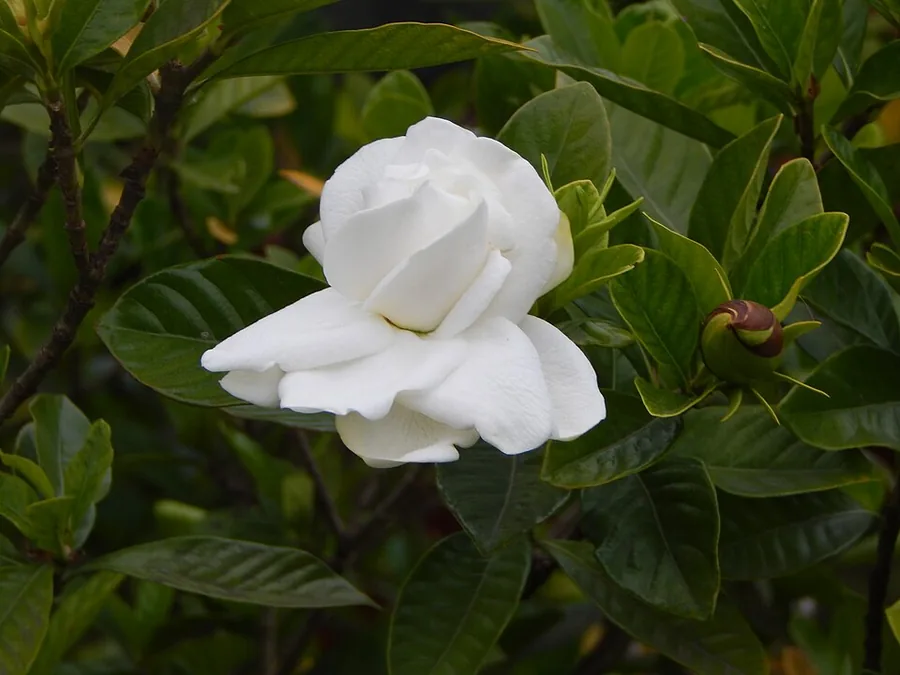
There's really one big reason people grow gardenias, and that's the rich perfume rising off those creamy white flowers in late spring and summer. It's a broadleaf evergreen shrub in the madder family, and even when it's not blooming its glossy dark leaves still look great. You can grow it in the ground across the mild South or keep it in a pot further north, and either way it wants a little warmth and attention in exchange for that scent.
Here's the honest part, though: it doesn't do well with neglect. Gardenias want acidic soil, even moisture, and humid air, and they sulk the moment one of those slips. Bud drop and yellowing leaves are the two things you'll hear about most, and the good news? Both come down to conditions you can fix, not bad luck.
Get the basics sorted and a gardenia settles into a long, steady life as a perennial shrub. Give it the soil and humidity it's after, and it'll bloom for weeks while the fragrance drifts right across the garden.
Care
The short version: part shade with morning sun, acidic soil kept around a pH of 5.0 to 6.0, even moisture from rainwater, and humid air. Feed an acid-forming fertilizer in spring and keep night temperatures steady while the buds are setting, and you're good.
Light
Gardenias are happiest in part shade, ideally morning sun with a break from the harsh afternoon heat. They'll take full sun in cooler climates and do fine in bright indirect light indoors, but deep shade? That'll cost you flowers.
Water
Keep the soil consistently moist but never soggy, since both extremes bring on bud drop. Water every 3 to 7 days depending on the weather, and go with rainwater or other non-alkaline water so you're not slowly nudging the soil pH up.
Soil
Plant it in well-drained, humus-rich, acidic soil with plenty of organic matter. Aim for a pH between 5.0 and 6.0, because letting it drift higher locks up iron and yellows the leaves.
Temperature
Gardenias are comfy anywhere from 50°F to 90°F (10°C to 32°C). Cool nights of 50°F to 55°F (10°C to 13°C) actually help the buds form, so don't sweat a chilly evening, just spare them the sharp swings that make buds drop.
Humidity
These shrubs love humidity above 50% and really don't like dry indoor air. Group your plants, set the pot on a pebble tray, or run a humidifier where it's dry, since low humidity is one of the top causes of bud drop.
Feeding
Feed an acid-forming azalea or camellia fertilizer like 10-8-8, lightly in spring after frost and again about 6 weeks later. Then stop by fall, because late nitrogen pushes soft growth that won't harden off before the cold shows up.
Pruning
Prune right after flowering in summer to tidy up straggly branches and spent blooms. Wait too long and you'll cut off the wood that carries next season's buds, so it pays to do it promptly.
Repotting
Bump a container gardenia up a pot size every 2 to 3 years, or sooner if roots circle the base, water runs straight through, or growth stalls and leaves yellow. Fresh acidic mix at repotting time keeps the pH right where the roots want it.
Size & spacing
A grown gardenia gets to about 4 to 8 feet (122 to 244 cm) tall and roughly as wide. Leave it 4 to 8 feet (122 to 244 cm) of room so air moves freely through the canopy and pests find fewer spots to settle in.
When to plant
Gardenias are warm-climate shrubs that are happy in zones 8 to 11, where they bloom from late spring into early summer, and year-round in the mildest spots. Plant new ones out in spring once the last frost's gone, then prune right after flowering so you don't lop off next year's buds.
Northern hemisphere
Southern hemisphere
Typical months for a temperate climate: start earlier in warm zones, later where spring frosts linger.
- Plant: spring after last frost
- Harvest: late spring to early summer (year-round in warm climates)
Hardiness
USDA hardiness zones: 8–11
Temperature: down to -12°C
Troubleshooting
With gardenias, trouble usually shows up on the buds and leaves first, and most of it comes back to soil, water, or air rather than any disease. Catch those early signs and you can fix the conditions before you lose flowers. Find what matches below, then tweak it.
Buds go yellow and fall off before they open
So the buds are dropping before they open? That's bud drop, and just about every gardenia grower runs into it. It usually follows a change the plant didn't care for, like chilly nights below 50°F to 55°F (10°C to 13°C), watering that's all over the place, or dry indoor air. Keep the soil evenly moist, bump up the humidity, and hold the temperature steady while buds are forming, and you'll see fewer of them let go.
Fix:
- Maintain consistent, even soil moisture with good drainage
- Provide cool night temperatures of 50-55 degrees F during bud set
- Raise humidity around the plant
- Provide adequate light and avoid over-fertilizing
New leaves yellow but the veins stay green
New leaves going yellow while the veins stay green? That's iron chlorosis, and it turns up when the soil gets too alkaline for the roots to grab the iron they need. Check the pH first, then bring it down with sulfur and switch to an acid-forming azalea or camellia fertilizer. A bit of chelated iron plus a move to rainwater usually gets the green back.
Fix:
- Lower soil pH using water-soluble sulfur or aluminum sulfate
- Apply chelated iron to soil or as a foliar spray
- Use an acid-forming (azalea/camellia) fertilizer such as 10-8-8
- Irrigate with rainwater or non-alkaline water
Sticky leaves with a black sooty coating
If the leaves feel sticky and shiny and there's a black sooty mold on top, that's a tip-off that sap-sucking bugs are feeding up above. On gardenia it's usually whiteflies, with scale, aphids, and mealybugs also in the mix. Spray insecticidal soap or horticultural oil under the leaves, do it again every 5 to 7 days, and once the bugs are gone you can just wipe the mold off.
Fix:
- Spray insecticidal soap or horticultural oil thoroughly on leaf undersides
- Repeat treatments at 5-7 day intervals
- Wipe sooty mold off with a moist cloth once insects are controlled
- Apply sprays when temperatures stay below 90 degrees F
Toxicity
Gardenia is only mildly toxic to pets and pretty gentle on people. The leaves and flowers carry geniposide and genipin, which can leave a cat, dog, or horse with vomiting, diarrhea, or hives. It stays mild, but it's still worth keeping curious pets and grazing animals away from the shrub.
Toxic to
Cats · Dogs · Horses · Rabbits · Livestock · Birds
Safe for
People
Cats Mild
If a cat nibbles a leaf or a flower, it might throw up, get the runs, or come out in hives. The compounds doing it, geniposide and genipin, are only mildly irritating, so most cats shake it off on their own.
Dogs Mild
Dogs chew more than cats do, so a mouthful can mean vomiting, loose stools, and sometimes a few raised welts. It's a mild upset that usually passes, but give the vet a call if it hangs around.
Horses Mild
A horse that grazes the leaves can end up with a queasy stomach and loose droppings. It stays mild, but it's still smart to keep the shrub out of paddocks so they aren't tempted.
Rabbits Caution
Rabbits aren't on the ASPCA list, but the same gut-irritating stuff is in there, so it's best to treat gardenia as off-limits. Keep an eye out for soft stools if a nosy rabbit sneaks a bite.
Livestock Caution
There's no clear record of cattle, goats, or sheep getting poisoned, but the iridoid glycosides could still upset their stomachs. Fencing the shrub off is the easy call.
Birds Caution
Nobody's really studied gardenia in pet birds, and since they're so small, any irritant matters more. Keeping them away from the leaves and flowers is the safe move.
People Essentially safe
People are essentially safe around gardenia, and funnily enough the same compounds show up in foods colored with gardenia extract. It's still not a snack, though, so keep kids from chewing the leaves.
Keep plants and fallen plant parts away from pets; ingestion causes mild gastrointestinal upset.
Helpline numbers

United States
ASPCA Animal Poison Control: (888) 426-4435 (fee applies)

United Kingdom
Animal PoisonLine: 01202 509000 (fee applies)

Australia
Animal Poisons Helpline: 1300 869 738
Varieties
Most garden gardenias are just forms of one species, but a few named types stand out for hardiness, size, or bloom. These are the ones worth asking for by name.
Kleim's Hardy
If cold's a concern, this single-flowered cultivar was bred to handle it and is said to be hardy down to about USDA zone 7.
Radicans
This dwarf, low-spreading one has small leaves and flowers, and it makes a nice creeping groundcover.
Veitchii
This compact everblooming type is the one to grab if you want a long, reliable flowering season.
How to propagate
Gardenias are slow but pretty dependable to multiply, whether you're rooting a summer cutting or pinning a branch down to layer it into a whole new plant.
Stem cuttingsModerate
Summer (June through August) · 6-12 weeks to root
Cuttings are how most folks start a new gardenia, and summer between June and August is the time to take them. Snip a semi-hardwood piece where the green wood's just turning brown, dip the cut end in rooting hormone, and set it under intermittent mist or in a covered pot. Give it 6 to 12 weeks to root, and softwood tip cuttings taken in early to mid summer work nicely too.
LayeringModerate
Growing season · Several weeks to months
Layering's another easy way to make more gardenias during the growing season. Just pin a low branch down into the soil and let it root right where it sits, which takes anywhere from several weeks to a few months before you cut it free and pot it up.
Myths
Gardenias are completely safe houseplants that pose no risk to pets.
Not quite, since the ASPCA does list gardenia as toxic to cats, dogs, and horses, though it's mild, usually just vomiting, diarrhea, or hives. It won't seriously poison a pet, but it's not totally harmless either, so it's worth sweeping up dropped buds and leaves.
Yellow gardenia leaves always mean you are overwatering.
Not always, because yellowing on new growth is way more often iron chlorosis from alkaline soil than too much water. Get the pH to 5.0 to 6.0 and add some iron, and the plant usually greens right back up.