Bulb · Asparagaceae
Grape Hyacinth
Muscari armeniacum
Pop the little bulbs in the ground this fall, and next spring they hand you rivers of blue.
Full sun
Every 7–14 days
USDA 4–8
4–8 in · 10–20 cm
Overview
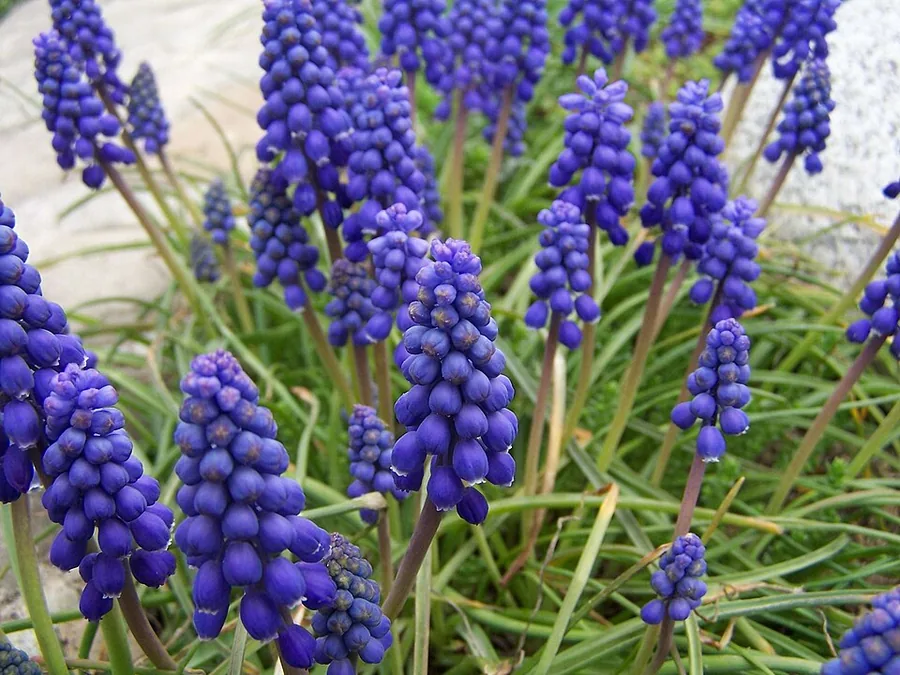
So where does the name come from? Grape hyacinth gets it from those tidy spikes of small, round flowers that look just like a bunch of upside-down grapes. It's a little bulb, only 4 to 8 inches (10 to 20 cm) tall, but plant it in drifts and let it come back every year, and it more than makes up for being short. And despite the name, it's no kin to the true hyacinth at all, sitting instead in its own genus, Muscari.
As bulbs go, this one's about as easy as it gets. Just drop the bulbs in the ground in fall, and they'll send up grassy leaves through winter and open their deep blue spikes in mid-spring, right when the tulips and daffodils show up. They'll settle in pretty much anywhere, and they laugh off cold all the way down to -29°F (-34°C).
The one thing to keep an eye on is how much it likes to spread. Grape hyacinth self-seeds and makes offset bulbs, so a small patch can drift into the lawn over a few seasons. That eagerness is great in a wild corner and kind of a pain in a neat border, so plant it somewhere a little wandering won't bug you.
Care
The short version: plant the bulbs in fall in well-drained soil, give them full sun to part shade, keep them moist through spring growth, then ease off the water once the foliage dies back.
Light
Grape hyacinth flowers best in full sun, but it's totally fine in partial sun or partial shade too. More light gets you denser spikes and stronger color, and a bit of afternoon shade is no problem in hot spots.
Water
Keep the soil evenly moist while the leaves and flowers are growing in spring. Once the foliage yellows and dies back, back off the water quite a bit, because the bulbs want to stay dry through their summer and fall dormancy.
Soil
Average, well-drained soil does the trick, and it even puts up with clay as long as water doesn't pool. A pH somewhere between 6.0 and 7.0, with a little organic matter mixed in, keeps the bulbs happy.
Temperature
This is a tough, cold-hardy little bulb that handles winters down to -29°F (-34°C) and grows well up to about 75°F (24°C). That deep winter chill? It's actually what sets off a good strong spring bloom.
Humidity
Regular outdoor humidity is all it wants, so there's no number to keep track of. What matters way more is drainage, since bulbs sitting in soggy ground are the ones that end up rotting.
Feeding
Work a bit of bone meal or balanced bulb fertilizer into the soil at planting, then feed once more after the flowers fade so the bulbs can build up for next year. It's not a hungry plant, so go easy.
Pruning
There's really nothing to prune here. Let the foliage die back on its own after the flowers fade so the bulb can store up energy, and only then clear off the spent leaves, because cutting them green just weakens next year's show.
Repotting
In the ground, just let the bulbs multiply and divide a crowded clump every 4 to 5 years. You'll know it's time when the clumps get congested, the flowers thin out, and the bulbs start heaving up to the surface.
Size & spacing
Grape hyacinth stays little at 4 to 8 inches (10 to 20 cm) tall with a spread of just 3 to 6 inches (8 to 15 cm). Tuck the bulbs in close together in groups so they read as a solid sheet of blue instead of scattered dots.
When to plant
Grape hyacinth runs on the bulb calendar, plain and simple. Plant the bulbs in fall before the ground freezes, let them root and rest over winter, and they'll pay you back with blue spikes in mid-spring, somewhere around April to May.
Northern hemisphere
Southern hemisphere
Typical months for a temperate climate: start earlier in warm zones, later where spring frosts linger.
- Plant: Fall, before ground freezes
- Harvest: Mid-spring (April to May)
Hardiness
USDA hardiness zones: 4–8
Temperature: down to -34°C
Troubleshooting
Grape hyacinth gives you hardly any grief, and what does crop up is usually just cosmetic or a matter of it spreading too freely. Once you can tell its normal winter scruffiness from an actual problem, you can mostly leave it alone. Match what you're seeing to the notes below before you grab for a fix.
Plants popping up way past where you planted them
Here's the thing about grape hyacinth: it's a real go-getter at self-seeding, and it makes offset bulbs too, so a neat little patch can wander into the lawn and beds in just a few years. Want to slow it down? Snip off the spent flower spikes before they set seed, and dig up any seedlings and stray bulbs you'd rather not keep. And if you grow it in a pot or a walled-off bed, it stays put.
Fix:
- Deadhead spent flower spikes before seed sets
- Dig and remove unwanted seedlings and offset bulbs
- Grow in containers or contained beds to limit spread
Floppy, yellowing leaves that look rough all fall and winter
Seeing scruffy leaves and worried something's wrong? Nine times out of ten it's just the plant's normal habit. Grape hyacinth throws up its grassy leaves in autumn and hangs onto them all winter, so they look worn out long before the spring flowers show up. Just let the foliage sit there until it yellows and dies back on its own, and if the clump's gotten packed, go ahead and split it.
Fix:
- Leave foliage in place until it yellows and dies back naturally
- Divide crowded clumps every 4 to 5 years
- Reduce watering once foliage begins to die back
Chewed-up leaves and flower stalks that disappeared
Good news, grape hyacinth brushes off most pests, but deer will nibble it now and then when their usual food gets hard to find. Notice torn, ragged foliage with tracks or droppings nearby? That's them. A repellent spray usually sorts it out, though where deer come around a lot, fencing or slipping the bulbs in among plants deer don't like works better.
Fix:
- Apply deer repellent
- Use fencing or interplant with less palatable bulbs
Toxicity
Grape hyacinth is a low-toxicity plant and an easy one to have around most homes. The leaves and flowers won't hurt anyone, and the flowers even get eaten in some places, but the bulbs hold mild saponins that can cause drooling or an upset stomach if a pet or kid digs one up and eats it. Just keep an eye on the diggers and the curious toddlers, and the rest sorts itself out.
Safe for
People · Cats · Dogs · Horses · Rabbits · Livestock · Birds
Cats Caution
The leaves and flowers are fine for cats, but the bulbs have mild saponins that can leave a cat drooling or a bit queasy if it digs one up and chews it. A quick nibble of foliage, though? That's really nothing to stress about.
Dogs Caution
If a dog likes to dig, it might gulp down a bulb, and the saponins in there can set off some drooling and an upset tummy. The parts above the soil aren't much of a worry.
Horses None
Horses can crop the grassy leaves without any harm, since there's no toxin in the plant that bothers them.
Rabbits None
Rabbits can munch the leaves just fine, because nothing in the foliage gives them trouble.
Livestock None
Cattle, goats, and sheep can graze around grape hyacinth no problem, since the foliage won't bother them.
Birds None
Birds aren't affected at all, so backyard flocks can poke around near a planting without any concern.
People Caution
Believe it or not, the flowers get pickled and eaten in some places, but the raw bulb is best left alone, because its saponins can bring on drooling and an upset stomach if eaten. Just keep little kids from tasting the bulbs.
No special handling precautions are required; the plant is considered pet-safe.
Varieties
Most of what you'll find for sale is the plain species, but there are a handful of named cultivars worth tracking down for their different shades and shapes.
Cantab
It's a sweetly scented, sky-blue one that blooms a bit later than the species and tops out around 6 to 9 inches tall.
Valerie Finnis
Its soft powder-blue flowers ride on stiff 8-inch spikes that hold themselves upright without any help.
Blue Spike
This one's a double, so the extra-crowded florets pack each spike into a fuller, plumper cluster.
Saffier
It's a deep blue, sterile type whose flowers hang on longer than most and never self-seed.
Album
A white-flowered pick that grows just a touch less vigorously than the blue species.
Companions
Grape hyacinth shines among other spring bulbs, where its low blue spikes carpet the ground beneath taller flowers that bloom at the same time.
Plant near
Daffodils (Narcissus): Bloom at the same mid-spring time and combine for layered drifts of color.
Tulips: Pairs well in mass plantings and borders for contrasting spring color.
Crocus: Early-blooming companion bulb for naturalized lawn and rock-garden plantings.
How to propagate
Grape hyacinth pretty much multiplies on its own, and you can give it a nudge by lifting offsets, splitting clumps, or just letting it set seed.
Offsets & pupsEasy
Lift and separate offset bulbs in summer dormancy or fall. · Offsets typically flower the following spring.
Want more grape hyacinth? The easiest route is to lift the offset bulbs that crop up around the parent and replant them, which is a job for summer dormancy or fall. The nice part is that most of those offsets are ready to flower the very next spring. Do this to a packed clump every 4 to 5 years and it keeps blooming beautifully.
DivisionEasy
When foliage has died back, in summer to early fall. · One season
Once the leaves have gone yellow and died back, somewhere from summer into early fall, you can dig up a tired clump and split it into chunks. The divisions get settled in within a single season, so you're not waiting long. It's also the handiest way to keep an eager patch from creeping too far.
SeedModerate
Self-sows readily; collected seed sown after ripening. · Seed-grown plants may take up to 4 years to flower.
Honestly, grape hyacinth self-sows so freely that you almost never need to sow it yourself, though you can gather and sow the ripened seed if that's your thing. The catch is patience, because a seed-grown plant can take up to 4 years before its first bloom. Snipping off the spent spikes is the easiest way to keep all that self-seeding under control.
Myths
Grape hyacinth is as poisonous to cats and dogs as a true hyacinth.
Not the case at all. The ASPCA lists Muscari armeniacum as non-toxic to dogs and cats, and it isn't even related to the truly toxic true hyacinth, even though they share part of a name. The bulbs do carry mild saponins, so a pet that digs one up and eats it might drool or get a sour stomach, but the plant's nothing like its dangerous namesake.
Grape hyacinth is a kind of true hyacinth.
It sits in its own genus, Muscari, in the family Asparagaceae, not in the genus Hyacinthus. The hyacinth in the name is really just about how the flower clusters look, not any close family connection.