
Introduction
I planted a crossvine plant along my back fence, and one April it lit up with orange-red trumpets. The first hummingbird of the year showed up hungry, right on cue. That is this vine at its best. It blooms early, when little else has nectar, and it pulls hummingbirds straight to your yard. This guide gives you the full, sourced picture so you can grow it well.
The plant goes by the botanical name Bignonia capreolata. It is a native woody vine, and it keeps most of its leaves through winter. It comes from the southeastern United States. It climbs 30 to 50 feet using branched tendrils tipped with tiny sticky disks. So it grips bark, brick, and fences on its own. It is hardy in roughly zones 5 to 9. It stays glossy green in the Deep South and turns reddish-purple in colder spots. Each trumpet flower is about 2 inches long, orange outside with a yellow throat.
Plenty of care pages leave out the parts you actually need. You rarely learn how the vine climbs, or whether it can harm a wall. You almost never hear about fire-safe siting. Yet NC State gives crossvine a high flammability rating near a home. A real cultivar comparison is just as hard to find. This guide covers all three, plus the everyday care steps you came here for.
Here is the plan in plain terms. You will learn what this native vine is, how to grow it, and how its self-clinging tendrils work. You will see which cultivar to pick. You will learn why this hummingbird vine earns a spot in a pollinator garden, and how to keep its root suckers in check. State garden experts call crossvine a tame native vine. They tell you to plant it in place of vines that take over. Once you see it bloom, you will get why.
What Is the Crossvine Plant?
The crossvine plant is a native, semi-evergreen woody climber in the trumpetvine family. It grows wild across the southeast and south-central United States. It earns a spot in yards with one of the heaviest flower shows of any vine you can grow.
Its formal name is Bignonia capreolata. The genus honors Abbe Jean-Paul Bignon, and capreolata is Latin for having tendrils, which is exactly how this vine grabs hold and climbs. Both names tell you something true about the plant before you ever see it bloom.
The common name comes from a neat trick of the stem. Cut the squarish stem open and four pith rays form a clear cross-shaped pith inside. That little cross is the fastest way to confirm the right plant, and it is where the word crossvine comes from.
This native flowering vine climbs 30 to 50 feet (9 to 15 m) in a garden. In the wild it can pass 50 feet. The spread stays a tidy 6 to 9 feet (1.8 to 2.7 m). Picture the size at a glance with the quick facts below.
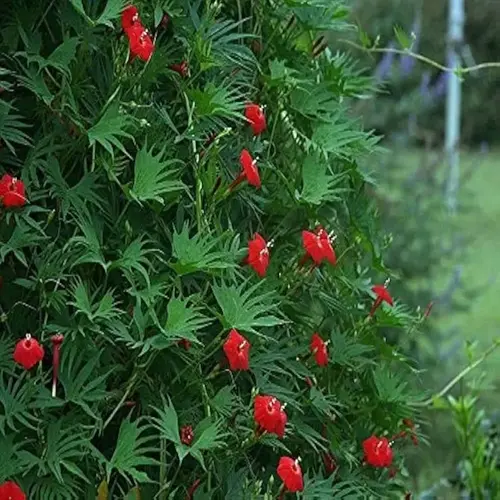
The blooms are the reason most people plant it. Each trumpet flower runs about 2 inches (5 cm) long and hangs in clusters of 2 to 5. The petals are orange-red on the outside with a warm yellow throat inside, and they cover the vine in early spring.
Georgia DNR notes that some growers say crossvine bears more flowers per foot than almost any other plant. That high flower count is a big reason it has become a yard favorite. It also explains the wall of color you see in spring.
The leaves help you tell it apart from trumpet creeper, the plant it gets confused with most. Crossvine carries dark, glossy compound leaves 4 to 6 inches (10 to 15 cm) long, with just two leaflets set opposite on the stem. Trumpet creeper, by contrast, has many small leaflets running down each leaf like a feather.
Need one final check? Slice the stem and look inside for the cross.
A cross-section of its stem reveals the conducting wood forming a cross, hence the common name.
How to Grow Crossvine
In its third spring, one Tangerine Beauty covered a whole fence in orange-red trumpets. I had set it 3 feet from a back wooden fence at the woods edge in the Georgia Piedmont. That first summer it looked like nothing, just a few thin shoots reaching for the boards. The second year added some height and little else. Then the third spring it took off and ran the full length of the fence.
That slow start then fast climb is the pattern you plan around when you learn how to grow crossvine. The roots dig in for a year or two before the top growth races, so give the vine a strong support and a little patience up front. Get the site right at the start and the plant rewards you with heavy bloom once it settles in.
Site it in full sun for the best flowering, since deep shade can cut the bloom to about a third of what an open spot gives you. Crossvine still climbs and stays green in shade, but you trade most of the color for it. Strong morning light brings out the heaviest flush, so an east or south fence works well.
Crossvine wants well-drained soil that is organically rich and close to neutral, with a pH from 6.0 to 8.0. Work some compost into the bed before you plant and the roots take hold faster. When planting crossvine along a fence, space each one 3 to 4 feet (0.9 to 1.2 m) apart so the vines fill in without crowding.
Water deeply in the morning while the plant gets set in. This keeps the leaves dry and the bed healthy as the roots build fast. Once the roots take hold, crossvine is drought tolerant and asks for very little. That toughness suits hard sites. It handles salty coastal air, packed ground, heat and even heavy shade that send other vines packing.
Choose a sunny site near a fence, arbor or rough wall, keeping it away from the immediate defensible space close to the house.
Loosen the bed and work in compost so the well-drained, organically rich soil sits near a neutral pH of 6.0 to 8.0.
Plant the root ball level with the surrounding soil and space plants 3 to 4 feet (0.9 to 1.2 m) apart along a fence line.
Tie new growth to the support and water deeply, ideally in the morning, until the fast-growing roots are established.
Day-to-day crossvine care stays simple after that first season. Keep the soil from sitting wet, guide the early growth onto your fence or arbor, and let the vine do the rest. Plant it well and you set up years of spring color with almost no fuss.
How Crossvine Climbs and Clings
So how does crossvine climb without a single nail or wire? It reaches up with branched tendrils, and each one is tipped with a tiny adhesive disk. Think of those disks as small suction-style pads. They press onto a rough surface and hold tight, much like a gecko's foot grips a wall.
That grip changes where you can plant the vine. The tendrils do two jobs at once. They curl around thin things like fence wire, lattice and tree bark, and the adhesive disks stick flat against brick, stone and masonry. That dual hold is why crossvine handles climbing on brick so well while ivy needs aerial roots to do the same thing.
The catch is paint and soft wood. Those same disks can mar a finish or work into a crack, so you don't want them pressed against your siding. The fix is simple. Mount a crossvine trellis a few inches off the wall and let the vine grab the trellis instead of your house.
Branched tendrils
- Structure: Each leaf petiole carries two leaflets plus one branched tendril, so the vine has many small gripping arms along every stem.
- Action: The tendrils reach out, branch, and curl around twigs, wire, lattice and rough bark to pull new growth upward.
- Best support: They grab thin structures like trellis bars, fencing and tree bark most easily, giving the fastest, tidiest climb.
Adhesive disks
- Structure: The branched tendrils are tipped with small adhesive disks that act like tiny suction-style pads at each tip.
- Action: These disks let crossvine stick directly to flat, rough surfaces such as brick, stone and masonry without any wires.
- Caution: On painted or soft-wood siding the disks can leave marks, so a standoff trellis keeps the surface protected.
Suitable surfaces
- Great fit: Rough brick, stone walls, wooden fences, arbors and chain-link all give crossvine plenty to cling to and climb.
- Use care: Smooth or painted surfaces and delicate siding are better served by a trellis set a little off the wall.
- Coverage: As it matures, crossvine can cascade back down a fence, knitting into a dense living screen across the whole span.
Living screen use
- Privacy: Trained along a fence or arbor, crossvine fills in fast to create a flowering privacy screen and shade.
- Chain-link: It readily covers a plain chain-link fence, turning bare metal into a green, blooming living wall.
- Maintenance: Guide and tie young stems early, then let the tendrils take over and clothe the structure on their own.
On painted or soft-wood walls, mount a standoff trellis a few inches off the surface so the adhesive disks grip the trellis instead of marking the siding.
Give the vine the right structure and it pays you back fast. As crossvine fills in, it cascades back down a fence and knits into a dense living screen. That habit turns a plain chain-link fence into a flowering privacy wall. Guide and tie the young stems for the first season, then step back and let the tendrils take over the rest of the job.
Crossvine Cultivars Compared
Buying a named selection beats grabbing a generic vine off the rack. The crossvine cultivars below let you match the plant to your climate and your nose, since both bloom strength and scent shift from one selection to the next.
Pick by three things: bloom strength, cold-hardiness, and crossvine flower colors. Most lists just name the cultivars and stop, so I built a real comparison. Two of them carry solid grower notes. The rest are proven names, so confirm them at the nursery before you pay.
For most yards, the Tangerine Beauty crossvine is the easy call and the best crossvine variety to start with. It blooms heavily even in part shade, and its orange petals with a yellow throat cling well to light brick. That makes it a safe pick if your wall gets dappled sun instead of all-day light.
Garden near the cold edge of the range? Reach for a tough, evergreen selection like Jekyll. It traces back to wild plants on Jekyll Island, and growers cite it as the most cold-hardy crossvine. One more thing to check before you buy: scent. Some named selections carry little fragrance, so smell the flowers in person if a sweet vine is what you want.
Crossvine for Hummingbirds
An early April morning in the Georgia Piedmont, and a flash of green hung at my kitchen window. A ruby-throated hummingbird worked the row of orange trumpets on the back fence, dipping into one bloom and then the next. The vine had opened only days before. I watched the bird that had just crossed the Gulf of Mexico to get there.
That overlap is the whole reason crossvine for hummingbirds beats almost any other vine you can plant. It blooms for 3 to 4 weeks starting in April here, right as the birds return from migration. Few other plants have flowered yet, so the timing gives you a critical early-spring nectar source when the birds need fuel the most.
The trumpet shape is the draw. The long flowers hold deep nectar that suits a hummingbird's bill and tongue. The vine is in fact pollinated by the ruby-throated hummingbird as it feeds. That match of bloom time and bird matters. It makes crossvine one of the best pollinator vine picks for early visitors in your garden.
Hummingbirds get the headlines, but they are not your only guests. The same flowers feed bees, butterflies, and moths through the bloom window. Crossvine is also a host plant for the rustic sphinx moth, and deer and beavers browse the foliage in fall and winter. Here is the range of wildlife you can expect it to support.
Ruby-throated hummingbirds
- Timing: Crossvine blooms in early spring just as ruby-throated hummingbirds return from migration and need fuel.
- Value: Its trumpet flowers are a critical nectar source when few other plants are flowering yet.
- Design: Planting it where you can see it, such as near a window, turns spring migration into a daily show.
Bees and butterflies
- Nectar: The abundant spring flowers also feed bees and butterflies looking for early-season nectar.
- Spread: Clusters of 2 to 5 trumpet blooms keep the vine busy with pollinators through the bloom window.
- Benefit: This makes crossvine a strong anchor plant for a broader pollinator and native-plant garden.
Moths
- Host plant: Crossvine is a host for the rustic sphinx moth, whose caterpillars feed on the foliage.
- Food web: Supporting moth larvae feeds songbirds that rely on caterpillars to raise their young.
- Value: This host-plant role adds real ecological depth, feeding the food web beyond nectar visitors.
Browsers
- Deer and beavers: White-tailed deer and beavers browse crossvine foliage, especially in fall and winter.
- Note: This means crossvine is not reliably deer-proof, though it is rarely destroyed outright.
- Placement: In heavy deer pressure, give a young vine some protection until it climbs out of reach.
Add it all up and crossvine earns its spot as a true native plant for wildlife, not just a pretty fence cover. One vine feeds migrating birds, pollinators, and moth larvae, and the larvae in turn feed the songbirds that raise their young on caterpillars. Few early-spring plants do that much work in one corner of the yard. Georgia DNR put the hummingbird role this way.
These long-distance migrants flock to crossvines, feeding on the abundant nectar during a time when there are few excellent sources of nectar available for what is arguably Georgia's favorite bird.
Keeping Crossvine in Check
So is crossvine invasive? Not in the way oriental bittersweet is. The USDA Forest Service calls it a native alternative to that pest and says it stays easier to manage than trumpet creeper. You still need to keep an eye on it, but you are not fighting a true thug.
The catch is how it spreads. NC State tags the vine as weedy and aggressive because it travels two ways. It drops seed, and it sends up root suckers that pop up around the base and creep out into nearby beds. Pull those shoots while they are young and managing crossvine stays a 5-minute job each season.
Timing matters when you cut back crossvine. Prune right after the main spring bloom so you shape the plant without cutting off the wood that carries flowers. Wait too long and you trade next year's blooms for a tidier shape, which is a bad deal on a vine grown for its color.
One last point matters in dry country. NC State gives crossvine a high flammability rating. So where you plant it is a safety call. Keep it off the house and out of the defensible space, and run it up a fence or arbor at a safe distance instead.
- Prune: Cut back and shape crossvine right after the main spring bloom so you do not remove the wood that carries flowers.
- Pull suckers: Pull or cut root suckers promptly each season before they root into the surrounding landscape and spread.
- Deadhead seed: Remove spent flowers and seed capsules where you want to limit self-seeding into nearby beds.
- Site for fire safety: Keep crossvine out of the defensible space close to the house in fire-prone areas, given its high flammability rating.
- Stop pruning and feeding about two months before the first frost so new growth hardens off.
NC State gives crossvine a high flammability rating and advises against planting it within a home's defensible space, so place it on a fence or arbor away from the house in wildfire-prone regions.
5 Common Myths
People often assume crossvine and trumpet creeper are the same plant because both carry trumpet-shaped orange flowers on climbing stems.
They are different plants. Crossvine is Bignonia capreolata, blooms earlier in spring, and is far easier to manage than aggressive trumpet creeper.
Many gardeners believe crossvine is invasive and will overrun the yard the way oriental bittersweet or trumpet creeper can.
Crossvine is vigorous and suckers, but extension services promote it as a well-behaved native alternative to truly invasive vines when managed.
It is commonly said that crossvine needs a trellis or wires because it cannot climb a wall or fence on its own.
Crossvine self-clings using branched tendrils tipped with adhesive disks, gripping bark, brick, and rough surfaces without any added support.
Some assume crossvine is a tender annual or a soft perennial that dies completely and must be replanted each year.
Crossvine is a long-lived woody perennial vine. Even if cold kills the top in a hard winter, the hardy roots usually resprout in spring.
A frequent belief is that every crossvine is strongly fragrant, so any plant labeled crossvine will perfume the garden.
The wild species is fragrant, but fragrance is reduced or missing in some named cultivars, so scent varies from plant to plant.
Conclusion
The crossvine plant earns its spot in the yard for one simple reason. It feeds ruby-throated hummingbirds in early spring, when almost nothing else is blooming, and it covers a bare fence fast while it does. That makes it both a native vine and a true hummingbird vine, not just a pretty face on the trellis.
Keep the load-bearing facts in mind as you plan. Crossvine climbs 30 to 50 feet on branched tendrils tipped with adhesive disks, so it grips bark, brick, and fence rails on its own. Its orange-red trumpets with yellow throats open in early spring, and the plant is hardy in zones 5 to 9. Best of all, it gives you a native look that is far easier to manage than aggressive trumpet creeper.
Good crossvine care comes down to a few moves you can repeat each year. Pick a named cultivar like Tangerine Beauty for reliable, heavy bloom. Give it full sun and a fence or arbor to grab. Prune right after the spring flowers fade, and pull any root suckers as they appear. Keep the vine out of the defensible space close to your house too, since its foliage is rated as a fire risk.
Do that, and a future spring takes care of the rest. On my own fence, the first hummingbird shows up before the maple leaves have fully opened. It works the trumpets a few feet from the kitchen window. Picture your own fence or arbor draped in those flowers next spring. That is a lot of life and color for one tough, low-maintenance native that asks so little in return.
Glossary
- adhesive disks
- Tiny suction-like pads at the tips of a vine's tendrils that let it stick directly to flat, rough surfaces like brick or stone.
- branched tendrils
- Slender, dividing gripping arms a vine uses to curl around and attach to supports such as bark, wire, or lattice.
- cross-shaped pith
- The soft central tissue of crossvine's stem that forms a cross pattern when the stem is cut, giving the plant its common name.
- defensible space
- The cleared, fire-resistant buffer area kept around a home so flames have less fuel to spread from the landscape to the building.
- root suckers
- New shoots that sprout from a plant's roots away from the main stem, allowing it to spread sideways into the surrounding landscape.
- ruby-throated hummingbird
- A small migratory hummingbird of eastern North America that relies on early-spring nectar plants like crossvine during its spring migration.
- semi-evergreen
- A plant that keeps most of its leaves through winter in mild climates but drops some or all of them where winters are cold.
- tendrils
- Slender, coiling stems a vine uses to grab onto a surface and pull itself upward.
External Sources
Frequently Asked Questions
How aggressive is crossvine?
Crossvine is vigorous and spreads by seed and root suckers, but it is better-behaved than trumpet creeper and easy to keep in check.
Are crossvine roots invasive?
Crossvine roots send up suckers that spread into the landscape, so pull them promptly, but they do not damage foundations.
Does crossvine bloom all summer?
No. Crossvine blooms heavily in early-to-mid spring, then puts out only lighter, scattered repeat flowers through summer.
How to keep crossvine blooming?
For the heaviest bloom, give crossvine full sun, water through the first season, and prune only right after the spring flush.
Does crossvine need a trellis?
Crossvine self-clings to rough surfaces with tendril disks, so it does not strictly need a trellis, but support keeps it tidy.
How long does it take for crossvine to grow?
Crossvine settles its roots in the first year, then grows fast, climbing toward its mature 30 to 50 foot height within a few seasons.
What does crossvine look like in winter?
Crossvine is semi-evergreen. It stays glossy green in the Deep South and turns reddish-purple or drops leaves in colder zones.
Does crossvine smell good?
The wild species is fragrant, described as mocha-like or Bit-O-Honey candy, but fragrance is reduced or absent in some cultivars.
Do you cut back crossvine?
Yes. Cut crossvine back right after its main spring bloom so you shape the plant without removing the wood that carries flowers.
Does crossvine climb?
Yes. Crossvine is a high-climbing woody vine that grabs bark, brick, stone and fences using branched tendrils tipped with adhesive disks.